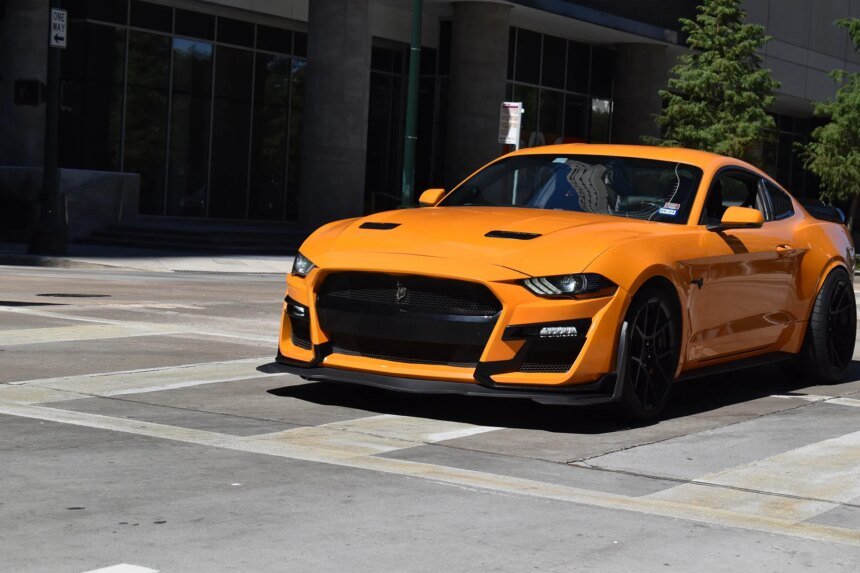
The name “Shelby” has always been the golden signature on Ford Mustang cars, as it is the symbol that transforms the car from an American muscle vehicle to a powerful beast that everyone fears on the roads and on the track.
With the launch of the all-new seventh generation Mustang (S650), fans of the blue brand noticed a shocking absence of the famous “Snake” logo, and instead of a new “Shelby GT500,” Ford introduced a new name, “Dark Horse.”
This transformation raised widespread questions among car enthusiasts: Has the decades-long love story between Ford and the Shelby Foundation ended? Or does the matter have economic dimensions, a new vision for the future of performance, and a deeper strategy than we can imagine?

Shelby’s high bill
The fact that many may not realize is that Ford does not own the rights to the “Shelby” name; Rather, the intellectual property belongs to the completely independent Shelby American company. This means that every car that rolls off the production lines bearing that name requires a licensing fee for every unit sold.
According to a report published by the Ford Authority website, citing internal sources, the value of these fees amounted to about $800 for every Mustang Shelby sold. While neither Ford nor Shelby American has officially confirmed this number, the language of numbers does not lie; By doing a simple calculation during the previous generation (S550) era alone, we discover the size of the exorbitant bill that Ford paid:
24,211 units of the Shelby GT350 and GT350R were produced, and 14,130 units of the legendary GT500 (between 2020 and 2022).
The result: a licensing fee exceeding $30.6 million was paid just for the use of the name and logo! This is a huge amount that the Blue Label chose to invest internally in developing its own technologies.
By abandoning the Shelby name and adopting the “Dark Horse” name, which is fully owned by Ford, the company succeeded in retaining these millions and investing them in enhancing the power and performance of its engines without external financial burdens, regardless of the legacy carried by the ancient logo.
Redefining identity
It’s not just dry financial calculations. Under CEO Jim Farley’s new vision, Ford is moving forward with building an independent performance identity, moving beyond total reliance on the glories of the 1960s. The emergence of the “Dark Horse” and its more brutal sister, “Dark Horse SC”, represents a clear indication that the high-performance sports and technical division within the global Ford company has taken the initiative to be the real star on the scene now.
This strategic direction is precisely in line with Ford’s renewed ambitions in the world of motorsport. In conjunction with the launch of the new generation of Mustang, the company unveiled six versions dedicated to the tracks, starting from the basic model “Dark Horse S” all the way to the full-fledged racing car “GT3”. The ambitions did not stop there, as a road map was drawn to introduce the “Dark Horse SC” on the (NASCAR) racing circuits by 2027.
The marketing logic here seems smart and decisive at the same time, as the issue goes beyond simply introducing a new model, to linking the car’s mechanical upgrades directly to factory-supported engineering efforts.
By integrating the ancient Mustang heritage with the company’s major projects, most notably the expected return to Formula 1, Ford is providing serious proof that its DNA alone is capable of creating glories and achieving victories, without the need to remain under the shadow of borrowed names from the past.
Attracting a new generation
There is a new strategic reality that Ford is well aware of, which is what can be called “legacy fatigue.” The “Shelby” name, despite its legendary greatness, now carries a legacy that is more than sixty years old, which may represent a time gap with Generation Z and the emerging generations.
Reports indicate that Ford is seriously seeking to attract a younger segment of enthusiasts, who are looking for technology and digital innovation as much as they are looking for engine power, and do not necessarily feel a deep emotional connection to the character of “Carroll Shelby” as previous generations did. For these people, the “beautiful” past is no longer enough to arouse enthusiasm. Rather, they are looking for a contemporary hero who matches their language and aspirations.
Hence, names such as “Dark Horse” emerge as a modern alternative that carries a pure, unalloyed “Ford” identity. They give the company complete flexibility in building a completely new legacy that is not bound by the restrictions of the past or the requirements of the heirs.
This transformation allows Ford to forge a new performance legend, which the new generation of drivers will embrace as their own symbol, far from the shadows of the 1960s. It is an attempt to transform the Mustang from a “historical” car into a renewed future icon, imposing its prestige thanks to the technology it provides today on the asphalt, and not what it achieved half a century ago.

Is the snake gone forever?
Despite this “technical divorce,” the relationship between Ford and Shelby has historically been “cyclical.” Gary Patterson, president of Shelby American, said that this shift is not new, recalling Ford’s return to names such as “Boss” and “Mach 1” in the past, and stressing that Shelby will remain focused on refining the “Blue Mark” identity in its own way.
While Ford today is busy establishing the feet of its “dark horse” in the markets and track, Shelby does not stop practicing its hobby of building its own independent monsters inside its own workshops.
However, the fundamental question remains in the minds of speed enthusiasts: Can the Mustang reach the peak of its glory and sit at the top without that ancient logo that has accompanied it for decades?
Ultimately, it appears that Ford made a bold strategic decision by choosing to invest in its “own house” and build its independent legacy, rather than continuing to lease a historic name for billions of cents. “Dark Horse” is not just an alternative, but rather the new bet that proves day after day, through the language of performance and numbers, that it is competent to carry the banner.
However, despite all the financial logic and marketing calculations, the name “Shelby” still has a special charm that Ford may have to return to again when it decides that the historical moment has come to restore the “snake” to its usual lair.