Published on 4/30/2026
|
Last update: 04:00 (Mecca time)
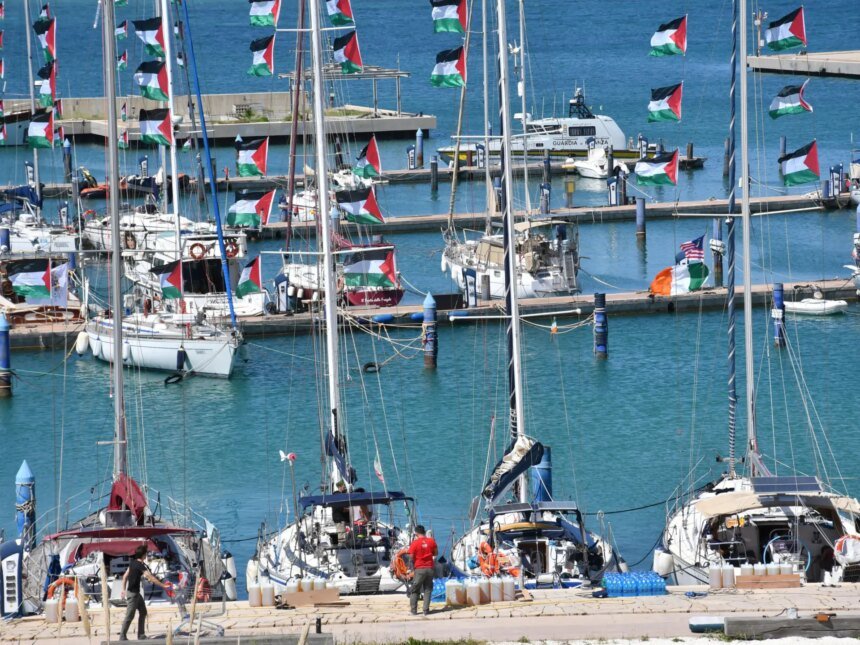
At dawn on Thursday, Israeli naval commandos began the operation to control the ships of the Al-Samoud fleet in international waters off the coast of Crete, before they reached the shores of the Gaza Strip.
According to Al Jazeera correspondent Muhammad Khairy, the Israeli army addressed the activists and asked them to return to the ports from which they departed, warning that their continued sailing would expose them to danger and force the army to use the means available to intercept.
Khairy added that the Israeli army plans to take the ships to the port of Ashdod, where the humanitarian aid will be subjected to security inspection before being transported to Gaza.
He pointed out that Prime Minister Benjamin Netanyahu – wanted by the International Criminal Court – held an emergency meeting at the Ministry of Defense in Tel Aviv, after he requested to reduce the hours of his testimony in court, to discuss the mechanism for dealing with the fleet, which resulted in directives to intercept it early.
Loss of communication with some boats
For his part, member of the Steering Committee of the Resilience Fleet, Patrick Bush, said – during the political analysis segment – that the ships sailed safely from Sicilian ports, heading to Gaza, and were intercepted first by drones and then by Israeli naval ships.
He pointed out that the flotilla is still more than 100 nautical miles from Gaza, and that contact has been cut off with some boats without assurances about their complete detention.
In contrast to the Israeli narrative, international law professor Dr. Luigi Daniele considered that intercepting civilian ships in international waters amounts to an international crime, and stated that the International Court of Justice has classified the Israeli blockade on Gaza as illegal, and that obstructing humanitarian aid constitutes a violation of the Rome Statute of the International Criminal Court.
Despite agreement on the general principle, the disagreement emerges in application, as the Israeli army insists that the naval blockade is legal, and that trying to break it constitutes a violation of international laws. However, fleet spokeswoman Rana Hamida confirmed that the fleet is moving in accordance with Article 87 of the United Nations Convention on the Law of the Sea, which guarantees freedom of navigation in international waters.
On the other hand, solidarity activist Ghazlan Ghazlan expected that the activists would be subjected to inhumane treatment similar to the experiences of previous fleets, which included physical attacks, sleep deprivation, and being forced to sign under threat. She pointed out that cameras were present on board the boats to document any violations that might be committed by Israeli soldiers.
Israel’s loss
As for the expert on Israeli affairs, Dr. Mahmoud Yazbek, he saw that Israel is losing the global narrative war, as evidenced by the transformation of its support from a political gain into a burden on American politicians. He added that the Israelis are now hiding their passports for fear of the world’s view of them because of the crimes committed in Gaza.
He concluded that the fleet succeeds in shedding light on the unjust blockade, and that the primary goal is to open a safe humanitarian corridor to break the blockade imposed for years.
Minutes before midnight, those in charge of the Al-Samoud Fleet issued a distress signal and reported that most of their boats in the Mediterranean had been subjected to interference, followed by talk of military boats approaching their ships.
The Israeli Navy announced that it had begun intercepting fleet ships near the Greek island of Crete, according to what was reported by Israeli media, and confirmed that it had taken control of 7 ships out of 58, justifying this by saying that “the attempt to break the legal naval blockade of Gaza is a violation of international law,” according to what naval officers told the Maariv newspaper.