Published On 4/28/2026
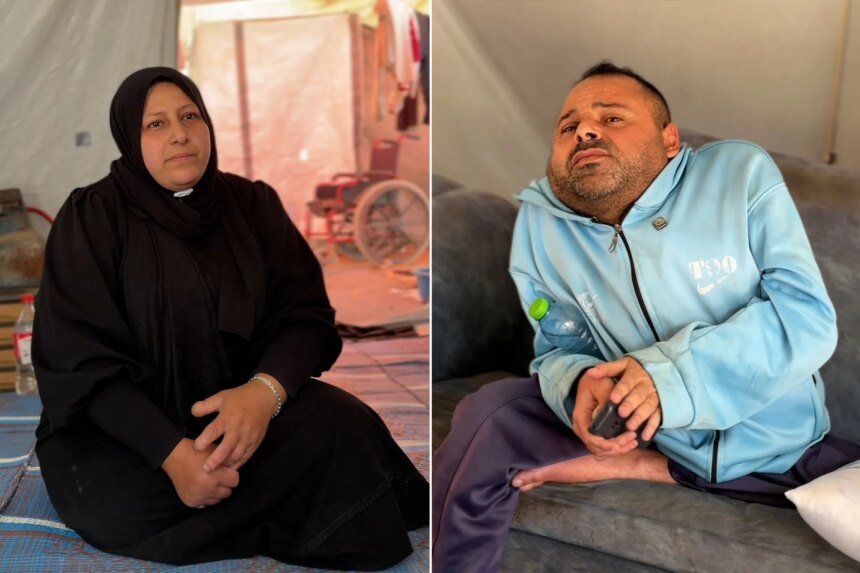
From a room that was a palace for them, in which they lived like a Sultan and his princess, with complete happiness and prosperity despite the pain, to a tent in which all the conditions of misery and oppression gathered, so it became an unbearable “prison” or “grave.” This is how the life of a disabled couple, Zainab and Nihad Jarbou from the Gaza Strip, changed.
Fate wanted Nihad and Zeinab to meet as a couple, even though Zeinab knew about her partner’s health condition and that he had been suffering from quadriplegia since childhood. She knew in her heart that she would be his support and helper, but after 4 years of marriage, she fell ill with an illness that led to the amputation of her feet, making her crippled next to him. Instead of helping him, they needed someone to support them both.
Despite this, they lived a happy life in their “kingdom”, full of hope and patience, as they had two electric wheelchairs, with which they moved around and supported their two children, until the war came, shattering their dreams and turning them into displaced people, suffering from a difficult and harsh life, and the most difficult thing was to provide treatment.
They lost their most precious possession
Zainab says while sitting on the ground in her tent in Deir al-Balah, to which she was displaced from the Shaboura camp in the city of Rafah, south of the Gaza Strip: “War for us as people with special needs means death, as we were displaced 9 times, amidst unspeakable suffering. All of our dependence was on our two children to transport us and provide food and drink and everything, and how much I wished to die and not be displaced.”
In the tent, the most basic needs are not available, and what is available is inadequate, especially the toilet, which is a bucket, in addition to the cats, insects, and rodents that eat them. “I feel sad for my child (12 years old) as he transports me in a wheelchair to treatment or to the market, and brings water and food,” Zainab says.
She added in her interview with Al Jazeera, “As for my daughter (13 years old), I burden her with the burdens of the house and taking care of me and her father that she cannot bear. She is the one who washes and cleans the utensils, prepares food, and so on.”
As fate would have it, the disabled couple had their electric chairs bombed by the occupation, which exacerbated their suffering even more, as the chairs were “life” for them and not just a means of transportation. What is available now, which is a manual wheelchair, would not have solved the problem, especially during displacement, or “death” as Zainab describes it, to which they were exposed several times and people saved them.
In addition to her disability, Zainab suffers from a serious neurological disease, which causes swelling and severe wounds in her hands if she does not take treatment, which is hardly available.

Illness increased
As for the husband, Nihad Jarbou, he almost forgot his stomach illness and his many pains in front of what his wife saw and saw with his own eyes. He said that they live as people with disabilities in a “prison” and not a tent.
Nihad speaks to Al Jazeera from his sofa, which has become a sleeping bed, and he has not left it for 70 days, describing displacement as the harshest thing they face, adding, “We used to live in good conditions, and move wherever we want, and our children study. Today we live in death in colours, and there is nothing available. Our life is zero, a life of hell.”
The couple lacks simple means of living, such as gas, as the wife is forced with great difficulty to light firewood as an alternative to cooking or making tea, “which I dispensed with as my main food as a result of this suffering,” Nihad adds.
What worries the husband most is his wife’s nervous illness and the lack of treatment for her, and he fears that she will lose the rest of her limbs, especially her hands, because of this, as “she bites her fingers and hands out of severe pain, and I plead.”
Even the regular wheelchair that he shares with his wife is no longer important to him, as he is very tired, “and it is not like the electric chair that is comfortable to sit and use,” Nihad explains, adding that his greatest wish is for these chairs to be available for him and his wife.
Iyad, the man of the house
The child, Iyad, summarizes the story of his parents and their tragedy, which was reflected on him as a child who became the “man of the house” and was assigned important tasks. Bringing food and drinks, transporting his parents, and helping them prepare everything in the tent.
Iyad hopes to return to his school, from which he was expelled due to his busyness. He says: “I was deprived of education, my childhood, and playing with my friends.”
Iyad is knocking on the door of the “humanitarian world” to provide treatment for his parents outside Gaza, and it is a cry in which the parents share, especially his mother Zainab, who appealed to take them out of the Gaza Strip for treatment and “the installation of artificial limbs” that will help them complete their lives easily, stressing, “We do not want food or drink, but only treatment. We are dead here.”
According to data from the Palestinian Central Bureau of Statistics until last December, about 42,000 people in the Gaza Strip suffer from serious, life-altering injuries that require continuous, long-term rehabilitation, indicating nearly 6,000 cases of amputation of limbs in the Strip, 75% of which are in the lower limbs.
He explained that children constitute a large percentage of these injuries, as more than 10,000 children suffer from severe injuries causing disability, making up 51% of medical evacuations outside the Gaza Strip during the period from May 2024 to June 2025.