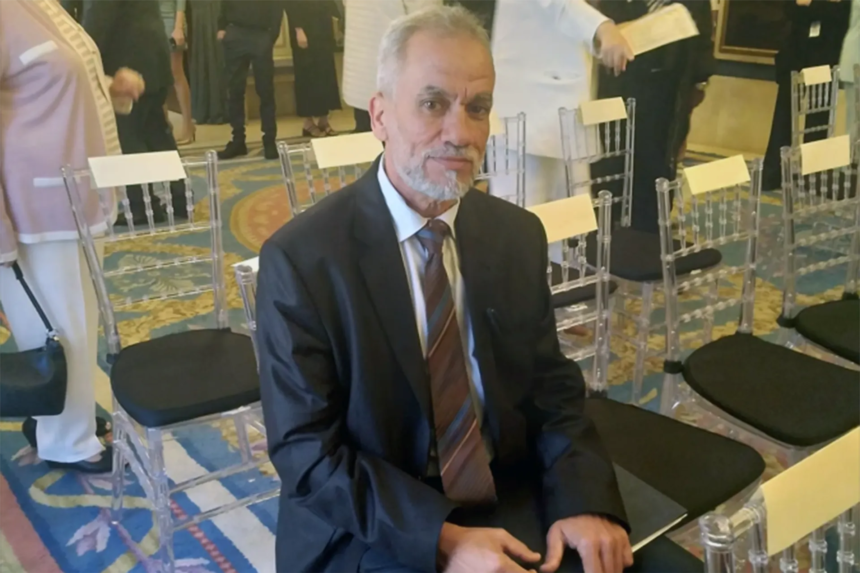
While young people flee from the pages of classic novels to phone screens, the novelist Muhammad Al-Zarrouk decides to follow them there, transforming solid Libyan literature into digitally encoded “comics” frames as part of his project, towards reinterpreting and presenting them in new formats that respond to the interests of young people and their contemporary questions in order to protect the Libyan literary memory and reintegrate it into the consciousness of the new generation.
In this dialogue, Muhammad Al-Zarrouk talks about the stakes of this project, its challenges, its artistic and linguistic choices, and his vision of the role of literature in consolidating the concepts of identity and citizenship among young people, in a country whose transformations are still open to complex questions.
Read also
list of 2 itemsend of list
The Libyan novel in the era of “blockchain”
- In the context of the growing interest in rewriting the classics, how do you read your project’s position within this trend? Where do you place it on the map of children’s and young people’s literature in Libya and the Arab world?
There is no doubt that the interest in rewriting the classics to suit young people’s perceptions is a prevailing global wave, but my project goes beyond the idea of simplifying the language and deleting scenes that do not suit them, to reinterpreting and presenting them in a way that suits their ideas and the aspirations of their generation, which are undoubtedly very different from what we used to have, especially in light of the reluctance of adults and children to read these days as a result of modern challenges. One of these challenges is technology and digitization.
Therefore, documenting these works electronically and preserving them on the blockchain was a later stage after presenting these works in the form of comics, and what concerns me is not only “facilitating” the classics, but rather re-presenting them as living texts that can enter into a dialogue with the young reader, and touch upon his contemporary questions, whether at the level of identity, ethics, or human experience. In addition to engaging the emerging reader and getting closer to his world so that he can read using the available means.

“What concerns me is not only to facilitate the classics, but to re-present them as living texts that can touch upon the young reader’s contemporary questions.”
On the local level, although I do not know that anyone has previously presented Libyan works intended for adults to suit those who are younger, even though we are accustomed to reading that in our early stages of life, I heard about another project that preceded this project that seeks to introduce Libyan children to their cultural, historical, and architectural heritage, presented by a writer named Ahmed Al-Bukhari. However, we actually have those who write for children, including Dr. Ghalia Al-Darani, the author of one of the novels that was included in the project and was published, thank God, in the Arab world. We can count it among the Arab projects completed by Arab writers, especially in Egypt. By the way, I translated one of the novels into English, which is (Men around Ghousuf) by my friend Ibrahim Al-Imam.
The project may extend beyond the local and scope of Arabic-speaking countries when capabilities are available. Dreams remain legitimate, and we have learned in management that the path to success is paved as long as we dream and strive toward achieving our dreams.
Language strategy: refining pronunciation and approximating interpretation
- The novels that you have written are rich in local vocabulary. How do you deal with this vocabulary? Is it replaced or explained in a way that enriches the linguistic vocabulary of the young reader?
My personality in presenting creative work, and my approach in writing, even for adults, includes refining pronunciation and staying away from brutal and ambiguous words. The text cannot be a test of the recipient’s abilities to understand, as much as it is available to be savored and opened to interpretation in a way that suits his intellectual specificity. I used this same thing with the kids.
An ambiguous or difficult word was replaced by an easier one, and if a word could not be replaced, especially one used on a narrow scale in a purely local setting, it was explained in the margin or between parentheses.
Challenging the worlds of Ibrahim Al-Imam
- In the works of Ibrahim Al-Imam, mythological worlds intersect with philosophical symbols inspired by the Ghadamesian environment. How did you transform these symbols into a dramatic structure suitable for young people, without compromising the intellectual depth of the text?
My selection of Ibrahim Al-Imam’s works was based primarily on historical narration, and a great distance from fantasy and mythology, which we rarely find in Al-Imam’s writings. It was not difficult to modify the text, especially since young people are attracted by stories of movement, including stories of wars and fighting. I may find it difficult to convert other works by the same writer, and this may constitute an upcoming challenge.
Inculcating citizenship
- As part of your project, the novel “Umm al-Zein,” which deals with a turbulent phase in Libya’s history, how can retelling these events enhance young people’s concepts of citizenship, land, and identity?
Dr. Ghalia wrote the novel “Umm al-Zein” in the voice of the first-person narrator. She presented the events that took place in February 2011 and beyond with a neutral tone, and showed sympathy for the Tunisian Bouazizi, may God have mercy on him, who was the spark of these revolutions and unrest in the region. She did not neglect to show the image of the rebel carrying weapons with two contradictory faces. I think that it succeeded to a large extent in presenting the general atmosphere prevailing in those days, without supporting or opposing it, and this alone instils in young people the idea that the nation is more comprehensive than all individuals, and broader than their differences and even their fighting.
“Umm al-Zein’s novel instills in young people the idea that the homeland is more comprehensive than all individuals, and broader than their differences and even their fighting.”

The suffering of women in “The Women of Torelli”
- Your novel “The Women of Torelli” evokes the memory of the place and the transformations of society in Benghazi. What is the specificity of the appropriate language to address young people in this context?
Although I liked the novel The Women of Torelli College, I found it more difficult to recycle for a young person. The reason I chose it among the other two novels is that it met the highest standards (nearness to the release date, achievement of completion, and ease of obtaining approval from its owners to rewrite), and I excluded the novel “Barr al-Habash” due to the intensity of its events.
The language that had to be chosen to address young people in it required caution, as it is a novel specific to the suffering of adult women in our difficult society. Here I had to stop and exclude entire scenes, even though they were among the basic details of the novel.
I’m afraid to say that I presented the worst version of the three works. I leave that to the young recipient. Perhaps more appropriate would be to conduct youth-led workshops and inductions (as a colleague suggested) to obtain appropriate feedback and evaluate our performance.
The horizon of expansion and protecting national memory
- Do you intend to expand this project to include other novel experiences?
Of course, I have completed several other novels, including Professor Khairiya Fathi Abdel Jalil’s novel (Missing of Non-Solid Memory), which I changed its title to (Soft Misappropriation), and there is also a story in Metafiction titled (The Amazons and the Fighter of the Wind), which I had previously written years ago. It was intended for adults, and my friend Tunisian children’s writer Imad Al-Jalasi suggested that I write it for children. These works will be printed and some of them will be prepared in the form of graphic novels, God willing.
To what extent does this project contribute to protecting Libyan national memory?
This particular question brings me back to the reason for reviving this project and its goals, which were: introducing Libyan youth to its literature (not just fiction) as well as to its cultural and historical heritage, documenting it electronically and preserving the rights of its owners via Blockchain. I believe that this project, if successful and completed, will be a way to revive and protect Libyan memory, heritage, and identity, especially since blockchain has provided this feature without the need to resort to long and complex administrative procedures.
Rooting young people’s literature and the poetics of place
- Who is the character in these three novels that gave her a loud voice after she was marginalized?
Maybe Samira in (Torelli) and Souad in (Umm Al-Zein).
- Can your project be considered the foundation of Libyan young adult literature?
I am not the first person to write for young people to claim this honor, but I hope that he has maintained his position and secured his place within the history of young adult literature in Libya.
- In all your works of fiction and short stories, we see a special interest in place. Why?
My places are more than inanimate. Prepare them as living creatures that talk to us about the past and the present and dream with us about the future. We sense places with our five senses. Places can become people. Places are an essential part of a novel, but for me they are the whole novel.
“Places are living creatures that speak to us. Places may turn into characters, and for me they are the whole story.”
- Has Libyan literature succeeded in documenting the major transformations that society has undergone?
Libyan poetry succeeded in doing this a long time ago. Popular poetry preceded eloquent poetry, and eloquent poetry documented and chronicled events. Today, the novel largely fulfills this role.