Published On 4/28/2026
Between the stakes of political stability and the requirements of economic reform, attention in Iraq is turning to a stage described as decisive in reshaping the executive authority, as analysts believe that its success is linked to the extent of commitment to constitutional terms, the ability of political consensuses to transform into a comfortable parliamentary majority, as well as the nature of ministerial choices based on competence.
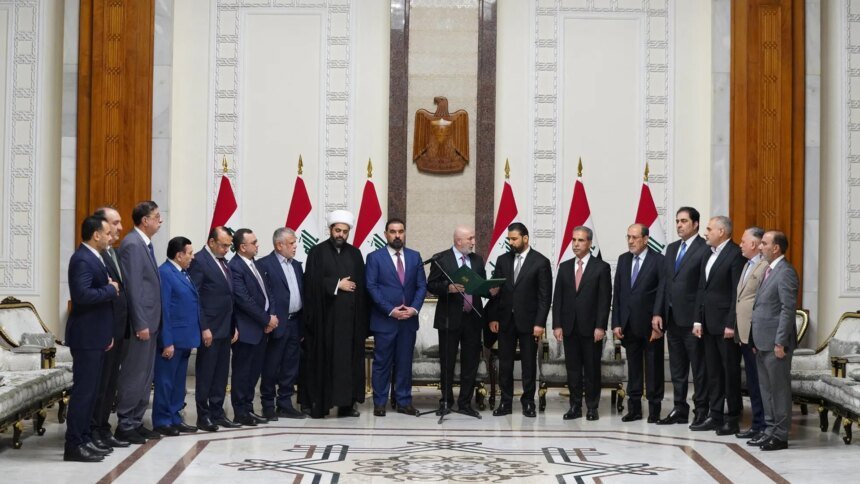
Experts confirm that the economic background of the Coordinating Framework candidate, Ali al-Zaidi, who was tasked today by Iraqi President Nizar Amidi to form a new government, may represent an opportunity to address the chronic imbalances in the Iraqi economy, at a time when an unconventional personality, less involved in political polarization, is being relied upon to lead a stage that requires practical decisions and delicate internal and external balances.
In a legal reading of this step, legal expert Saad Al-Bukhati considered that resolving the file of the candidate of the largest parliamentary bloc represents the most important joints, stages and complementary constitutional entitlements, explaining that this resolution will be a starting point and basis for the formation of the executive authority, which is responsible for achieving political stability and protecting state institutions.
Al-Bukhati pointed out that adherence to the constitutional deadlines, especially the thirty-day deadline, gives strength and prestige to the constitution and the law, considering that this period is sufficient to resolve the ministerial cabinet file and the government program, in preparation for presenting them to the House of Representatives for a vote in accordance with the constitutional frameworks, whether on the ministers individually or the program collectively.
Regarding the possibility of the prospective government obtaining the confidence of Parliament, Al-Bukhati explained that consensus within the coordination framework, in addition to the possession of the largest parliamentary bloc of the required majority, will enable the candidate to pass his government with a comfortable majority, pointing out that the basic knot was in deciding the candidate of the largest bloc, and it has now been overcome.
He added that the success of the next government will depend on the nature of the ministerial choices, stressing the need for the government to be built on professional standards and the standards of state institutions, allowing it to confront security, economic and regional challenges, stressing that correct introductions lead to successful results, in reference to the importance of choosing the government team well.
In the same context, Al-Bukhati suggested that Al-Zaidi would benefit from his professional background, explaining that he possesses a vision and ideologies that are appropriate for diagnosing obstacles in various fields, not just in the economic aspect, in a way that enhances the chances of achieving comprehensive stability in the country.
Getting out of the political crisis
For his part, Professor of Political Science at Al-Nahrain University, Osama Al-Saeedi, saw that the assignment represents an actual beginning to emerge from the political crisis, explaining that the announcement has become an official constitutional mandate, and from today the countdown to forming the government begins, with the start of consultations to form the ministerial team and prepare the government program.
Al-Saidi described the choice of Al-Zaidi as surprising compared to the names that were circulating, considering that the coordination framework recorded two important points:
- The first is not to choose a figure from the traditional leadership.
- The second is to choose a relatively young figure in politics and from an economic background.
He explained that choosing a businessman to head the government reflects an awareness of the scale of the economic challenges, noting that Iraq needs an economic vision capable of adapting to the reality of an economy suffering from distortion, especially in light of the transition from a centralized economy to an open economy after 2003.
Al-Saeedi added that Al-Zaidi, due to his administrative and economic background, may be able to formulate a new economic theory that is compatible with the Iraqi situation, in light of the challenges associated with rising expenditures and declining revenues.
In a broader political reading, he pointed out that the absence of Al-Zaidi’s prominent political history may give him an advantage, explaining that he does not hold previous political positions that could be interpreted against any party, which may help him make less controversial decisions among the political forces.
Al-Saidi also pointed out an international dimension to the choice, considering that choosing an economic figure may contribute to improving communication with international parties, especially the United States, through the language of economic interests instead of traditional political discourse.
This assignment comes at a time when Iraq faces complex challenges, including issues of security, economy, and foreign relations, which puts the prospective government before a difficult test to achieve a balance between internal stability and external openness.