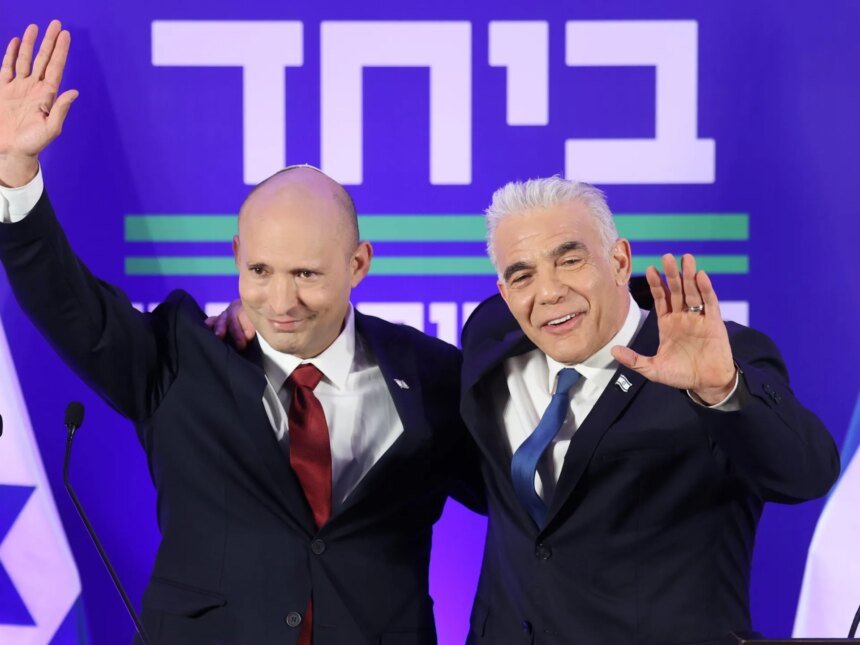
Israeli opinion polls that followed the announcement of Naftali Bennett and Yair Lapid to run in the elections on a joint list revealed that the event caused a political and media uproar, but did not produce a clear electoral coup.
The general picture does not say that Netanyahu has fallen, nor that the opposition has decided on the alternative. Rather, it says that Israel has entered a broad realignment phase, the title of which is: Who leads the “post-Netanyahu” camp?
Read also
list of 3 itemsend of list
The numbers cannot be read in isolation from the channel that publishes them and the polling company that implements them. Channel 14, which in the Israeli media mood is affiliated with the right-wing and Likud audiences, published a poll prepared by Shlomo Filber, a name that is read politically inside Israel due to his previous background close to Netanyahu’s circles before he became a state witness in one of his files.
Therefore, it does not seem surprising that the result gives Likud 34 seats and the right-wing bloc 64 seats, with Netanyahu prevailing in the question of suitability to head the government with 51% compared to 32% for Bennett.
As for i24NEWS, its results need to be read within the background of its owner, Patrick Drahi, the French-Israeli billionaire and owner of the HOT network and i24NEWS.
The numbers cannot be read in isolation from the channel that publishes them and the polling company that carries them out
Israeli reports describe i24NEWS, especially its Hebrew version, as a conservative channel that leans toward right-wing rhetoric, and is trying to fill a space between Channel 14, which is more ardent in its support of Netanyahu, and the traditional channels that are more critical of the government.
Therefore, its poll numbers do not appear to be isolated from a media environment that gives Likud and the right-wing bloc a strong position; It gave Likud 33 seats, the Bennett-Lapid coalition 24, and the coalition 62 seats. This is a result closer to the narrative of “Netanyahu is still able to form a government” than to the narrative of “the opposition has decided on the alternative.”
On the other hand, Channel 12, Kan 11 (the official broadcasting authority), the “Wala” website, and the “Maariv” newspaper present a less comfortable picture of Netanyahu, but they do not give the opposition a final decision.
The Kan Broadcasting Corporation, a public institution that is more conservative in its political presentation, gave Bennett Lapid’s party 24 seats and Likud 27, with 52 seats for Netanyahu’s bloc, compared to 58 for his opponents and 10 for the Arabs. As for “Wala” and “Maariv”, according to the Lazar Research poll in cooperation with Panel4All, they present an average number: 27 seats for the Bennett-Lapid coalition, 28 for Likud, and 59 for the opposition, compared to 51 for the coalition and 10 for the Arab parties.

Numbers gap
The strength of the “Together” (Behad) list ranges from 20 seats in the Channel 14 poll, 24 in the i24NEWS and 11 poll, 26 in Channels 12 and 13, and 27 in the Walla/Maariv poll.
This gap is not a technical detail, as it reflects a difference in the audience sample, the measurement method, and the media environment in which the results are presented.
The closer the poll platform is to the right-wing audience, the more stable Netanyahu appears, and the wider the sample is towards the center and opposition audiences, the Bennett-Lapid alliance appears as a serious challenge rather than a settled alternative.
The common denominator in most polls is that the union is less than the sum of its previous strength separately. “Kan 11” indicated that Bennett had 19 seats and Yesh Atid had 6, while the coalition had only 24.
Walla said that the new list won 27 seats, 4 seats less than the total of Bennett and Lapid in previous polls.

Netanyahu holds out
The most prominent result is that Netanyahu does not appear as a collapsed leader. In some polls, Likud declines to 25 or 27 seats, but he remains a central player, and in other polls he clearly leads. i24NEWS gives him 33 seats compared to 24 for the Bennett-Lapid alliance, and Channel 14 gives him 34 seats.
This means that the new coalition has not yet succeeded in sufficiently withdrawing a solid right-wing base from Likud.
More important than the seats is the question of suitability to head the government. On Channel 14, Netanyahu is ahead by 51% compared to 32% for Bennett, and on Channel 12 he is also ahead of Bennett by 41% compared to 37%.
These numbers reveal that the image of the “able leader” continues to work in Netanyahu’s favor, even when his government is subjected to widespread security and social criticism.
Polls also show that Gadi Eisenkot is the decisive figure in the opposition camp. He does not excel alone, but he gives the coalition a security and centrist dimension that may reassure hesitant voters.
In the scenario of his accession, Walla and Maariv give the unified list 41 seats, but keep the opposition at 59 seats, that is, without a majority of 61. This is the essence of the crisis, as the opposition can produce a large party, but it does not yet have a guaranteed governance equation.
But the most important map is not the name of the largest party, but rather the map of the blocs. Channel 14 gives the right 64 seats, and i24NEWS gives it 62, while 11 gives it to Netanyahu’s bloc only 52, and Walla/Maariv puts it at 51 seats.
This discrepancy imposes editorial caution, which is that it is not permissible to read any poll as a final truth, especially with the presence of parties on the edge of the threshold, such as Religious Zionism, Blue and White, and Balad, where a small change in voting percentages can turn the whole scene around.
Polls show that Gadi Eisenkot is the decisive figure in the opposition camp. He does not excel alone, but he gives the coalition a security and centrist dimension that may reassure hesitant voters.
Unrequited anger
The Channel 13 poll adds an important qualitative dimension, which is that 70% of the public believe that the government is not doing enough to protect the people of the north, and 76% believe that it is not addressing the wave of violence sufficiently. These numbers give the opposition strong offensive material, but it does not automatically turn into an electoral majority unless it finds a unified leadership address and a convincing program.
The union of Bennett and Lapid created a movement, but it did not achieve a decisive outcome. It gives the opposition a new center of gravity and weakens its dispersion, but it carries within it a contradiction between Bennett’s right-wing and Lapid’s liberalism and Eisenkot’s need for an independent position.
As for Netanyahu, despite the security and political exhaustion, he still maintains a solid bloc and the image of the most capable leader among a wide segment. Therefore, the upcoming elections, according to these polls, appear to be a battle over the identity of the alternative rather than a decided referendum on the end of Netanyahu.