Published on 4/25/2026
A recent international study revealed that a symbiotic relationship that had lasted for more than 10 million years between tropical plants and their protector ants in the forests of Malaysian Borneo began to be subjected to unexpected disturbance, after scientists noticed that predatory wasps took control of the internal structures that plants possess, and are used to shelter ant colonies.
The results came in a study published in the journal PeerJ, and was conducted by an international team from Queen Mary University of London, the Royal Botanic Gardens Kew, and the Biology Center of the Czech Academy of Sciences, along with other research institutions.
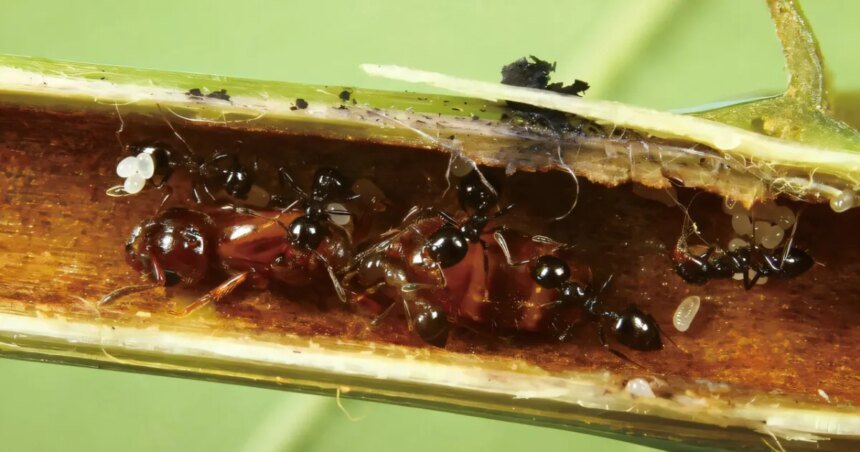
The research focuses on a tropical plant known as “Makaranga Pancana”, which is one of the “ant plants” that over millions of years has developed cavities within its stems to serve as shelter for ants, in exchange for the ants protecting the plant from herbivorous insects such as caterpillars, and this mutual cooperation has enabled both parties to thrive in dense rainforest environments.
But the study reveals that this delicate system began to suffer a clear imbalance, as the researchers noticed that a type of predatory wasp began to exploit these plant cavities to its advantage, turning into a “new occupier” of these vital structures.
Stores for feeding wasps
While examining the stems of young plants in partially cleared forest areas and in oil palm plantations, researchers found that the wasps paralyze the flies and store them inside plant cavities to feed their larvae, a behavior that turns the plant into something like a “food store” for the wasps rather than the ants.
The researchers noted that plants in areas of oil palm plantations were much more likely to harbor these wasps compared to those in less disturbed forests. It was also noted that plants controlled by wasps contained much smaller ant colonies, indicating the possibility of ants being displaced from their natural habitats.
Scientists believe that human-caused changes in natural habitats play an important role in this transformation, whether by cutting down forests or converting them to agricultural land, which creates unstable environments that allow the spread of this new behavior. It is also still unclear whether these wasps are a local species or an alien to the ecosystem.
Dr. Kalsom Yusa, a participant in the study, warns in an official press release issued by Queen Mary University of London that this change may affect the plant’s ability to recover in degraded areas, as losing its “natural protection” from ants may weaken its resistance to pests and affect forest regeneration.
Dr. Tom Weil, a researcher involved in the study, confirms that these results reveal a deeper aspect of human impact on ecosystems, which is not limited only to the loss of species, but also extends to the dismantling of delicate relationships between living organisms, which may lead to long-term transformations in the structure of tropical forests and their environmental balance.