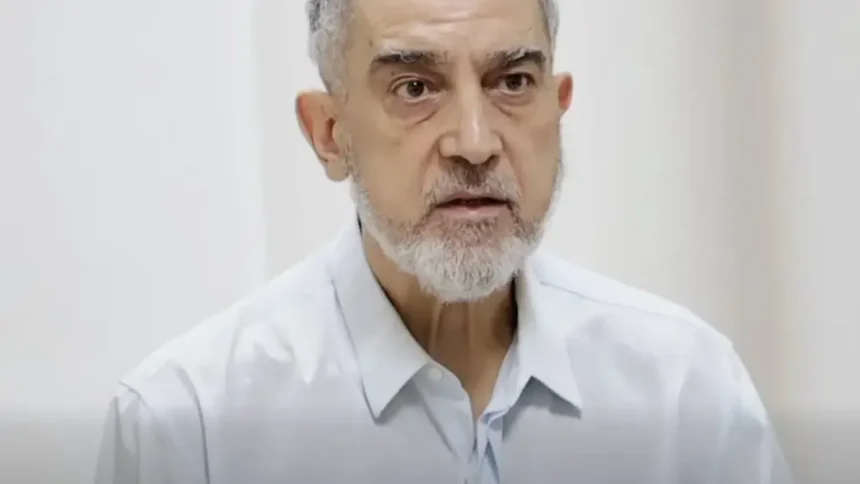
Today, Sunday, the Damascus Criminal Court will hold a public session to try the former head of the Political Security Branch in Daraa, Atef Najib, in the first trial announced by the Syrian government as part of the process of holding accountable officials of the ousted President Bashar al-Assad’s regime.
Najib’s trial represents the first public test of the demand for transitional justice in Syria. Since the fall of the regime on December 8, 2024, Syrians have been demanding that the file of major violations to which they were exposed over the past years be transformed into a clear judicial path that restores their rights, holds criminals accountable, and prevents impunity, in light of the construction of a new Syria.
The National Transitional Justice Authority announced that the trial comes within the framework of dealing with files of crimes and serious violations in accordance with legal procedures, which represents part of an ongoing process based on accountability and revealing the truth.

Why Atef Naguib first?
Atef Najib, a cousin of Bashar al-Assad, assumed the presidency of the Political Security Branch in Daraa until the outbreak of the Syrian revolution in 2011.
During that period, the branch worked within the security apparatus that pursued opponents and activists in the governorate, and it had a direct role in dealing with the incident of the arrest of Daraa children who were subjected to torture after writing slogans against the Assad regime on the walls of their school.
This incident sparked widespread protests in the city, after the people demanded the release of the children and the accountability of those responsible for their arrest and torture, especially after the security forces handed over the body of the child Hamza Al-Khatib and the families were subjected to insults.
After the fall of the regime, the forces of the Public Security Department of the Syrian Ministry of Interior arrested Najib in January 2025 during a security campaign to pursue the remnants of the former regime in Latakia Governorate. His arrest constituted one of the most prominent arrests of former security officials, as he held a sensitive security position in Daraa at the beginning of the revolution.
Minister of Justice Mazhar Al-Wais also said that public trials will begin from the events in Daraa, considering that “justice requires” that the trial process begin from the city where the revolution began in 2011.
What is transitional justice?
Najib’s trial will be held in accordance with the Code of Criminal Procedure in force in Syria, until the People’s Assembly approves, after its session, a draft law on transitional justice that the Syrian people demand.
Transitional justice refers to a set of measures adopted by countries emerging from authoritarian rule or widespread conflict to address the legacy of violations. It is not limited to trying the accused, but also includes reparation for the victims and ensuring that crimes are not repeated.
In the Syrian case, Fadel Abdel Ghani, director of the Syrian Network for Human Rights, identifies – in an article on Al Jazeera Net – four interconnected pillars to form the path of transitional justice: criminal accountability, revealing the truth, including determining the fate of missing and forcibly disappeared persons, reparation and compensation, and reforming judicial, security and military institutions.
Thus, transitional justice extends to addressing the impact of violations on victims, society, and state institutions.

What is missing from the Syrian track?
According to human rights activists and jurists, the Syrian path towards transitional justice still lacks a clear legal framework that determines how to deal with the crimes of the former regime.
Syrian law allows for the prosecution and accountability of perpetrators of crimes such as murder, torture, and involvement in specific violations, but it does not necessarily include sufficient tools to deal with broad and systematic crimes such as war crimes and crimes against humanity.
Therefore, if former officials are tried under criminal laws only, the cases may be limited to limited acts and punishments, while the nature of the crimes committed as part of a broad state policy against civilians is lost.
Syrian human rights activists are calling for the establishment of specialized courts or chambers, and for benefiting from international legal expertise, so that trials do not turn into files separate from the larger context of violations.
In an interview with the “Beyond the News” program, academic and political researcher Kamal Abboud explained that the path of transitional justice in Syria cannot be separated from civil peace, given that Syrian society is torn apart by sectarianism founded by the ousted regime.
Therefore, any step in the field of transitional justice must also be preceded by a step in the field of civil peace, to prevent matters from slipping into internal fighting or retaliatory justice, according to Abboud.
The path also faces major challenges related to the size of the files, as there are thousands of families waiting to know the fate of the missing, former detainees who need recognition and justice, mass graves that need specialized forensic teams, and evidence and documents distributed among former state institutions and human rights organizations.
In May 2025, the Syrian presidency issued a decree to form a transitional justice body responsible for uncovering the facts regarding the previous regime’s violations, holding those responsible accountable, and reparating the harm inflicted on the victims, but it is still in the process of being established amid the need for logistical capabilities and time to deal with complex files.
Does Syria need a special model of justice?
There is no single model of transitional justice that can be transferred to Syria as it is. Other countries have adopted different tools depending on the nature of the violations, the state of the institutions, and the extent of the internal division, from truth and reconciliation commissions in South Africa, to special courts in Rwanda, and international trials in Bosnia and Herzegovina.
These experiences show that the choice of transitional justice tools is linked to the nature of the crime and the state of the country after the conflict, and not once the trials begin.
At the same time, Syria faces issues of accountability, missing persons, victims, reforming institutions, and preventing revenge, which means the need for a path that combines the judiciary, revealing the truth, and protecting civil peace.
The difference between experiments is not limited to the form of institutions in which they were established, but also includes the scope of accounting. In large-scale crimes, justice does not usually stop with the direct perpetrators, but rather extends to those who planned, issued orders, and managed the violations.
This was demonstrated by the Nuremberg Trials, which were held in Germany between November 1945 and October 1946 to try the leaders of the Nazi regime, and the trial of Adolf Eichmann in Israel in 1961 because of his role in organizing the deportation of Jews to ghettos and killing camps.
These examples are useful in the Syrian case, because they not only present the trial of individuals accused of committing crimes, but also test the ability of the judicial process to uncover those who ordered, facilitated, and covered up violations within the institutions of the former regime.
Who is the most wanted?
In Syria, the files of those wanted and those accused of violations against citizens are distributed at several levels. At the top level, Bashar al-Assad, his brother Maher, and senior political, military, and security officials whose names are associated with managing policies of repression, war, and detention, stand out.
They are followed by the leaders of security services and branches, army officers, and those responsible for prisons and investigation centers.
The Syrian Public Prosecution filed public lawsuits against a number of perpetrators of violations before the investigating judge, including the deposed mufti of the regime, Ahmed Badr al-Din Hassoun, the former Syrian Minister of the Interior, Muhammad al-Shaar, the officer, Ibrahim al-Hawija, and Waseem al-Assad, who was involved in the drug trade.
Has transitional justice really begun?
While the Syrian people await the trial of all those arrested by the security forces during the past months and those whom the authorities continue to pursue, with the trial of Najib, Syria begins the first steps towards justice.
However, transitional justice still needs more than a court and defendants. It needs a clear law, an independent body, a reliable judiciary, the involvement of victims, and revealing the fate of the missing.