Published On 4/26/2026
The definition of the “Al-Tadamon Neighborhood Massacre” goes beyond being merely a tragic incident to a symbolic date that documents the mixing of Syrian blood with the blood of Palestinians in one of the most cruel and horrific crimes of the new millennium.
While the authorities in Syria and the international community are working to follow up on investigations and the course of justice after the arrest of Amjad Youssef, the first accused of committing the massacre, after his arrest in the city of Hama (central), the echo of old pains has returned to echo in the Tadamon neighborhood as if the victims had gone missing yesterday.
What is hidden may be greater
According to data collected by the Action Group for the Palestinians of Syria, the number of victims of the massacre reached 288 civilians, including Palestinian refugees, some of whom were recognized by the people, including Waseem Omar Siyam, Saeed Ahmed Khattab, and Louay Al-Kabra.
The group’s estimates indicate that between 40 and 50 civilians were killed in one location, with the possibility that there are higher numbers that have not been documented.
In total, the group documented the killing of 58 Palestinian refugees from the Tadamon neighborhood, including 7 women who died in the events, in addition to 21 cases of field executions.
Notarized certificates
In testimonies documented through published video clips, a Palestinian woman lost a family of 11 members, including her brother, his wife, and his two sons, and the rest were cousins. They also included children, the youngest of whom was an 18-month-old infant.
Another video – published by Al Jazeera – shows executions in a large pit on suspicion of belonging to the Islamic Resistance Movement (Hamas). The Syrian Observatory for Human Rights also spoke about 3 Palestinian victims who were identified as soon as the British newspaper The Guardian leaked clips of the massacre.
A Palestinian family reported to the Syrian “Verify” platform, which specializes in verifying news, that its son, Waseem Siam, a father of two children, disappeared from the Yarmouk camp on April 14. He was among the victims of the “Solidarity Massacre,” and was clearly spotted in the leaked clips.
Numerically, reports by organizations – including the Action Group for the Palestinians of Syria – suggest that the majority of Palestinian victims were killed in the massacre, but this hypothesis has not been officially confirmed in light of the ongoing security investigations.
However, Syrians and Palestinians today share the same calls to uncover the truth 13 years after the forced death of their loved ones, in an incident that ranks among the most horrific mass murders of the millennium.
Syria’s representative to the United Nations, Ibrahim Olabi, said that the arrest of Amjad Youssef represents an important step in the path of transitional justice, calling on the international community to hand over all “fugitive criminals” to his country.
What do we know about the massacre?
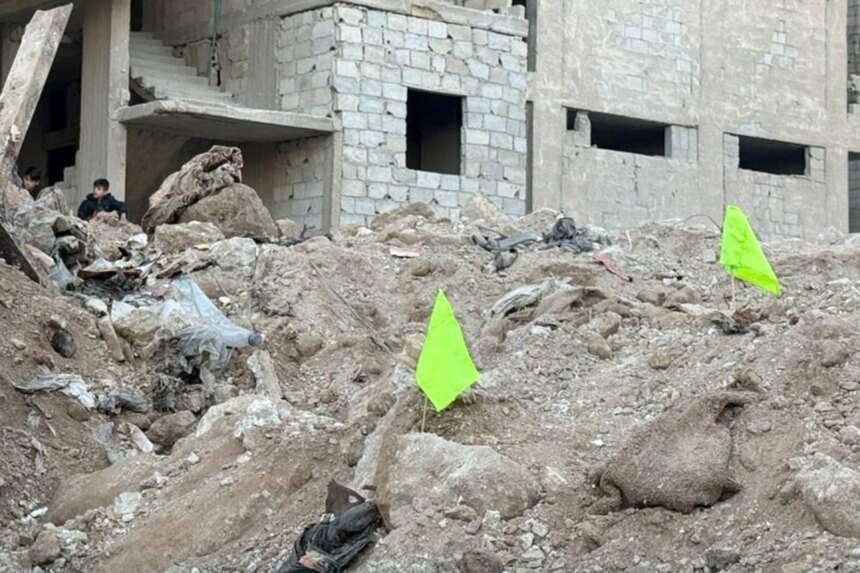
On April 16, 2013, the forces of the ousted regime killed 41 civilians in a massacre in the Tadamon neighborhood in Damascus, and threw them into a large hole. Human bones were later found in the area, according to what was reported by Anatolia Agency on December 20, 2024.
On April 27, 2022, the British newspaper The Guardian published a video clip – which it said was leaked by a recruit in a pro-regime militia – showing the killing of “Branch 227” forces of the regime’s military intelligence at least 41 people and burning their bodies in the Tadamon neighborhood.
Clips – circulated by international media and social media platforms – showed the intelligence officer in the regime at the time, Youssef, with his face exposed, shooting blindfolded and handcuffed civilians after detaining them and ordering them to run before they fell into a pit prepared for them.