Published On 4/26/2026
The American blockade of Iran’s ports continues, causing more trouble for its economy, as oil supplies face difficulties at the export level, which negatively affects storage and production capabilities.
The Americans stress that the naval blockade on Iranian ports will continue as long as an agreement is not reached between Washington and Tehran. In the latest developments, the US Navy announced the interception of an oil tanker linked to Iran that attempted to cross the Arabian Sea.
Figures indicate that Iran possesses the third largest oil reserve in the world, and produces about 3.5 million barrels per day. Local refineries obtain two million barrels per day, and the rest, i.e. 1.5 million barrels, is exported to Asia and China on a daily basis.
With the continuation of the American blockade, concern prevails among Iranians about the remaining storage capacity to accommodate crude, and unofficial estimates indicate that Iran’s maximum storage capacity may not exceed 120 million barrels.
In the same context, oil and energy markets analyst Bashar Al-Halabi explained that Iran has a storage capacity on land, estimates range from 30 million to 90 million at the maximum, and the fleet it owns allows it to store approximately 120 million barrels of oil.
According to Al-Halabi, Iran’s storage capacity in general is estimated at 200 million, but the estimated number is 120 million barrels.
Since Iran’s oil production amounts to 3.5 million barrels per day, 2 million barrels of which go to the domestic market and 1.5 million to exports, this situation practically puts Iran between 3 weeks at a minimum and up to two months to confront the storage crisis.
Methods for storage
While he talked about the not easy options facing Iran due in large part to the success of the US blockade, Al-Halabi says that Iran can continue at current production rates and delay production cuts, because some oil tankers continue to pass through the Strait of Hormuz, specifically towards China.
He believes that the naval blockade imposed on Iran reduces its ability to export to markets, specifically to China, and with the continuation of the blockade, the possibility of Iran increasing towards the difficult option, which is stopping Iranian oil exports, increases.
For his part, oil and energy markets analyst Bashar Al-Halabi explains that US President Donald Trump, in his first presidential term, followed a policy of maximum pressure against Tehran between 2018 and 2022, which led to a reduction in Iran’s oil exports due to the sanctions, but it continued production and export and devised methods to avoid the repercussions of the sanctions.
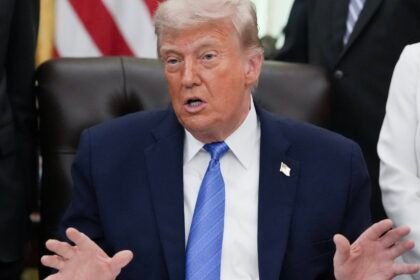
The US naval blockade of Iran began on April 13, he said US President Donald Trump later said Iran “It is collapsing financially,” and it is losing hundreds of millions of dollars every day due to this blockade.
On the other hand, Iran reduces the effects of the US blockade on its economy, and said through its Foreign Minister Abbas Araghchi that the blockade is an “act of war” and therefore represents a violation of the ceasefire between the two countries.
Economist Isaac Saedian explained to Al Jazeera Net that Iran has some tools that mitigate the impact of pressure, most notably its wide land borders that officially extend for about 6,031 kilometers with neighboring countries, such as Iraq, Turkey, Afghanistan, and Pakistan. But he stressed that this land network, despite its importance, cannot be a complete substitute for maritime trade, but rather provides only a measure of support in crisis circumstances.