Gaza- On October 7, 2023, three hours before the outbreak of the genocidal war on Gaza, baby Nour Abu Samaan was born, and her birth coincided with the disaster of the war from its first moment.
Her mother, Samar Hammad, looked at her with happiness and satisfaction, until the decisive moment came on the second day. On October 8, 2023, while she was resting in her mother’s arms, Israeli missiles shook the place where they were, filling the air with their suffocating effects, and poison gas bombs fell and spread in the air, blocking the breath.
The family survived the massacre and quickly went to another shelter. With a hoarse voice and heavy breaths held between one sentence and another, Samar spoke – to Al Jazeera Net – about those hours: “My daughter suddenly suffocated in my hands, her color turned blue, and her eyes rolled back, before she entered a critical condition that caused her to lose movement completely.”
After the girl’s condition was diagnosed at Al-Nasr Children’s Hospital, it was found that toxic gases had seeped into her breath, paralyzing her movement. Thus, Nour moved from the birth bed to the treatment bed, and began her short life with a heavy journey between pain and hospitals.
Samar then received words that she described as the harshest in her life, when doctors told her that her daughter was “dead, but on machines,” but she refused to believe it.

Survival in intensive care
Nour’s mother spent an entire month in Al-Nasr Children’s Hospital, guarding her daughter’s bed with a watchful eye and a heart caught between hope and terror. The little girl was lying in intensive care, while the war was tightening around the hospital day after day, the bombing was looming nearby, shrapnel reached the walls, and hunger and thirst were destroying those who remained in the place.
As the siege around the area intensified, the atmosphere of the hospital began to change in a more harsh manner. Families began to sense the approaching danger, and the pace of evacuation increased. In those moments, the mother came out with her daughter before the battle intensified, carrying a small body exhausted by injury, without knowing that this step would make Nour the child the only survivor of the Al-Nasr Children’s Hospital massacre, after the disaster that befell the premature babies who remained in intensive care.
After the storming of the hospital, a number of premature babies remained in intensive care to preserve their lives, but the occupation forces removed the devices from them and their bodies were later found decomposed on the beds, after days of prevention and impossibility in a brutal scene that remained witness to one of the most painful pages in Gaza’s memory.
After Nour left Al-Nasr Hospital, she began an exhausting journey of treatment and transportation between hospitals. When she arrived at Al-Wafa Hospital, the place was targeted, and the little girl came out from under the effects of the bombing and its rubble, before she was transferred again to the Baptist Hospital, where the targeting caught her while she was still inside it. At this point, treatment in the mother’s memory became associated with fear, and the name of the hospital then began to evoke the meaning of temporary survival more than the meaning of recovery.

More severe than paralysis
Othman Abu Samaan (42 years old) speaks with glances at his daughter, Nour, and he feels overwhelmed by her condition. He recalls what the doctors repeatedly repeat, and nothing of the pain in his heart changes: “The injury left Nour with a clear delay in speech, and severe stiffness in the limbs, and left her in a condition he describes as more severe than paralysis.”
He explains that the doctors recommended physical therapy sessions for her after exhausting the available treatment paths, as her movement rate did not exceed 1%, then it increased to about 20% after physical therapy, before this path stopped at its possible limits.
He added that the child now needs surgical interventions in the brain, feet, bones, and pelvis, in an attempt to improve her condition: “We have repeatedly tried to make her sit, but she cannot, and does not control her head, as it moves back, and she cannot sit at all.”

Consequences of toxic gases
We repeatedly tried to reach Warda al-Jarou, the mother of the child Misk, to conduct the interview, but the way to her each time passed through a hospital or an appointment with a new doctor.
We waited for her until late hours, before she arrived exhausted; Her gaze was filled with heavy despair, and her body bore the effects of a long journey of anxiety and fatigue. She sat in weak silence, then extended her arms and raised her six-month-old daughter, Misk, in front of us.
At that moment, the scene seemed too harsh for the eye to bear easily; A small, incomplete body, with no clear joints in the hands, nor complete joints in the feet, and a little girl who has been facing pain far beyond her age since birth.
The mother says that Misk was not alone in the beginning; She was pregnant with twins, and the two girls were supposed to come to life together, but Misk’s twin sister died in her womb, while Misk was born alone, burdened with deformities and complex health problems. The mother linked her appearance to the bombing and repeated inhalation of toxic gases she was exposed to during pregnancy, in light of the absence of regular medical follow-up and care under the weight of war.

There is no treatment in Gaza
“Misk is in a lot of pain, and every day I feel that her condition is getting more difficult. Even changing her diapers has become very tiring because of the bends and curvatures in her back and pelvis. I am her mother, and yet I feel that I am unable to deal with her properly.”
She added that the doctors to whom Misk’s case was presented inside Gaza agreed that the treatment available within the Strip could achieve very limited improvement, while the girl needs much broader medical capabilities and higher specialized care than what is currently available.
The weight of this suffering extends to the entire family reality. Her husband was injured during the war, and his injury affected his ability to support the house as it was before, at a time when Misk’s medical and living needs are piling up beyond the family’s capacity, so the health pain is intertwined with the hardship of living, and the mother says in a broken voice: “My husband has been injured since the war, and the whole house is living in a difficult circumstance, and above all of this we are required to treat Misk and take care of her.”

Survivor with deep burns
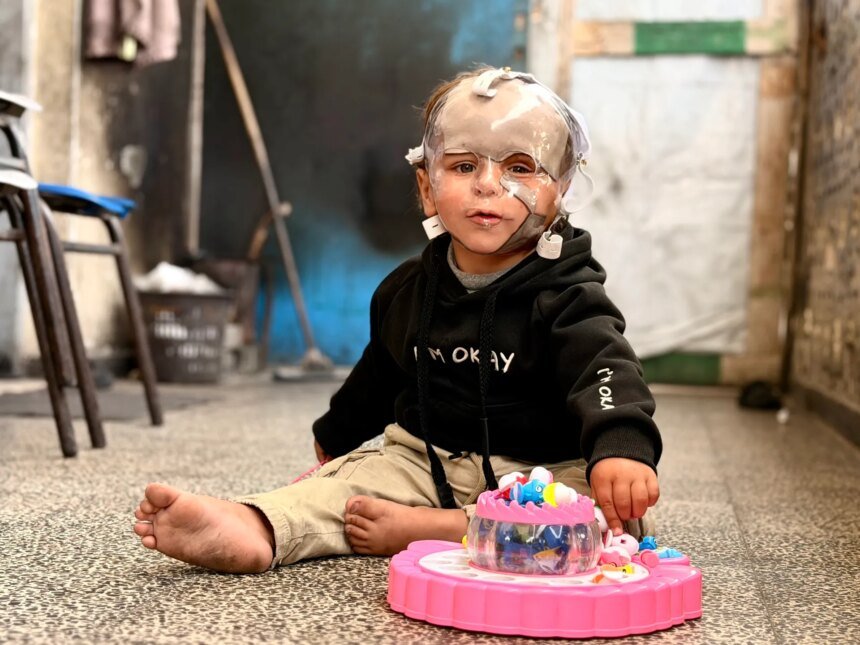
Ramez Abu Hajila, the father of the child Muhammad, sits in the corridors between the classrooms of Mustafa Hafez School, west of Gaza City, trying to calm his two-year-old son and place a therapeutic mask on his face. The child resists the mask with his crying and movement, after a delay in speech due to the injury.
At dawn on Thursday, July 3, 2025, at 2:30 p.m., the bombing surprised the school where many families took shelter from the war. Within minutes, the place was filled with rubble and screams, and 14 of Ramez’s relatives fell martyrs, including two families who were completely erased from the civil registry.
From the heart of this scene, Muhammad emerged alive with deep third-degree burns that affected 18% of his body, including his face, chest, and legs.
The father talks about that moment with his hands tight around the edge of the mask, as if they were still holding the child on his first escape to the hospital. From that night, a harsh treatment journey began, at a time when famine was pressuring people, and the child needed special food, milk, diapers, and careful care.

Very tough week
Over the course of 45 days, Muhammad underwent repeated operations under full anesthesia that lasted between 15 and 20 days, and included cleaning wounds, skin scraping, and chest interventions, before his condition improved by about 40%.
During that time, he went through a very tough week, during which he suffered from poisoning and severe diarrhea. Then he entered another stage of treatment. A temporary compression mask was made for him inside Gaza for six months. It helps put pressure on the head and face and preserve the tissues for about 20 hours a day. Ramez says: “After he wakes up, we feed him and prepare him for the hours of torment that will come.”
The effect of the mask extended to more than one place in the child’s life, and closing the mouth for long hours made speech heavier and slower, and narrowed the space that Muhammad needed for food, rest, and building his body. His father describes the scene with great sadness, when the child’s eye falls on a bottle of milk and he cries, and tries to pull the mask off his face, then grabs his hair and runs around his father and grandmother, looking for a short moment of respite from treatment.
Double hardship
In the shelter school, the hardship is doubled. The place is overcrowded, the movement is wide, the toilets are public, and the child is at an age where he wants to play, run and go.
From here, caring for Muhammad turns into constant follow-up, and into daily worry about pollution, friction, and the large number of people. Ramez says, as his eyes follow his son’s anxious steps: “Mohammed wants to play and run like any child, and I keep watching him and trying to protect him as much as I can.”
Despite this difficult journey, his father states that the mask made a visible improvement in his face after a period of adherence to it, with the effects remaining prominent, testament to deep burns, long treatment, and daily hours of endurance.
When he describes Muhammad before the hospital trip and operations, the father’s tone changes slightly, and he returns to his first image in his memory: “A child with beautiful features, intelligent, quick to pay attention to those around him. He entered the war as a young child, and endured enough pain for ages.”