Published On 4/24/2026
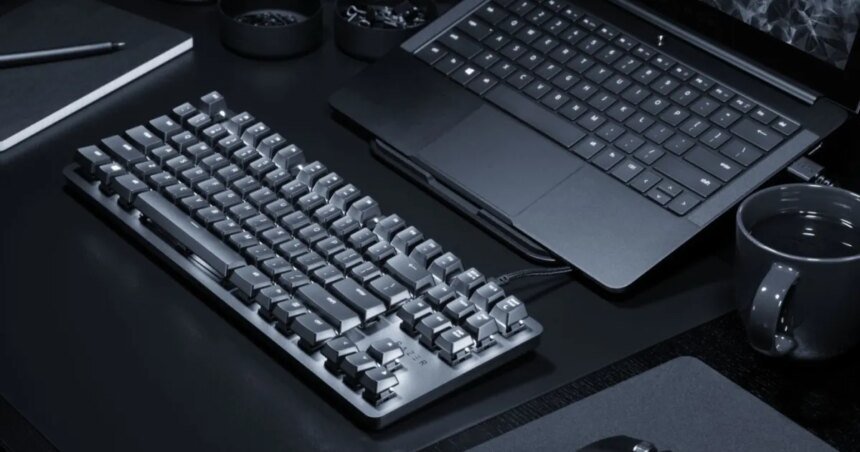
Ever since primitive man grabbed a piece of charcoal to draw on cave walls, the “tool” has been the only bridge through which the human mind crosses over to physical reality. In the modern history of computing, the keyboard and mouse were not just plastic accessories, but rather the stone that decoded the communication between human intelligence and rigid machine logic.
Over the course of four decades, humans have adapted to “machine language,” learning to press specific buttons to convey their thoughts, and mastering their wrists to move a cursor on a two-dimensional screen. This era was known as the “Age of Human Adaptation to Technology,” in which “clicking” and “typing” were the only means of imposing will on silicon processors.
But today, the world stands before a defining historical moment similar to the moment when man replaced the manual plow with the steam engine. It leaves the era of “intermediary tools” and enters the era of “direct communication.” With the rise of generative artificial intelligence, the computer no longer needs you to tell it “how” to carry out a task via the keyboard, but rather just waits for you to tell it “what” you want. The rug being pulled out from under the “mouse” today is an announcement of the end of the era of mechanical mediation and the beginning of the era of mental sovereignty.

From graphical interfaces to linguistic interfaces
The famous technical analyst at the American Stratechery platform, Ben Thompson, believes that the world is moving from the era of the graphical interface (GUI) to the era of the linguistic interface (LUI). In the previous era, the user had to memorize the location of buttons and functions within complex programs such as Photoshop or Excel.
But today, thanks to big language models like GPT-4o and Gemini 1.5 Pro, it’s the computer that needs to understand our language. Microsoft reports that the Copilot feature has reduced users’ need to navigate through menus by up to 40% in some office tasks, as dozens of clicks are replaced with one simple text command.
The era of “agents” and freeing hands
The most notable development in 2025 and 2026 is the emergence of “independent agents.” According to a study issued by the American research firm Gartner, the future of computing will depend on “agents who see the screen.”
For example, OpenAI has announced the development of features that allow artificial intelligence to automate the desktop. This means that artificial intelligence can “see” icons and move the mouse “virtually” to carry out complex tasks such as booking a flight or organizing accounting files, without the user touching the real mouse. Here, the mouse becomes a tool for monitoring, not execution.
Spatial computing and biometric input
The threat is not limited to software artificial intelligence only, but extends to hardware. With the launch of mixed reality glasses such as Apple Vision Pro, the mouse has been replaced by eye tracking technologies and manual gestures.
Meta Reality Labs reports confirm that integrating artificial intelligence with motion sensors makes responding to commands faster than the movement of a hand on a keyboard. In this context, “gaze” becomes “click,” and “gesture” becomes “swipe.”

The “screenless” device revolution
Devices such as the Ai Pin from the American company Humane and the Rabbit R1 emerged as the first commercial attempts to eliminate the keyboard completely. These devices are based on the concept of “intent-based computing”.
According to technical reviews in the American magazine Wired, these devices are betting that the future is “audio first.” Instead of writing a long email, the AI shapes it based on the context of your previous conversations, and all you have to do is give a nod.
Why won’t traditional tools disappear “completely”?
Despite this creep, there is a consensus among experts at MIT Technology Review that the keyboard and mouse will turn into “specialized tools” rather than general tools, for several reasons:
– Accuracy: In the fields of intensive programming, cinematic editing, and CAD, the mouse remains an unrivaled tool for microscopic precision.
– Privacy factor: “Silent typing” on the keyboard remains the ideal solution in open offices, where the user does not want to shout out voice commands in front of strangers.
– Tactile feedbackHumans are naturally drawn to physical tools that give them a sense of control, something that audio interfaces lack.

Observers believe that the world is not witnessing the death of the keyboard and mouse, but rather is witnessing their “retirement” from arduous and daily tasks. The rug is effectively being pulled out from under public use, leaving it only to professionals.
As Microsoft CEO Satya Nadella says, “AI is the autopilot that will make us stop worrying about how to operate the machine, and focus only on what we want to accomplish.” In this new world, your “idea” will be the engine, and your “language” will be the new keyboard.