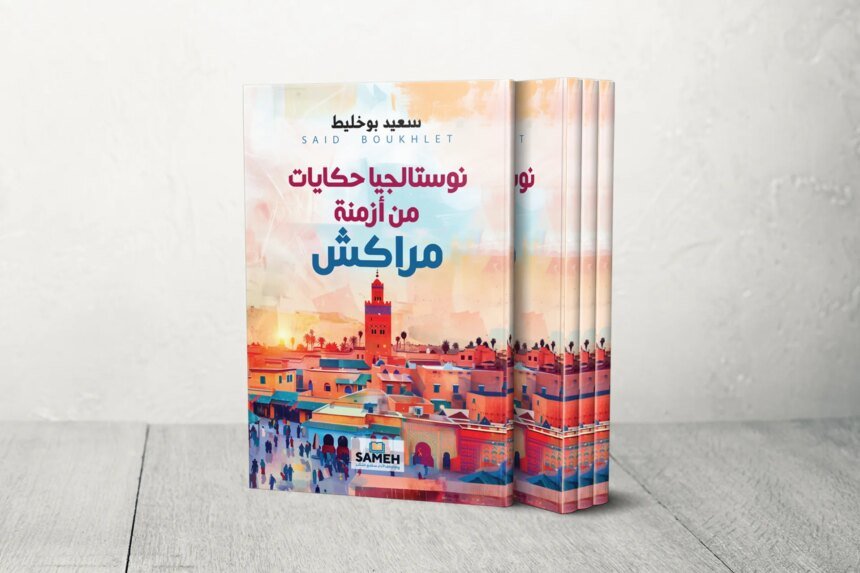
In the book “Nostalgia: Stories from the Times of Marrakesh,” Said Boukhlit praises a narrative architecture based on memory and place, as a tool of knowledge and not just nostalgia.
Time here is no longer a chronological measurement, but rather turns into a psychological aura overshadowed by the eyes, and into an embodiment of time in the form of abstract stone structures built in the abyss of the human soul, called upon to resist the weight of the present and the turmoil of the future, and to rebuild (the city) as a space-time inhabited by the reader and the writer.
Narrative panorama
With deep contemplation, Boukhlait places the concept of time in an aesthetic, emotional, and social context, mixing safety and hope with the brokenness of values, the brutality of consumption, and symbolic violence. Then he refers all of this to the example of Marrakesh, which he sees losing the warmth of its identity, as he sees that the mixing between text and its surroundings is conditional on the presence of a difference or semantic discrepancy between the parallel narrative and the temporal image, so his perception is exhausted under the pressure of chaotic material transformations, emptying the place of its soul, and turning the spoken heritage into a cumbersome facade.
It may be thought that the book does not content itself with presenting Marrakesh in a solid, panoramic image, but rather writes it from the inside through fragments of his diaries in the school, the neighborhood, the bus, the spectator squares, and the Jemaa el-Fna circles. The stories take the form of short scenes, but they are tied with a regulating thread, which is questioning the values that governed relationships, bodies, and language.

In “Teachers’ Tales,” for example, the writer restores the ancient faces of education not as naive nostalgia, but as a laboratory for educational violence, prestige, and rituals: a professor fills the blackboard silently and throws the chalk, shouting, “To hell, world,” and another hides his eyes behind dark glasses, and the punishment turns into a complete system of humiliation, including summoning the “strongest of the class” to carry out the falaqa. Here the school is restored as a space in which talent and dysfunction, compassion and cruelty, and symbolic power coexist, creating memory as much as it creates knowledge.
The falsity of virility
In another axis, the book opens the file of the body in the public sphere, not as an object of excitement, but as a mirror of social and psychological imbalances. It is a narration of incidents of harassment on buses, crowding, and around fences. It reveals how crowding turns into a cover for stealing pleasure, and how false masculinity intersects with voyeurism, coercion, and aggression, leading to examples that expose the deviation of social authority when the city is restored as a space that allows the violation of the other and then hiding behind habit or silence.
These stories are harsh, but they perform a deconstructive function, and give the text its moral tension: there is no whitewashing of reality, no soothing of wounds, but rather a description that puts the reader in the face of what is said in whispers and hidden behind masks.
The human impact deepens when the narrative moves from the social scene to personal loss, as in the chapter “Departure Before Departure,” where the memory takes the form of a shock: “A house that is noisy than usual, a father who loses the ability to speak, and a mysterious look that cannot be understood until one returns to a lying corpse and the sound of the Qur’an at one’s head.”
Here, Boukhlait’s language is condensed into a very sensitive scene, proving that nostalgia in the book is not a celebration of the past, but rather an examination of the meaning of fragility, and how the defining moment rearranges the entire world within a single sentence of looks, breaths, and rattles.
The chaos of alienation
He combines a long contemplative breath with fast-paced narrative narration, and weaves with the threads of his stories situations that suffer from alienation, in a chaos that only those who suffer from loss can understand. He moves from idea to image, from analysis to joke, and from bitterness to sarcasm, all in a way that pushes the reader to follow the threads of the plot that remain clinging to his thought even after he finishes reading it, without losing the unity of tone.
His eloquent language, loaded with metaphor, was able to masterfully capture the small details that establish meaning, whether when he describes the rituals of the circle in Jemaa el-Fna, or when he turns a common phrase such as “Release the hen so that she does not hatch eggs” into an introduction to dissecting the symbolic violence practiced by the language itself in the public sphere, and how the word becomes a tool of incitement, insult, and behavioral guidance, before it is an innocent description of reality.
In this sense, the book achieves a double literary value. It is enjoyable as a reservoir of stories vibrant with the scents and sounds of the place, and it is convincing as an interrogation of the meaning of transformation, and of the price of moving from a Marrakesh of “compassionate authenticity” to a Marrakesh conflicted by chaos and alienation. In essence, it is a testimony to a city that is read through the fragility of individuals, and to individuals who can only be understood through the cracks of the city.
Embezzlement of pleasures
The place affects the elements of the narrative work and is closely linked to the artistic tools that determine its dimensions and artistic parts, especially the element of the event that occurs from the production of its different and distinct characters, calling on the writer to investigate the immanence of the place to the dramatic event, allowing time to shroud the situation in the blur of feeling and the lostness of the characters.
We notice in the story “The Cemetery of Embezzlement” how the writer presents the idea of the cemetery as a formal narrative methodology with clear geographical features, in terms of its proximity to the neighborhood, which is separated by a low wall, and the hole made by nature that prevents children from entering the cemetery from the side of the door, which prompts people to go around the wall, and what permeates the spatial description of the cemetery is the inclusion of characters and the fictional stories accompanying them, such as the idea of jinn and ghosts and the theme of women who are abused by their husbands begging for safety. Forcing them to sleep next to gravestones until the sun rises, the story of two lovers who became insane after a bad night, a ghost appearing in the darkness, and many others.
Marrakesh… uncountable
“Marrakesh,” this closed place, is nothing but an internal and external siege for the reader, in an attempt by the writer to express in a whisper his feelings and childhood memories in order to rest in fear of the outside. In his distance and isolation in this place, his bonds are disintegrated, as the places for the storyteller take on the meaning of a room closed from the surrounding world, and an enumeration of everything within a separate world for every reader who seeks tranquility. He embraces some conversation, contemplation, fear, thinking, and other things that only he may know.
Where characters move in its space representing the reality of communication with others – the place – the place is the hero hidden behind the manifestations of the event, and the narration here is nothing but the message of the past clinging to the memory of bodies longing for liberation, fearful and trembling from the truth. The place came as a living witness that carried in its womb the meanings of identity, monitoring and movement in life. Between the signifier and the signified is the thread of Muawiyah. Once it is cut, the symbolism collapses and the secrets are exposed.
The author, Said Boukhlit, is a researcher and translator from Morocco. Between 2002 and 2025, he published about forty books between an author and a translator, the general subject of which is literary studies, criticism, philosophy, biography, and literary dialogues.