Published on 4/25/2026
Military and economic estimates revealed gaps in the effectiveness of the naval blockade, in exchange for warnings of serious repercussions that could affect the Iranian economy if the situation tightens in the next stage.
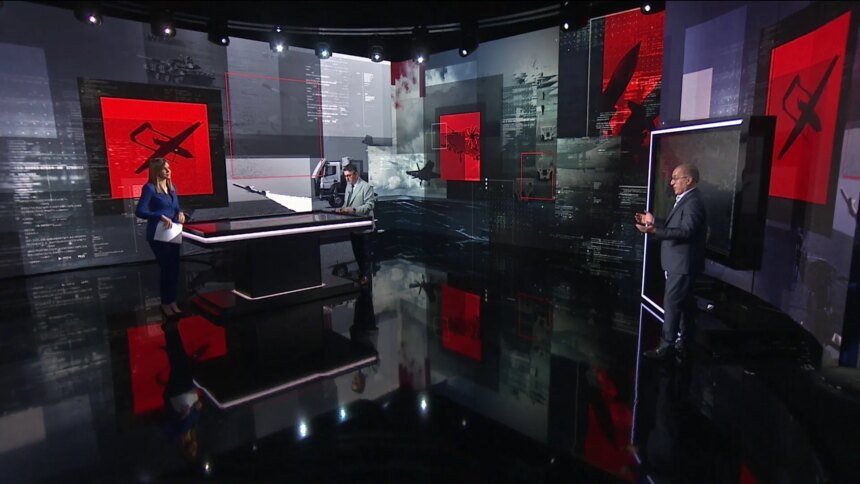
According to what was presented in Al Jazeera’s analytical studio, the military and strategic expert, Brigadier General Hassan Jouni, indicated that the circulating data regarding the crossing of dozens of Iranian oil tankers, including what was recently monitored via satellite images, reflects that the American blockade is not completely tight, pointing out that more than thirty ships were able to escape.
Johnny explained that this reality is linked to what is known as the Iranian “shadow fleet,” which is a vast network of ships that Tehran developed over years of sanctions, and works with complex camouflage mechanisms, including changing identities and flags, tampering with ship documents, as well as disabling or falsifying the signals of tracking devices to hide the source of the real trips.
He explained that this method puts the US Navy in front of a major challenge, as the blockade does not include all shipping traffic, but rather focuses on ships connected to Iranian ports, which imposes the necessity of verifying the identity of each ship individually, which is a complex process in time and technology, which allows some tankers to cross before they are discovered.
On the other hand, energy affairs expert Hashim Akl believes that the blockade, despite its loopholes, may turn into a highly effective pressure tool if it is tightened, explaining that the current military deployment is insufficient to cover a wide area such as the Arabian Sea, and that reliance is increasing on satellites to track the movement of ships.
Stifling the oil sector
Akl warned that the ultimate goal of this blockade is to strangle the Iranian oil sector, by restricting exports and filling land and floating tanks, which may lead to the cessation or decline of production, especially since the old oil fields in southern Iran cannot withstand closure for long periods, and may permanently lose part of their production capacity.
He pointed out that Iran cannot last long without exporting oil, suggesting that its endurance capacity will range between 30 and 60 days maximum, with a storage capacity estimated at about 140 million barrels, before the repercussions of the oil suffocation begin to appear, including a decrease in production by hundreds of thousands of barrels per day.
Regarding the available options, Akl considered that Tehran relies mainly on the shadow fleet, warning that tightening the screws on it, in parallel with tightening sanctions, may lead to a possible economic collapse, especially with Iran’s heavy dependence on the Chinese market, which accounts for the largest percentage of its oil exports.
For his part, Brigadier General Johnny described the current scene as closer to the equation of biting fingers, where each party seeks to exhaust the other. The United States is betting on weakening the Iranian economy to push it toward making concessions, while Tehran is betting on raising energy prices and putting indirect pressure on Washington.
He stressed that the current stage falls within the scope of neither war nor peace, indicating that the confrontation has begun to take on the character of a maritime economic war, with its theaters taking place in the Arabian Sea and the Indian Ocean on the one hand, and the Strait of Hormuz on the other hand, without a clear desire on the part of both parties to slide into a comprehensive military confrontation.
In light of these data, estimates intersect between the continuation of the game of cautious balancing, and the possibilities of an economic escalation that may have deeper repercussions inside Iran, if the tools of the blockade are tightened and the outlets that still allow Tehran to export its oil are closed.