Published on 4/25/2026
Field developments in southern Lebanon are moving towards restructuring the rules of engagement, with Israeli military operations continuing despite the announcement of a ceasefire, in a scene that reflects a shift from theoretical calm to a field reality open to the possibilities of escalation and the redrawing of security borders.
Field data reveal an escalating operational pattern that relies on aerial and artillery bombardment and the bombing of residential squares, as part of what appears to be an Israeli attempt to impose new facts on the ground that go beyond the limits of previous agreements and redefine the areas of conflict.
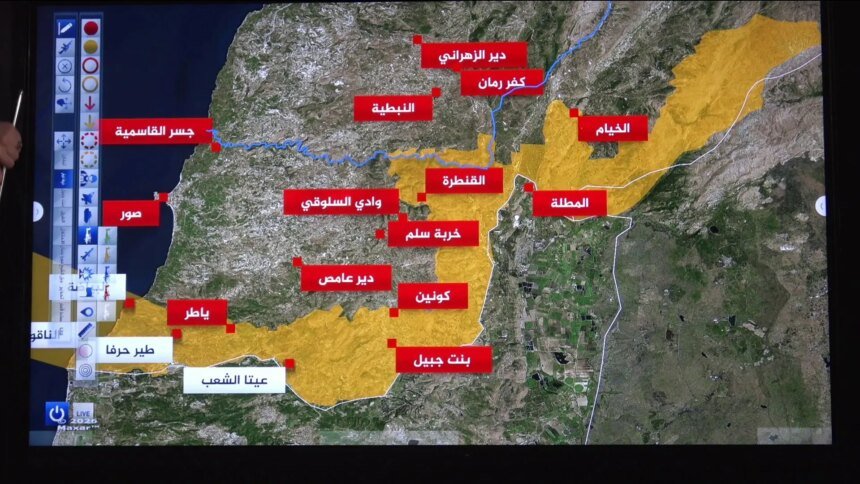
Our colleague Abdel Qader Arada explains via the interactive map that the Israeli army is threatening to expand its operations in southern Lebanon, prompted by a possible political green light, in conjunction with warnings directed to the residents of dozens of villages located within what Israel calls the Yellow Line, especially south of the Litani River.
These warnings include dozens of towns in a context simultaneous with large-scale bombing operations that affected entire residential squares in areas such as Khiam and Bint Jbeil, which reflects a trend towards emptying these areas of the necessities of life and reshaping them geographically and security-wise.
Data indicate that these operations are inseparable from the attempt to replicate the Gaza model by forcefully imposing a buffer zone, where bulldozing and destruction operations are repeated in a systematic manner, in line with a security vision that seeks to remove threats from the northern settlements.
On the ground, the targets are distributed over a wide range, including several southern towns such as Deir Amis and Khirbet Selm, in addition to relatively northern areas such as Deir Al-Zahrani and Kafr Rumman, where the Israeli army announced the targeting of what it described as missile launching pads.
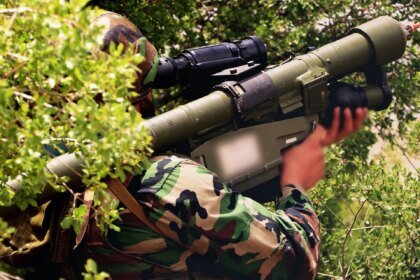
On the other hand, Hezbollah announced the implementation of counter-targeting operations that included military sites and Israeli vehicles, in addition to shooting down a “Hermes 450” drone, an indication of the continuation of military interaction despite what is supposed to be a ceasefire.
Set to fire
The military and strategic expert, Brigadier General Hassan Jouni, believes that what is happening cannot be described as a ceasefire, but rather is closer to a “ceasefire control,” as Israel continues its operations, but within different patterns and levels in terms of scope and depth.
Johnny explains that the first level of these operations is focused on the vicinity of what Israel calls the Yellow Line, as Tel Aviv seeks to stabilize this line on the ground through systematic destruction, even though it is still a theoretical concept that has not yet been fully verified on the ground.
As for the second level, it includes the area between this line and the Litani River, where attacks are repeated on an almost daily basis, causing human and material losses, within the framework of continuous pressure aimed at keeping this area within the scope of permanent tension.
The third level extends beyond that, to include the areas north of the Litani, reaching a greater depth, as happened in Deir Al-Zahrani and Kafr Rumman, which reflects a gradual expansion of the scope of operations beyond the traditional boundaries of the engagement.
In his explanation of the massive bombing operations, Johnny explains that they primarily target major cities and towns with a heavy population and history of resistance, such as Khiam and Bint Jbeil, with the aim of breaking them geographically and security-wise and preventing the re-formation of an incubating environment for resistance.
Eliminate the possibility of life
He adds that the destruction of these areas also falls within an effort to eliminate any possibility of returning normal life to them, given the security threat they represent according to the Israeli vision, especially due to their proximity to the border with the northern settlements.
On a broader level, Johnny links these moves to the memorandum issued by the US State Department, which gave Israel a wide margin to move under the title of “the right to self-defense” without clearly defining geographical or operational restrictions.
He points out that Israel is exploiting this ambiguity to consolidate its security presence in the region by gradually expanding the scope of its operations, taking advantage of the absence of a precise definition of the limits of this right, which opens the door to reformulating the rules of engagement.
In his assessment, Johnny confirms that the “self-defense” clause is originally an axiomatic principle in international law, but its current field translation goes beyond this framework to include large-scale destruction and assassination operations that are not consistent with the concept of traditional defense.
The military expert points out that Lebanon’s acceptance of these arrangements came under the pressure of the major military escalation that affected large areas, including the capital, Beirut, which prompted it to treat the agreement as an urgent option to reduce the severity of the attacks.