Published On 4/22/2026
|
Last update: 16:50 (Mecca time)
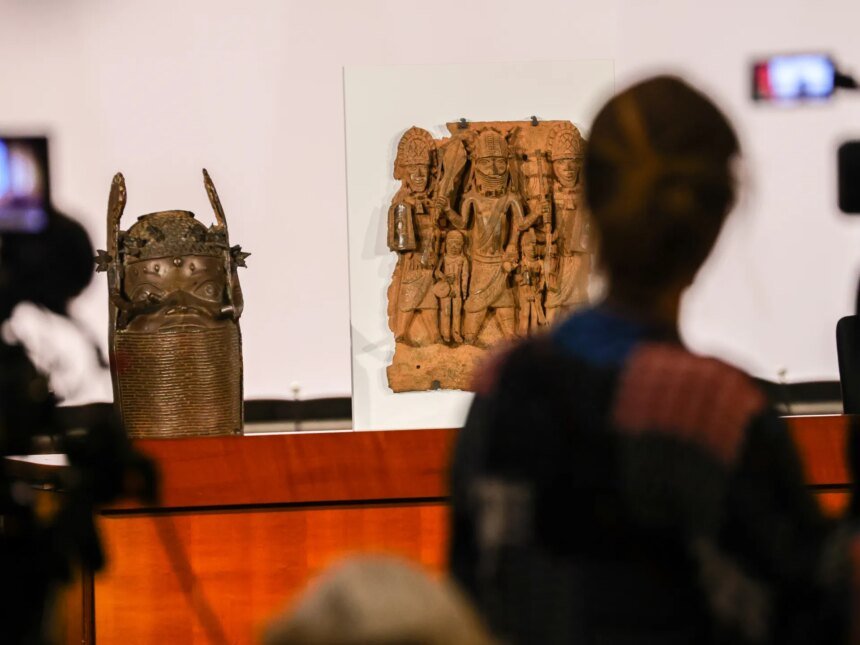
One of the Benin bronzes contains more than enough room for a book; A royal ritual, a legend about the emergence of a dynasty, the trace of a hand that passed down the craftsmanship from generation to generation, and inscriptions that preserve a story that can only be told with metal. However, most of these pieces live their second lives behind the glass of museums in London, Berlin and Vienna, far from the land that knew how to pronounce bronze.
In the spring of 1897, a British force stormed the capital of the Kingdom of Benin – in what is known today as Edo State in southern Nigeria – burning the royal palace and deporting thousands of pieces of art as part of what was later called the “Benin Campaign.” Bronzes cast between the fifteenth and sixteenth centuries—bas-reliefs, royal heads, and animal statues—in just a few months found themselves distributed among the museums of Europe and North America, establishing a forced residence that extends until today.

Back slowly
For decades, Nigeria – and before it the symbolic heirs of the Kingdom of Benin – has been demanding the return of what it describes as “colonial theft,” not just an artistic acquisition. But the response was slow and tortuous. In 2025, the Netherlands returned one hundred and nineteen objects in the largest single repatriation to date, and the University of Cambridge followed suit in 2026 with one hundred and sixteen objects that were held at the Museum of Archaeology and Anthropology. Germany had also delivered dozens of pieces before that.
Read also
list of 2 itemsend of list
The British Museum alone – which maintains the largest collection, nearly nine hundred pieces – is still hesitant, citing British laws that restrict the disposal of its collections. Behind these numbers stand a statistic that summarizes the extent of the wound. Between ninety and ninety-five percent of Africa’s cultural heritage remains outside the continent. It is no longer, despite its symbolism, a drop in the ocean.

Who has the right to speak?
Researchers from the Open Restoration Africa Initiative – an independent initiative that tracks looted African antiquities in European museums – believe that Western institutions are the ones who decide “who has the right to speak, what is considered evidence, and when it is permissible to respond.” In the eyes of researchers, this is not a disagreement over procedures, but rather a flaw in the structure of the relationship itself.
One of the direct consequences of this imbalance, according to the initiative, is the presentation of repatriation operations as generous “voluntary initiatives” from the West, rather than historical entitlements to their owners. The difference between the two formulations is not rhetorical; It is a difference between a gift and a right.

Sylvester Ogbeche, professor of art history at the University of California, believes that the public mood in Europe has moved from relative openness to increasing conservatism.
In his reading, Germany took further steps than Britain, which remained the most restrictive. As for the “loan” proposals that are sometimes put forward as an alternative to return, they maintain – according to his description – legal ownership in the West, and give their owners a document of continuation wrapped in apparent generosity.
The biggest dilemma, according to Ogbeche, is essentially legal. African countries are forced to demand their rights within a judicial system formulated by their historical adversary, not a neutral system.
If the discussion extends to the intellectual property rights associated with these pieces – their use in publishing, photos, and traveling exhibitions – the file of the pieces alone may turn into a much broader file.
Beyond the piece
Therefore, a team of researchers believes that the recovery of the objects, despite their importance, is incomplete unless it is accompanied by talk about broader compensation for the losses of the entire colonial era. On the other hand, Deidrea Farmer-Bellman, director of the working group concerned with this file, offers a different approach. The priority for her is not money, but rather actual participation in decision-making, from how these works are presented to the narration of their history, and the context in which the visitor is placed before them, especially when it comes to the slave trade and colonialism.
A unified African voice
The United Nations Educational, Scientific and Cultural Organization (UNESCO) calls for a path of international cooperation instead of unilateral steps, and believes that coordination with regional entities such as the African Union may accelerate the return. At the African level itself, experts believe that the absence of a unified continental strategy makes each claim file an individual case that is easier to manage or postpone, and the continent loses the weight of collective negotiation.
In its European window, bronze appears as a “relic” isolated from its surroundings. In her country of origin, she will become part of a narrative that is restored, an identity that is restored, and a relationship with history that African nations are still in the process of redefining.
“Benin Bronzes” goes beyond the issue of the return of the looted; The restoration of something remains incomplete unless the authority to speak about it is restored with it.