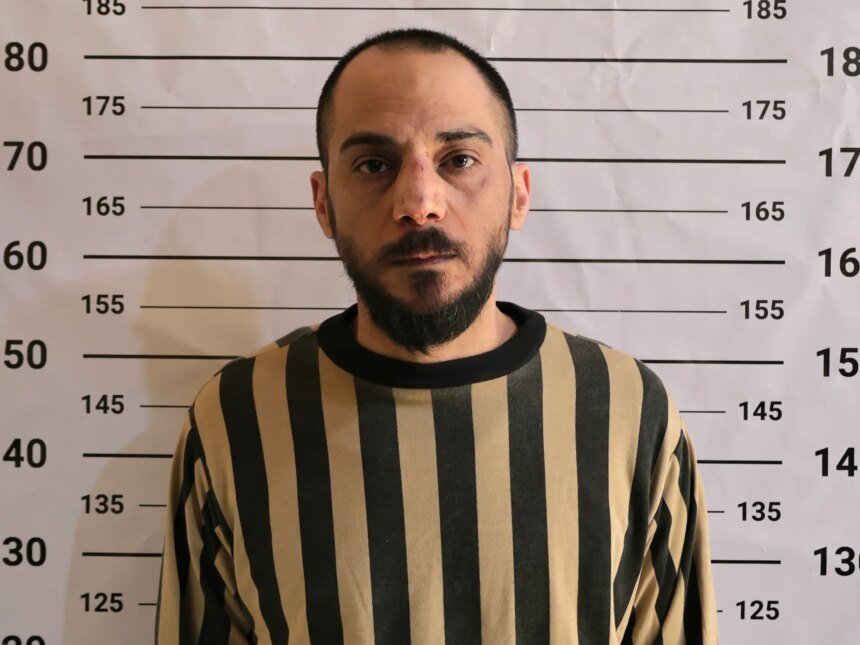
An intelligence officer in the Assad regime in Syria, he was responsible for security operations in southern Damascus during the period of the Syrian revolution. He is accused of being responsible for the arrest, torture, and killing of political opponents and civilians, including women, children, and the elderly.
Amjad Youssef is accused of committing many crimes against civilians, and he is accused of being primarily responsible for committing the Tadamon neighborhood massacre in 2013 in the Syrian Yarmouk camp.
The video of the massacre published by The Guardian (out of 27 video recordings) documented the killing of at least 41 civilians, while the people of the neighborhood documented the names of 288 victims killed in the neighborhood itself. A number of those involved in the massacre also confessed to committing a number of massacres in the neighborhood, in which 500 men and women were killed.
He disappeared from sight after the fall of Assad, until the Syrian authorities arrested him in a security operation in the Hama countryside on Friday, April 24, 2026.
Origin and formation
Amjad Youssef was born in 1986 in the village of Nabaa Al-Tayeb in the Al-Ghab region, northwest of Hama, and grew up in a large family that included 10 siblings.
He joined the Military Intelligence Academy in Maysalun in 2004, and underwent intensive training for 9 months.

In the military intelligence service
After joining the Intelligence Academy, Amjad Youssef rose through the military ranks until he became an investigator in Branch 227 of Syrian Intelligence by 2011, before becoming deputy head of the branch.
He was responsible for the arrest, torture, and killing of political opponents during the period of the Syrian revolution that broke out in 2011. Then he was sent to the Operations Department to lead the battles in southern Damascus, and he was responsible for security operations there, especially in the Tadamon and Yarmouk regions, where he led military operations until 2021.
Amjad moved through military work and security branches, and the British newspaper The Guardian reported in 2022 that until that time he was still working at the Kafarsouseh military base in Damascus.

A massacre in the Tadamon neighborhood
On April 1, 2013, a massacre occurred on Nisreen Street in the Tadamon neighborhood in the Yarmouk camp for Palestinian refugees in the Syrian capital, Damascus, but it was not revealed until about 9 years later, when on April 27, 2022, the British newspaper The Guardian published a video clip that it said it had obtained from a recruit in a militia loyal to the regime.
The video clip showed members of the army of the ousted President Bashar al-Assad’s regime asking civilians to run, convincing them that there was a sniper monitoring the street and that they had to run to escape from him.
The civilians’ hands were tied behind their backs and their eyes were blindfolded, as they ran toward a large pit about 10 feet deep that the army personnel had prepared for them. When they approached it, they opened fire on them and killed them, or they left them to fall into it and then raced to snatch them from the top with AK-47 machine guns.
They also took an old man and slaughtered him, and they took civilians who were arrested at the security checkpoints in the area, and threw them into the hole and then shot them, until when the bodies were piled one on top of the other, they threw car tires and wood on top of them, poured gasoline on them, and then burned them.
In this massacre, 41 people were counted among the victims, including 7 women and a number of children. Most of the victims were young or middle-aged, and there were also women, children, and the elderly.
This video was leaked to a member of Assad’s forces after he asked him to repair a laptop belonging to Branch 227 of the Syrian Intelligence, of which Amjad Youssef was deputy head. He found the recording on it, He, in turn, brought him to the Syrian activist Ansar Shahoud and Professor Ugur Umit Angur, who work at the Holocaust and Genocide Center at the University of Amsterdam, who followed this case for 3 years until they found the person shown in the video.
How was Amjad’s involvement revealed?
Amjad Yousef’s face appeared clearly in the video, as he took some of the victims and killed them or threw them into the pit, but his role and motives became clear in a completely different way.
After the Guardian investigation revealed the identity of one of the perpetrators of the massacre, and said that his name was Amjad Youssef, Shahoud searched for him on Facebook until she found him and contacted him impersonating a woman supportive of the Assad regime.
Communication continued between Amjad and Ansar until the officer confessed to having committed several killings, under the pretext of avenging the death of his younger brother, who was killed in 2013.
The recording published by The Guardian is only one of 27 video recordings of similar massacres in this place, in which more than 280 Syrians were killed by members of the Syrian regime’s intelligence, according to the investigation prepared by the two researchers.

The newspaper confirmed that it had seen an unpublished video clip showing Amjad Youssef shooting 6 women inside a hole “in front of the sight of the death squads” working under his command. After the killing operation ended, he set fire to the bodies of the dead women inside the hole that was filled in with a bulldozer, in an attempt to erase any evidence of this crime.
It also quoted a former colleague of Amjad’s that he confessed in a phone call to committing the massacre, and confirmed that Amjad was kidnapping women from the streets of the Tadamon neighborhood, and many of them disappeared. He explained that he saw him kidnapping women while they were waiting in line to buy bread in the morning, adding, “They were innocent women. They did nothing. They were either raped or killed.”
Amjad Youssef’s former colleague added that more than 12 mass massacres were carried out in the Tadamon neighborhood, and that local residents are aware of the locations where these crimes were committed.
He stressed that all the victims were Sunnis, and commented, “It was sectarian cleansing,” while other companions of Amjad indicated that the goal of the massacres was also to spread terror in the hearts of citizens and warn them against approaching the opposition.
After the fall of Assad
After the fall of the Assad regime on December 18, 2024, the Syrians healed their wounds and began searching for the fate of those missing during the revolution. Here, the Tadamon massacre returned from memory to the present, and the search began for the person accused of being primarily responsible for it, Amjad Youssef, who had disappeared from sight and no path was known to him.
The fall of Assad was preceded by judicial prosecutions of some of those accused of the massacre who left Syria. In August 2023, the German police arrested Ahmed Al-Hamrouni, accused of participating in the Tadamon massacre, and a close friend of Amjad, after 3 years of research and scrutiny in cooperation with the Syrian Center for Justice and Accountability.
After the fall of Assad, the new Syrian government, since its establishment, began a security campaign to pursue members of the former regime. Citizens also launched popular donations, which included a financial reward allocated to whoever was able to reach the perpetrators of the Solidarity massacre, headed by Amjad Youssef.
The location of the pit that contained the remains of the victims of the massacre has become a landmark in the region and is visited by journalists and researchers, especially after human bones were found near it.
Following several security operations, the Syrian Ministry of Interior was able to arrest a number of those involved in the Tadamon neighborhood massacre, but Amjad Youssef remained hidden from view.
Day of arrest
On the morning of Friday, April 24, 2026, Syrians woke up to photos leaked from a security vehicle, showing a man sitting frightened in the grip of security forces with his nose bleeding, with comments asking: “Is this Amjad Youssef?”
The Syrian Ministry of Interior soon confirmed the news, announcing the arrest of Amjad Youssef, who is accused of being primarily responsible for the Tadamon neighborhood massacre, in a security operation carried out by the Internal Security Forces in the Hama countryside, before publishing a picture of Amjad in a prison uniform.
The Syrian Ministry of the Interior revealed that the arrest operation came after months of careful security monitoring and follow-up, which intensified in its final stage about a month before the operation was carried out, when his location was approximately determined in the village of Nabi al-Tayeb in the Hama countryside.
The ministry spokesman explained that during that period, the competent authorities carried out repeated attempts to track down Youssef and arrest him, including an attempt that took place in September 2025, but it was not crowned with success.
He pointed out that Youssef had left Syria after his identity was exposed following the spread of video clips documenting the massacre, before he later returned to Damascus, where he continued his association with military security until the fall of the Assad regime. After that, he disappeared from sight, moving between several areas, including the Qardaha countryside and Al-Ghab Plain.