Beirut- Among the rubble of his destroyed house in “Nabi Sheet” Square in eastern Lebanon, Mukhtar Wahba Al-Moussawi stands as a witness to the tragedy caused by the Israeli raids in this town.
“Here is my home,” in a heavy voice, Al-Moussawi speaks to Al-Jazeera Net about the bitterness of the scene, “They were struck with all hatred, the damage is great, but we always say that God is the one who compensates, and this enemy can only be expected to destroy.”
The town of Nabi Sheet in the Bekaa, eastern Lebanon, is considered one of the towns most exposed to Israeli raids during the war, in addition to the Israeli landing there, which left Massive destruction And dozens of deaths.As well as the town of Sohmor, which It was completely evacuated at the height of the escalation.
Today, the people of the two towns, returning from displacement, are trying to restore their rhythm of life after the ceasefire, despite the effects of the war, and to restore the destruction that the two towns witnessed during the last war.

Everything is gone
Al-Mukhtar looks at the rubble of his house, not caring about building what was destroyed, as he considers that this stage is for steadfastness, and the absolute priority is not for reconstruction, but for defending the land. With words filled with pain, he says: “Our homes are a sacrifice for this land.”
The war did not end until it destroyed the livelihood of citizen Khalil al-Musawi, as today his small shop has become a silent witness to the years of fatigue that vanished in an instant.
Khalil stands in the middle of his shop, trying to piece together what was destroyed by the Israeli raids that destroyed the shop and its solar panels, in addition to the water tanks.He does not wait for aid from absent organizations or supportive parties. He faces the rubble alone, and restores his walls “from living flesh” and from the toil of years.
On the doorstep of his shop, which had become rubble, Ahmed Nour El-Din stared at his shop, which had its share of Israeli raids, telling Al Jazeera Net: “My meat shop was damaged, and now I am restoring it on my own with the capabilities I have.”

“disaster” area
The Health Emergency Operations Center of the Ministry of Public Health had announced, in a previous statement, that a series of raids launched by the Israeli enemy on the town of Nabi Sheet and surrounding towns in the Baalbek District in March resulted in a total of 41 citizens being martyred and 40 others injured.
While the Israeli army landed in the town on March 7, its mayor, Hani al-Moussawi, was watching with a heavy heart for his town to turn into a “disaster” area.
The losses were not just numbers in official records, but rather an infrastructure tragedy, including electricity, telephone, and sewage, that left people facing the cold.
About 25 houses were completely destroyed in Nabi Sheet, and there are 1,350 damaged houses so far. This is how Al-Moussawi describes the reality of reconstruction to Al-Jazeera Net, and says, “We will see what we can do to help the people whose homes were destroyed after the ceasefire is established and the war ends.”
The municipality did not wait for the war to calm down, as it worked to secure basic services for the population, and for Al-Musawi, the priority now is to enable people to survive, and to support them in repairing the infrastructure that has cracked.
Destruction of the town of Sohmor
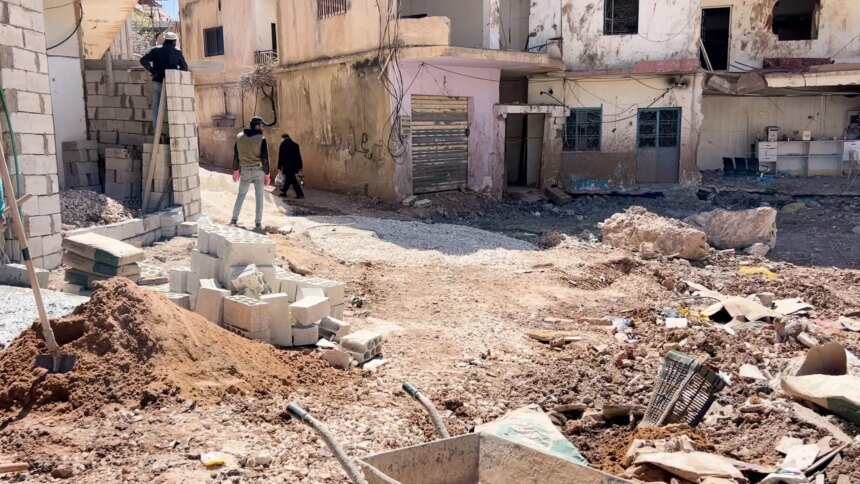
During Al Jazeera Net’s field tour in the streets of Sohmor, the extent of the destruction clearly appears: roads in poor condition, partially or completely demolished houses, and a ruined mosque, while rubble spreads throughout various neighborhoods. This heavy scene reflects the harshness of what Sohmor witnessed, but at the same time it does not obscure a gradual return to life, as residents are busy removing rubble and cleaning their homes, benefiting from a truce that may not last long.

Citizen Fatima Qamar from Sohmor says that she returned with her family immediately after the ceasefire, after she had been displaced to a safer town to escape the bombing. She describes the moment of returning to the town as shocking and painful, as the extent of the destruction seemed greater than she expected. She says that there are “weeping” scenes: houses are damaged, storefronts are destroyed, and neighborhoods have changed their features under the weight of the raids, adding that what the war left behind is harsh on both the people and the place.

Despite this reality, she confirms that the people did not wait long to remove the effects of the war. With the absence of the ability to complete restoration at the present time, many are trying to carry out preliminary repairs with whatever capabilities are available, from replacing broken glass, to cleaning homes from dust and rubble, and repairing what can be repaired with individual efforts.
She says that the return itself was a message of attachment to the town, even if the homes were still burdened by the effects of the bombing. She pointed out that movement has returned to almost normal in Sohmor despite everything, as the streets are crowded with people, and residents are scattering between removing rubble, inspecting their homes, and trying to reopen their businesses and shops.

For her part, Laila Al-Khatib narrates her experience after returning from displacement in the Qaraoun area, where she was staying with her brother. She says with regret that the scene of the town after returning is “very difficult,” noting that her house and shop were not spared from damage, as their windows were broken and cracked as a result of the raids that affected the area. Laila toured the village and was surprised by the extent of the destruction. Despite this, she confirms that she is determined to stay and believes that returning remains the only option.

emergency
Despite the return of about 75% of the people, the situation in Sohmor is still far from stable. The town suffers from an almost complete blackout of electricity and water. Five power stations in the town are down, in addition to major damage to the infrastructure. On the other hand, the municipality is working to open roads and remove rubble from the main streets, in an attempt to facilitate the movement of residents and the gradual return of life.
Within this context, the mayor of Sohmor, Muhammad Al-Khashin, confirmed in his interview with Al Jazeera Net that there are residential neighborhoods that were completely destroyed, indicating that the town is experiencing a real state of emergency, and describes it as one of the most affected towns in the Western Bekaa. On the other hand, he sends an urgent appeal to the official authorities and concerned organizations, calling for rapid intervention to support the people and secure the elements of resilience, in light of limited local capabilities and increasing needs.