


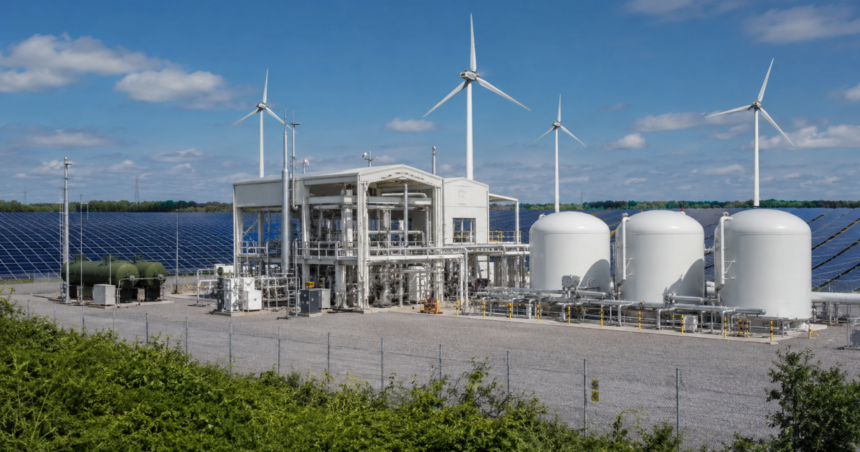
Muscat – In a step that moves the green hydrogen file in the Sultanate of Oman from the arena of governmental ambition to the realm of applied research, the German University of Technology in Oman “GEOTEC” launched a hydrogen laboratory printed with 3D printing technology. The project is described as the first of its kind in the region.
The inauguration took place under the patronage of the Minister of Energy and Minerals, Engineer Salem bin Nasser Al-Aufi, and with the support of OQ Gas Networks Company. The laboratory brings together under one roof three technologies that are seen as pillars of future cities, in a project that goes beyond the boundaries of a traditional building to be an advanced research and application platform.
In a special statement to Al Jazeera Net, the University’s Vice President for Administrative and Financial Affairs, Dr. Hussein bin Sulaiman Al Salmi, describes the laboratory as “a living embodiment of the future of sustainable innovation in the Sultanate of Oman,” not just an addition to academic facilities. He believes that the step is in line with the national trend towards achieving carbon neutrality by 2050, and supporting the goals of Oman Vision 2040 in this aspect.
The laboratory’s role is not only limited to studying clean energy, but also provides a living model for a future living environment. It aims to develop sustainable hydrogen solutions and raise the efficiency of resource use, at a time when the Sultanate of Oman seeks to become one of the largest exporters of green hydrogen in the world.
The project derives its distinction from its integration of three technical systems at the same time. It combines green hydrogen technology as the energy of the future, 3D structural printing technology as a mechanism for sustainable construction, in addition to advanced technologies for smart homes supported by artificial intelligence and the Internet of Things.
Al-Salmi points out that the building is the first of its kind in the region that relies 100% on renewable energy. He explains that this is achieved through integration between the solar energy system and green hydrogen production and storage technologies to meet its operational needs. The building is also self-managed through smart systems that adjust energy consumption according to actual needs and climatic conditions.
3D printing technology contributes to reducing construction waste by up to 60%, according to what the university announced. The building relies on materials manufactured 100% from local resources, which supports national industries and reduces the environmental footprint associated with transportation and manufacturing.

The scientific aspect… from electrolysis to smart homes
Green hydrogen production is scientifically based on separating the water molecule into oxygen and hydrogen through electrolysis, using electricity from renewable sources. The value of this path lies in its being free of carbon emissions, unlike hydrogen produced from fossil fuels.
The laboratory provides an environment for testing the efficiency of electrolysis systems and fuel cells, which are cells that convert stored hydrogen back into electricity when needed. Researchers are also working on developing smart algorithms to manage energy exchange between hydrogen sources and smart grids for buildings.
The building includes an advanced insulation system designed to adapt to the Sultanate’s climate, in addition to sensors, monitoring and control systems that monitor performance and constantly improve operating efficiency. The building thus becomes a living laboratory to measure the performance of low-carbon solutions under realistic operating conditions.
The university set four goals for the project, including localizing knowledge and building national capabilities, providing an applied research environment, developing scientific frameworks for smart sustainable construction, and supporting the knowledge-based economy by transforming research into industrial applications that raise local added value.
Al-Salmi also believes, in his own statement, that the project enhances integration between education, scientific research and the industrial sector. He explains that it opens horizons for students and researchers to contribute to solutions to energy and sustainability challenges, and provides a lively environment for experimentation and cooperation between academics and industrial partners.
He stresses that the initiative stems from the conviction that academic institutions must be at the forefront of leading change, not just transmitters of knowledge. He adds that the goal is to provide practical solutions that prove that the homes of the future can be environmentally friendly, smart, and rely on clean hydrogen energy, which contributes to building national capabilities and supporting the goals of carbon neutrality by 2050.
Where does Oman stand globally?
For her part, the University’s Assistant Vice President for Research and Innovation, Dr. Yasmine Suwaisi, said in a special statement to Al Jazeera Net that the Sultanate occupies a “promising and advanced position” in the green hydrogen sector globally, supported by a clear strategic vision.
Suwaisi points out that Oman has begun the transition from the planning stage to the implementation stage, benefiting from the abundance of renewable energy sources, especially solar and wind, and its geographical location overlooking the Arabian Sea and the Indian Ocean, and its proximity to major shipping lines. Which facilitates access to European and Asian markets.
There are multiple factors that qualify the Sultanate for leadership, including the low cost of hydrogen production in the long term, the advanced infrastructure in ports such as Duqm, Sohar and Salalah, and the presence of a clear national strategy and institutional framework that enhances investor confidence.
Suwaisi distinguishes the Omani experience by adopting an integrated approach that does not stop at production, but rather includes research, innovation, qualification of competencies, and strengthening partnerships. She pointed out that the Sultanate aims to produce one million tons annually of green hydrogen by 2030, reaching about 8.5 million tons by 2050.

Multiple national efforts
The laboratory does not come in isolation, but rather within a national system that has been taking shape for years. In 2022, Hydrom was established as the national body responsible for planning the green hydrogen sector, allocating land, and attracting investors through competitive auctions. The company seeks to allocate more than 50,000 square kilometers to hydrogen projects.
On the export front, the Sultanate signed an agreement to establish the first global trade corridor for liquefied green hydrogen, departing from the Port of Duqm to the Dutch Port of Amsterdam, and from there to European industrial centres. Oman plans to export the first shipment in 2029.
The activity extended to financing instruments, as the Oman Investment Authority, in partnership with the Oman Future Fund and the Chinese company Temple Water, announced the launch of the first fund specializing in energy transition with an initial capital of 77 million Omani riyals (about 200 million dollars).
According to a previous report by the International Energy Agency, “Renewable Hydrogen from Oman: A Productive Economy in Transition,” the Sultanate aims to produce at least one million tons annually of renewable hydrogen by 2030, then about 3.75 million tons by 2040, reaching approximately 8.5 million tons by 2050, a number that exceeds the current total European demand for hydrogen. The report believes that Oman is on its way to becoming the sixth largest exporter of hydrogen in the world, and the largest in the Middle East, by 2030. Reaching the 2030 goal alone requires cumulative investments of approximately $33 billion.
University studies
Talk about the hydrogen economy gains scientific depth when it moves beyond official plans to rigorous research. A study prepared by a team of researchers at Sultan Qaboos University, in cooperation with international researchers, concluded that the Sultanate is on the cusp of a broad energy transformation that requires huge infrastructure and investments worth billions of dollars.
The study was published in 2024 in the journal “Environment, Development and Sustainability” published by Springer, under the title “The transition to sustainable hydrogen energy in Oman.” It addressed four themes: natural resources, existing and planned projects, national policies, and institutional and research capabilities.
According to the scenario reviewed by the study to achieve long-term national goals, the Sultanate is expected to need about 5,200 electrolyzers to reach an electrolysis capacity of approximately 180 gigawatts by 2050. Operating this system requires an unprecedented expansion in renewable energy, including the installation of approximately 300 million solar panels and about a thousand wind turbines, with investments estimated at several billion dollars.
However, the research team concluded its conclusion with a methodological warning. He stressed the urgent need to enact specific policies and invest in innovative research programmes, to build a sustainable green hydrogen supply chain, while paying attention to the safety and environmental issues that may arise from such investment.
The study confirms that the future of hydrogen in Oman is not based on the abundance of sun and wind alone, but rather on the ability to build an integrated system that includes legislation, scientific research, institutional structure, supply chains, and national cadres. This is precisely where the importance of university laboratories stems.