Have you ever asked yourself: How can a person understand what is going on around him if sounds and images are completely absent from him? How does he know that someone is approaching him, or that a child is extending his hand towards him, or that there is a conversation going on in the room? At first glance, it seems closer to complete isolation, as if the doors to communication with the world have been closed, but the reality is more surprising and complex than we imagine.
In our world there live thousands of deaf and blind people who have lost hearing and sight to varying degrees, yet they have not stopped living, nor have they stopped communicating or understanding what is going on around them. With the support of science and modern technologies, they have developed other ways of reading the world that do not depend on the eye or ear, but rather on different senses capable of capturing details and translating them into meanings, feelings, and information.
Read also
list of 4 itemsend of list
On the International Day of Hearing-Visual Disability, which coincides with the anniversary of the birth of the inspiring writer Helen Keller, we come closer to this world, to see how deaf and blind people read what is going on around them, and how they rediscover people, places, and daily details in ways that may not occur to many people.
They are not isolated from the world…but they read it in a different way
A deaf-blind person is a person with a dual sensory impairment, sometimes referred to as “double sensory loss” or “multisensory impairment.” Often a person is neither completely deaf nor completely blind, but both hearing and vision impairment reach a degree that causes great difficulties in daily life, and the level of loss varies from one case to another, giving each person special individual care needs.
The natural question here: How does this person live and communicate? The answer is through the “language of touch” and sensory perception. Deafblind people have a different perceptual experience of the world; They do not rely on hearing or sight, but rather on alternative channels, most notably touch and physical signals. This difference does not mean separation from society, but it makes communication more complex and requires greater attention from both parties.
In everyday life for deafblind people, the simplest social cues can turn into a real challenge; Facial expressions, such as smiles or anger, and the tone of voice that most people rely on to understand the context of the conversation, become completely absent, thus creating a need for alternative means of communication that rely on touch and feeling vibrations. Studies show that vibrations can convey information about distance, proximity and movement, turning into a kind of “functional language” that helps in interacting with people and the environment.
Health guidelines state that a deaf-blind person’s ability to communicate, obtain information, and move may be affected, but this does not negate his independence, but rather prompts him to use alternative means that help him interact with the world gradually and orderly.
Many deafblind people use advanced communication systems, such as tactile gestures or hand communication, where words and meanings are transmitted through direct touch, forming a “conversation” that does not depend on sound or image.
It also perceives the surrounding environment by collecting numerous signals, such as physical proximity, the feeling of people moving and touching things, which allows understanding what is happening in a different but effective way.
In this sense, the deaf-blind person is not separate from the world, but rather a reader of it in another language. Touch becomes a window to understanding, and movement and vibrations become alternative tools for vision and hearing, so that communication remains possible even in the absence of the two senses most relied upon by humans.

How does the brain reinvent the senses? Reading through the skin
According to neuroscience, the brain can rewrite its map. When the image or sound is absent, he does not stop searching for information, but rather rebuilds new ways to read and understand it. Research indicates that the human brain has an amazing ability to reorganize the ways in which information is received, allowing some people with hearing and sight loss to perceive the world through unusual channels.
For the deaf-blind person, the “skin” becomes his primary window to the world, and touch turns into a complete language that carries meaning, feelings, and information at the same time, through what is known as direct tactile communication, where areas of the brain associated with vision or hearing are repurposed to process touch.
One study published in the journal Nature Neuroscience showed that a brain region known for its role in recognizing shapes through vision or touch is also activated when a person recognizes the shape of objects through sounds that represent those shapes. The results indicate that this region does not respond to the sense as much as it responds to the information itself, meaning that the brain is more concerned with “what is said” than “how it is received.”
Another study showed that adults blind from birth were able to learn to read letters and recognize complex pictures using “soundscapes,” which are organized sounds that represent pictures. The area of the brain normally responsible for reading written words becomes active while reading these sounds after a short period of training, which supports the idea that some areas of the brain are prepared to process specific types of information regardless of the conveying sense.
In a similar context, researchers found that people who used a system that converts images into sounds were able to extract information about their environment to higher degrees than expected even in the early stages of learning, with a clear improvement after limited training, indicative of the brain’s ability to quickly adapt to new methods of perception.
The matter is not limited to sounds, as modern technologies also benefit from the sense of touch. One recent study on sensory compensation devices based on vibrations or sounds showed that these devices can provide the user with information about the distance between his hand and surrounding objects, and that participants achieved high success rates in grasping tasks after using these systems, which reaffirms the brain’s ability to translate tactile signals into a practical “map” of the world.

Is technology becoming a new sense?
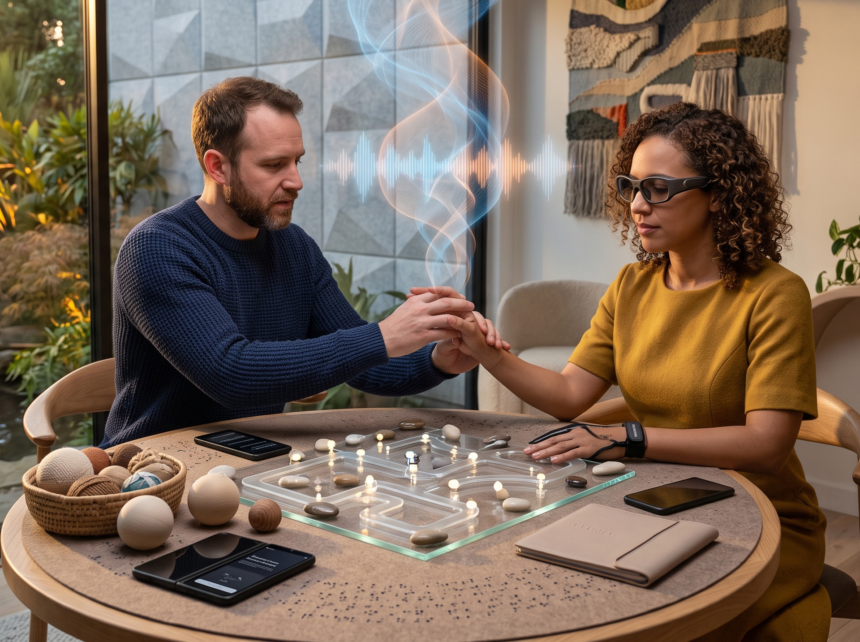
In this world, communication systems based entirely on touch have emerged, such as the “Protactile” language, which is a communication system based on direct physical interaction, where the hand, arm, and body are used to transmit information instead of visual signals. Here, touch is not just an aid, but the basis of language; Conversation is built through continuous physical contact between speakers, and touch is used to convey details about the environment, people’s orientation, movement, and social interactions within a place.
In addition, vibration-based technologies have emerged as a means of digital communication, transforming messages into vibration patterns felt on the skin. These systems were tested with deaf and blind users, and proved that they could be learned and used in transmission and reception after relatively short training periods, so that vibration became an effective and independent communication channel.
Technical experiments with haptic devices show that vibration patterns can be designed to carry different meanings, allowing complex messages and signals to be transmitted through specific vibrations. These systems have demonstrated users’ ability to interact with and understand signals in everyday contexts.
Studies indicate that certain vibration patterns can be used to transmit “social signals” and enhance social interaction, opening the door for deaf-blind people to participate in group conversations, via wearable haptic devices and designing custom haptic signals for effective social communication.

How does artificial intelligence redraw the relationship of the deaf-blind person with the world?
Recent research in artificial intelligence is moving towards developing wearable devices that not only build bridges for communication, but also reshape the way we perceive the environment in real time, by transforming the real scene into information that can be understood through sound or auxiliary signals.
One such system combines a small camera with an intelligent processor that analyzes what is happening in the surroundings; It recognizes people, objects, and obstacles within the scene, then converts this data into understandable sound or signals that help the user interact with the place. The user can also add information about new people and things to identify them later, improving the system’s accuracy over time.
These devices not only provide the ability to “see” the world, but also to interpret it, as they use artificial intelligence models to understand the context of the scene, differentiate between near and far, and provide a real-time description that helps in decision-making during movement, to build what resembles continuous “spatial awareness” that gives the user a live perception of the surrounding space, directions of movement, spaces, and obstacles.
Here, a broad scientific review published in 2020 indicates that these devices represent an accelerating trend in assistive technology, as artificial intelligence is being integrated with wearable designs with the aim of improving independence and reducing dependence on others in daily mobility. The review shows that previous years witnessed intense efforts to develop devices intended for the blind and visually impaired, which convert images into sounds, enhance their cognitive abilities while navigating in familiar and unfamiliar environments – internal and external – and raise the quality of life.
With rapid development, a new trend is emerging to integrate more than one “artificial sense” into one device. Not only does it convert information into sound, but it also adds vibration signals, making it more suitable for people who suffer from both hearing and vision loss. Wearable devices turn into a new medium that translates the world into several sensory languages at the same time. In the end, the question remains: Can technology one day replace the senses, or will it only give the deaf-blind person better access to the world?