The Israeli media did not read the framework agreement between Lebanon and Israel as the birth of a new peace, nor a clear defeat for Hezbollah, but rather a temporary political-security arrangement born under American pressure, and subject to a difficult Lebanese test on the ground.
The agreement, as shown in articles by Haaretz, Yedioth Ahronoth, Maariv, Israel Hayom, and Channel 12, brings Israel an achievement in principle, but at the same time it opens a series of questions about implementation and timetable, the capacity of the Lebanese army, Hezbollah’s position, and the limits of the American role.
Read also
list of 2 itemsend of list
The organizing thread of these readings is that the agreement is better than continuing the war, but it does not live up to the image of “complete victory” that Benjamin Netanyahu marketed to the Israeli public. It is not the end of a threat, but rather an attempt to manage it. It is not a clear withdrawal, but a conditional withdrawal. It is not a dismantling of Hezbollah, but rather a test of the Lebanese state’s ability to approach this goal.
Paper agreement
Haaretz military analyst Amos Harel meets with Yedioth Ahronoth’s veteran military commentator Ron Ben Yishai at a central point that the agreement is important in principle, but its real value will not be measured in Washington but in southern Lebanon.
Harel wrote that simply listening to Hezbollah’s angry reactions is enough to conclude that the agreement carries “good news from Israel’s point of view,” because Lebanon’s willingness to bear full responsibility and exercise its sovereignty in the south is “critically important,” but he adds the decisive sentence: “The test, as usual, will be in implementing the terms of the agreement.”

Ben Yishai arrives at the same conclusion from a different angle. He is not concerned with marketing the agreement as a breakthrough, but rather focuses on the principles it proves: respect for mutual sovereignty, separating Lebanon from Iran, and confining security and sovereignty responsibility to the Lebanese government and its armed forces. However, he acknowledges that the details of the agreement have not been fully announced, and that there is no clear timetable for its implementation, nor an accurate definition of the scope of the “enclaves” or “experimental areas” from which the Israeli army is supposed to withdraw.
Thus, Harel and Ben Yishai agree that the agreement “on paper” is good for Israel, but it is worth nothing without an actual Lebanese ability to impose sovereignty in the south. The difference between them is that Harel starts from the memory of the collapse of the previous ceasefire agreement in November 2024, recalling the 1983 agreement and United Nations Resolution 1701, while Ben Yishai focuses on that the value of the document lies in the principles and not in the executive promises that remain vague.
Ground test
Israeli military commentator Hayom Yoav Limor expands this idea into a direct security question: What will happen when the application begins? He believes that the agreement prevents an immediate Israeli withdrawal that might be filled by Hezbollah, and gives Washington a role in verifying the performance of the Lebanese army.
But he warns – like Harel – that the precedent of November 2024 does not encourage optimism; The Lebanese army did not succeed at that time in imposing complete control over the south, and American oversight was not sufficient to prevent the collapse.
Arab affairs commentator for Maariv and Army Radio, Jackie Haughey, enters from the perspective of military scenes, not theoretical analysis. He reveals that Israeli and Lebanese officers held talks in Washington over a period of months, and that this may lead to a coordination mechanism and perhaps a hotline between the Israeli Northern Command and the Lebanese Army Command in the south.

This reading does not negate the fragility of the agreement, but it adds a practical dimension, as behind the announced document is a silent military path, based on the evacuation of one enclave after another, the deployment of the Lebanese army in place of the Israeli army, and the withdrawal of Hezbollah cells according to Israeli maps.
But this same practical picture opens a counter question: Can the Lebanese army implement Israeli maps without sliding into an internal confrontation with Hezbollah? Here, Hogi meets with Limor and Harel at the same conclusion that the agreement is not the problem, but rather the ability to implement it.
Implementation mines
Haaretz Arab affairs analyst Zvi Barel takes the discussion from the field of security to the structure of the agreement itself. He believes that the agreement is full of terms of peace, sovereignty, reconstruction, and disarmament, but it carries “mines” in its implementation mechanisms.
The question – according to Bar’el – is not only whether Lebanon will disarm Hezbollah, but also who will decide that the disarmament has been completed? Who gives “confirmation”? Will Israel remain in the experimental areas during the operation? What is the timetable for withdrawal, expansion, or the start of bilateral talks?
Here, Barel meets with Ronen Bergman in Yedioth Ahronoth, but from a different approach. Bergman says that the problem with the agreement is not what is in it, but rather what is absent from it.

He identifies four missing elements that may lead to its failure or disruption: no timetable for completion or even progress; There is no clear formulation of the ceasefire and its monitoring mechanism; There is no convincing explanation for why we believe that the Lebanese government will succeed this time where it failed before; Most importantly, Hezbollah is not a party to the agreement, but rather declared its opposition to it.
The value of Bergman’s reading is that it summarizes the impasse in a political phrase, which is that Lebanon is committed to dissolving Hezbollah, but Hezbollah is not committed to dissolving itself. Therefore, in his view, the agreement becomes a management document, not a resolution document. “The title says victory,” he writes, but “the small letters say: the first phase,” while the other side is still armed, organized, entrenched, and waiting.
Deferred victory
This tension between the title and the details is what makes Bergman’s reading close to that of the senior researcher at the Dayan Center at Tel Aviv University, Michael Milstein, who does not stop at the terms of the agreement, but rather places it within a broader review of Israeli security policy after October 7.
He criticizes the transformation of control of territory in Lebanon, Gaza, and Syria into a central security recipe, warning that the failure of October 7 was not only caused by the enemy’s proximity to the borders, but rather by the enemy’s arrogance and misunderstanding.
From this angle, Milstein sees that the agreement with Lebanon appears as a “peace” for a possible Israeli withdrawal from southern Lebanon, which is the lesser of two evils compared to the continuation of the war and the occupation of land without an organized plan. However, he does not call for a blind withdrawal, but rather to separate the security goal from the obsession with clinging to the land. Israel’s interest, in his opinion, is not to remain in the south, but rather to maintain freedom of action against the growth of Hezbollah and the return of Iran.
Washington pressure
As for Barak Ravid’s scenes on Channel 12, they add a necessary background to understanding why the agreement came out in this form? He talked about intense negotiations in Washington that ended in three documents: a framework agreement, a security annex, and a withdrawal agreement. According to these scenes, the negotiations were not smooth, but rather went through moments of blockage and American pressure from Secretary of State Marco Rubio and Vice President J.D. Vance.

This background makes reading Lisa Rozofsky in Haaretz even more important. It believes that the agreement reveals a contradiction in the Trump administration between two paths: the path of Switzerland’s understandings with Iran regarding regional calm, and the path of Washington, which says that Iran and Hezbollah have no role in Lebanon.
With this reading, the agreement is no longer just a Lebanese-Israeli understanding, but rather part of a broader American management of the files of Iran, Lebanon, and Gaza. This explains why Netanyahu considered the agreement “a major blow to Iran,” while analysts believed that this blow would remain symbolic if Tehran was able to use its understandings with Washington to slow down the implementation or thwart it.
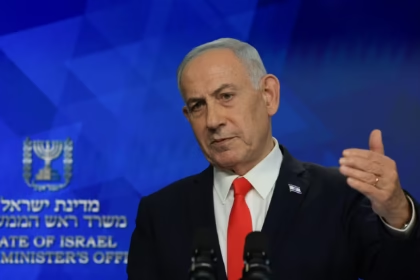
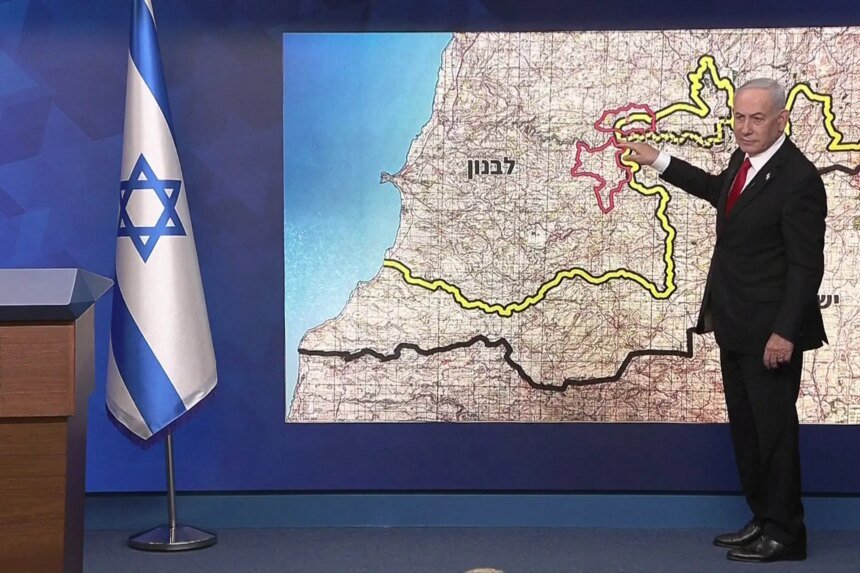
Inside Israel, the discussion about the agreement was not separate from Netanyahu’s political crisis. In the press conference broadcast by Yaron Abraham on Channel 12, Netanyahu said that “the Lebanese government showed great courage,” and that the agreement was “a major blow to Iran and Hezbollah,” stressing that Israel will remain on the “yellow line,” that “security comes first,” and that the army will work against any immediate threat.
But the political writer in Maariv Ben Caspit read the scene in the opposite way. He did not reject the agreement itself, but rather described it as “the right step” and “the lesser evil” compared to the bloody clash and the price paid by the Israeli army and the settlers of the north. However, he saw that Netanyahu “corrupted” its marketing, and likened the agreement to a “marriage without a bride,” because Hezbollah, the party capable of blowing up the south or calming it down, is not part of it.

He added that the agreement gives Israel quite a few achievements, but it is “written on ice,” because its success first required resolving the Lebanese internal crisis with Hezbollah, and this is what no one has either the strength or the time to accomplish now.
In conclusion, the majority of Israeli readings agree that the agreement is better than continuing a war without a horizon, but it does not guarantee peace and does not disarm Hezbollah.