When the late American academic and political researcher Joseph Nye formulated the concept of soft power, he was not looking for an alternative to military and economic power, as much as he was drawing attention to another aspect of influence that has long been neglected, and is determined by the state’s ability to make others want what it wants, not out of fear or greed, but out of conviction and attraction.
The source of this power, in his view, is the state’s culture and values and the apparent credibility of its external behavior. If this content is not attractive, public diplomacy will be unable to produce any soft power.
In this horizon we can read football, as the most popular game in the world gives its owner a symbolic presence that crosses borders and languages.
However, the thesis on which this text is based goes beyond reading the event in its isolated moment to reading it as a cumulative process. The Qatar 2022 World Cup – for Morocco – was the time of foundation and accumulation of symbolic capital, and the 2026 United States World Cup is the time of radiating this capital and testing it on new soil.
Soft power cannot be completely successful unless its symbolic appeal is translated into tangible material gains. The external radiation and the bright image that was painted about Morocco in Qatar broke the classic stereotypes that some may have about the North African countries.
Accumulation of value and symbol
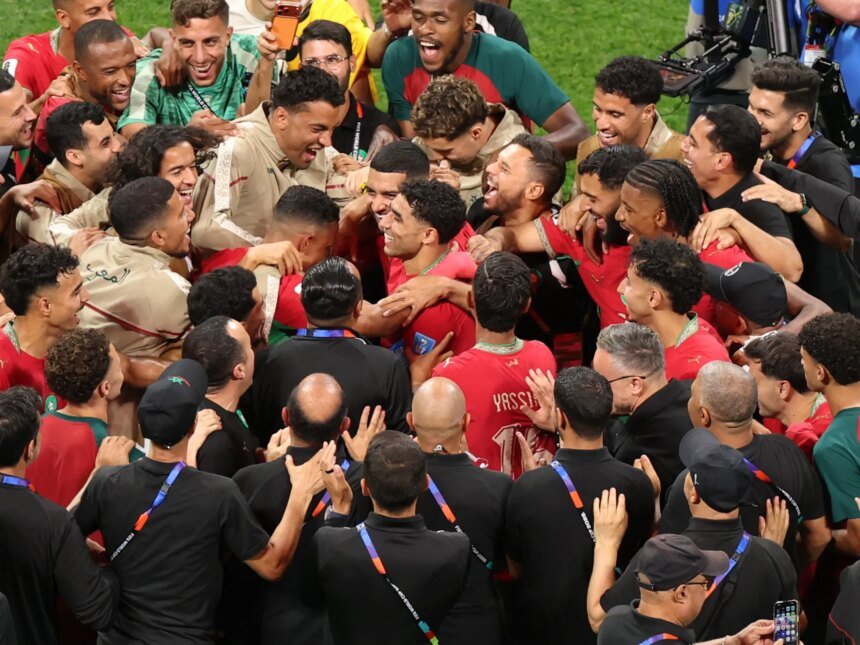
Values in the soft power literature are derived from behavior, not from discourse. Specifically here, the scene of a Moroccan player ascending to the stadium in Qatar to kiss his mother’s head, until it became a signature for the entire team, sparked an international reading as an indication of a hierarchy of values with the family at the top.
Because these images were not made for foreign consumption, they gained credibility that direct discourse cannot achieve, and they contributed to revising preconceived notions about the Muslim man of Arab, Amazigh, and African origins.
In parallel with the value system, the symbol operated. According to Simon Anholt, founder of the concept of nation branding, visual identity plays a decisive role in the mental image.
Thus, the red shirt, with its patterns inspired by Moroccan embroidery, turned from a sports garment into a language of belonging and a commodity sold out of the markets. Whoever wears it does not simply declare encouragement, but rather his affiliation to an attractive story and narrative, in a time when identity has become built more on narrative than on place and time.
This was clearly reflected in the pictures of Brazilian children wearing Moroccan sports jerseys, in the alleys of the football empire where the sun never sets, as a kind of innate bias towards the hero who breaks expectations, but this effect would not have expanded without the digital structure that transformed the human footage of Atlas lions into a self-reproducing global phenomenon.
It is this accumulated symbolic capital that returned to shine in the 2026 edition, held for the first time with the participation of 48 teams and jointly organized by the United States, Canada, and Mexico.
The team that entered Qatar unexpectedly entered America carrying the title of the first Arab and African team to reach the semi-finals of the World Cup, a record that now precedes it on the stadiums, and with every new victory, with stars who have become international names such as Achraf Hakimi, Ibrahim Diaz and Nassir Mazraoui, the same story is turning again, in front of a wider audience and in a more distant geography.
However, the champion is no longer the team alone, but also its fans, as Moroccan fans have become one of the most prominent headlines of the tournament, and international media have considered them among the most influential fans, after large numbers of the Moroccan community residing in the United States, Canada and Europe marched to furnish a remarkable public display in the stadiums of New York, Boston and Atlanta.
Thus, the Moroccan “diaspora” became a natural extension of the state’s soft power, carrying the national team’s jersey to the heart of American cities.
Soft power cannot be completely successful unless its symbolic appeal is translated into tangible material gains. The external radiation and the bright image that was painted about Morocco in Qatar broke the classic stereotypes that some may have about the North African countries, and generated in millions a real curiosity to discover the geography and culture of this country that gave birth to these heroes and these mothers. So where does the impact of this appear in practice?
In tourism before anything else, the number of arrivals to Morocco has jumped significantly, surpassing well-established regional competitors, with a record number of nearly 20 million tourists in 2025.
Football has turned into the most powerful free advertising campaign in the history of Moroccan tourism, a campaign built on sincere feelings, fascination, and emotional participation, not on offers with preferential prices.
New markets
While statistics indicate an unprecedented influx of tourists since 2023 from new markets that did not place Morocco among their first choices, such as Latin America, Asia, and Eastern Europe, in a way that exceeded the state’s expectations in the field of tourism.
Football has turned into the most powerful free advertising campaign in the history of Moroccan tourism, a campaign built on sincere feelings, fascination, and emotional participation, not on offers with preferential prices.
It is true that there are multiple reasons for the matter, from modernizing the infrastructure through the traditions of Moroccan hospitality to opening new airlines, but the image that was formed in Qatar has opened the appetite of many nationalities to discover the owner of the story.
Thus, the symbolic attraction was transformed, through a quiet series of curiosity, interest, and then visitation, into human and economic figures. This momentum did not fade with the end of the tournament, as Morocco hosted major competitions, most notably the 2025 African Cup, which kept the cycle of radiation and investment going, moving it from external spheres to the paths of Rabat, Fez, Tangier, Agadir, Marrakesh, and Casablanca.
In this sense, Morocco has moved from a country that has accumulated symbolic capital to a country that has employable capital and advantages. And it is precisely here that the 2026 World Cup emerges as a testing station for this capital on new ground.
The Kingdom of Morocco did not leave the moment to its spontaneity this time, but rather began to seize it little by little, which is a qualitative development in sports diplomacy.
The Royal University allocated subsidized tickets to facilitate the attendance of audiences, and Royal Air Maroc scheduled additional flights to the host cities at preferential prices, despite the restrictions imposed by visa obstacles and the cost of travel.
America and the limits of sports employment
This reading is not complete without placing it in the context of the host country, which presents a significant case in the opposite direction. The United States, whose image in the global imagination is associated with hard power through wars, interventions, and economic sanctions, sought to use hosting the World Cup as a soft power façade that softens this image and re-presents it in the garb of openness and universal celebration.
This use is not new, as major events have often been used by countries to rebuild their image, from Brazil 2014 to Russia 2018 to Qatar 2022.
However, what is clear is that the American bet in 2026 has partly turned against it, as the logic of hard power has overshadowed the soft facade, due to a series of immigration and visa restrictions that affected fans and officials from participating countries.
Some even described the event as being closer to a World Cup of “exclusion” than a World Cup of “inclusion,” and the fact that a prominent African referee was prevented from entering despite his official accreditation turned into an image that sums up the irony.
The bottom line is that what happened is closer to a display of power than to the production of gravity. Because soft power, as Joseph Nye himself warned, is neither bought nor imposed by administrative action, but rather stems from the credibility of behavior.
In this contrast, the value of the Moroccan experience is highlighted. While a superpower struggles to create an attraction that clashes with its policies, Morocco presents a model of soft power that grew spontaneously from value and symbols, and gained credibility that cannot be bought.
Soft power is a fragile asset that accumulates slowly and is lost quickly, and does not become a permanent influence unless the state translates it into public policies and sports diplomacy with specific goals.
No warranty window
There is something that football can achieve that official channels cannot achieve. 90 repeated minutes have cemented Morocco in the imagination of hundreds of millions and given it a friendly image that the most expensive campaigns cannot buy, because its influence is voluntary and the public adopts it by choice.
The Moroccan experience is not unique in its time, as Croatia preceded it after the 2018 final, but its peculiarity is that it was not satisfied with the moment, but rather accumulated on it through two versions, so it moved from surprise to consolidation.
Soft power remains a fragile asset that accumulates slowly and is lost quickly, and does not become a permanent influence unless the state translates it into public policies and sports diplomacy with specific goals.
The World Cup in Qatar has opened a rare window to form symbolic capital, and the World Cup in America has proven that this capital can be radiated in a new geography, but keeping the window open depends on the infrastructure, cultural diplomacy, and investment in people that will be built behind it. Then, the presence of the Atlas Lions becomes a constant lever for radiation, not a beautiful flash whose glow rises and then fades.
The opinions expressed in the article do not necessarily reflect the editorial position of Al Jazeera Network.