Published on 6/28/2026
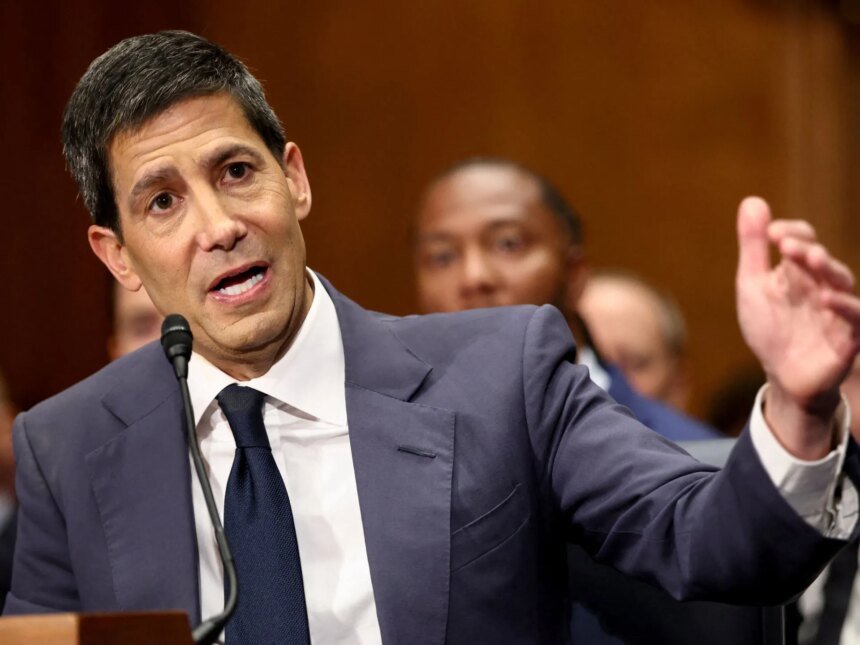
US Federal Reserve Chairman Kevin Warsh is facing a crucial week that may shape the features of the first phase of his term, with anticipation of a ruling from the US Supreme Court regarding the legality of President Donald Trump’s decision to dismiss Board member Lisa Cook.
The Supreme Court is expected to decide early next week on the case that Cook filed to challenge her dismissal, after the lower courts kept her in her position temporarily until the final decision.
Read also
list of 4 itemsend of list
The case is the first judicial test of an American president’s attempt to remove a member of the Federal Reserve Board, as the law stipulates that members of the Board can only be removed for “good cause,” a standard that has not previously been interpreted by American courts.
Observers believe that the upcoming ruling will have direct repercussions on the independence of the US Central Bank, as Cook’s confirmation in her position will limit the president’s ability to influence the formation of the Federal Reserve Board or pressure monetary policy makers.

Political pressure
The legal and financial circles view the case as a direct test of the Federal Reserve’s independence from the executive authority, after President Donald Trump sought to replace some members of the Board with candidates close to him, following central bank officials’ objection to his demands to sharply reduce interest rates.
During previous sessions, the Supreme Court expressed skepticism about the Trump administration’s justifications, while legal experts believe that the court’s previous rulings grant the Federal Reserve a special status that protects its members from arbitrary dismissal, which may enhance the independence of the monetary institution in the future.
Despite the continuing dispute over interest rates, Trump toned down his criticism of Federal Reserve Chairman Kevin Warsh compared to his predecessor, Jerome Powell, saying in a television interview: “Kevin is great, and I want him to do what he sees fit, and I do not want to influence him greatly.”
New approach
At the same time, Warsh is moving towards adopting a different approach to communicating with markets, based on reducing what is known as “forward guidance”, which is the approach that the central bank uses to indicate in advance the path of interest rates.
Warsh stresses that markets should base their expectations on economic data and not on prior signals from the Central Bank, stressing that he will not provide advance guidance regarding interest decisions, and that monetary policy will remain linked to economic data at every meeting.
It is expected that this approach will be subjected to the first international test during Warsh’s participation on Wednesday in the annual forum of the European Central Bank in the Portuguese city of Sintra, along with European Central Bank President Christine Lagarde, Bank of England Governor Andrew Bailey, and Bank of Canada Governor Tiff Macklem, as investors await whether he will continue his cautious approach in providing limited signals to global markets.
This comes at a time when recent economic data has reinforced market expectations for continued tightening of monetary policy, after inflation recorded more than double the target level of 2% in May, which increases the possibility of raising interest rates in the coming months, contrary to Trump’s demands to reduce them.
Who is Lisa Cook?
- Cook serves on the seven-member Board of Governors, which, along with five of the 12 Reserve Bank presidents, makes up the Federal Open Market Committee responsible for setting interest rates.
- She became the first black woman to be appointed to the Federal Reserve Board of Directors in its more than 100-year history, when she was nominated by President Joe Biden. In 2022 for a period ending in 2024, then Biden reappointed her for a new term of 14 years, of which she is now a member, and which will end in 2038.
- Cook holds a doctorate in economics, which is common among Federal Reserve officials, and was a professor of economics and international relations at the University of Michigan Before joining the Central Bank.
- Cook’s research has focused on international central banking, financial crises, racial economic disparities, and the effects of innovation on the economy.
- Cook served on President Barack Obama’s Council of Economic AdvisersIn the early 2000s, in the Ministry of the Treasury.
- Cook, a native of Georgia, and her family were active in the civil rights movementHer uncle, Samuel DuBois Cook, was a classmate of Martin Luther King Jr. and a prominent political scientist.