Gaza- Marine rescuer Ibrahim Kabaja was forced to run hundreds of meters as soon as he received a signal that 3 girls had drowned in the Gaza City port basin, before he began an urgent mission to save their lives.
While the waves were hitting him without any equipment, he was able to reach the girls at critical moments and transfer them to the ambulance that was on standby on the coast.
Rescuer Kabaja spends 12 hours a day, starting from the morning hours until sunset, in a task that he describes as more difficult compared to the previous 22 years in which he was practicing rescue on the shore of the Gaza Sea, due to his lack of the minimum requirements for work.

Limited capabilities
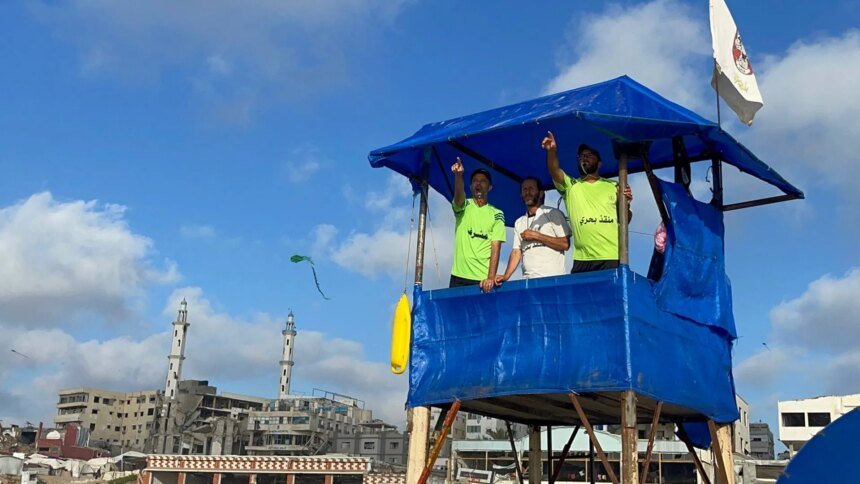
Kabaja, who is atop a wooden watchtower made from the remains of furniture destroyed by the Israeli war machine, places his whistle between his lips, whistling it sometimes and waving his hand at other times for the young men to move away from the sea current and swim in a safe area.
Kabaja told Al Jazeera Net that rescuers work long hours, under difficult conditions and with almost non-existent capabilities, using what remains of primitive and dilapidated watchtowers that do not provide the minimum work requirements.
He adds that the marine rescue teams deployed on the Gaza coast are experiencing the worst conditions today. Most of the watchtowers, equipment and rescue means were lost as a result of the war, and rescuers have only very limited capabilities to deal with drowning and emergency situations.
The shortage is not limited to equipment, according to him, but also includes human resources. The number of lifeguards is not enough to cover the entire coast, at a time when many of them suffer from unemployment and the lack of any bodies capable of supporting them or providing salaries for them due to the stifling financial crisis.

Emergency needs
According to the rescuer Kabaja, the summer summer season was previously limited to only 4 months, during which the competent authorities provided seasonal jobs for the rescue teams, but with the outbreak of war and the beach turning into a large shelter center with tents for the displaced piled up throughout the year, which means that emergency circumstances have begun to require the presence of rescuers throughout the months of the year, which is not currently available.
Kabaja and dozens like him volunteer after the end of their seasonal contract, in a mission he describes as humanitarian, to save the lives of citizens. He warns that the absence of lifeguards from large areas of the beach increases the possibility of drowning cases, stressing that employing additional lifeguards requires providing salaries and basic work requirements to ensure they continue to perform their duties.
Kabaja calls on the concerned authorities and supporting institutions to provide the necessary rescue equipment, and to provide the beaches with qualified, experienced and efficient lifeguards, in addition to securing salaries for them to help them continue their work.
Difficult tasks and few rescuers
Like Kabaja, marine rescuer Riyad Al-Habil complains about the lack of loudspeakers that rescuers rely on to guide dozens of people at sea and warn them remotely of dangerous sea currents, which contributes to saving lives and reduces the risks facing vacationers and rescuers alike.
He confirms that the rescue capabilities on the shores of Gaza are almost non-existent, at a time when the sea is witnessing an unprecedented demand from citizens who have begun to use it as their only outlet to escape the heat of the tents and the harsh conditions of displacement.
Al-Habil told Al-Jazeera Net that the great pressure on the beach is not proportional to the numbers of lifeguards available, who mainly suffer from a severe shortage of personnel and capabilities necessary to ensure the safety of vacationers.
Rescuers continue to perform their duties despite the difficult circumstances and the absence of salaries for a long time. Al-Habil added, calling on the concerned authorities and supporting institutions to provide basic needs and enhance the capabilities of marine rescue teams, especially in light of the continuous increase in the number of seafarers during the summer.
He pointed out that the nature of the work is exhausting and requires continuous effort, at a time when many citizens do not adhere to the instructions and instructions of lifeguards aimed at preserving their safety, at a time when the difficult living and psychological pressures experienced by residents push them to enter the sea without paying attention to safety procedures or potential risks, in search of moments of rest and relief from the burdens of daily life.

A self-effort and a temporary project
Marine rescuer Allam Zaghra recounts the most difficult drowning case he has dealt with recently, when a child got stuck between rocks that usually witness strong sea currents, and when a number of his relatives intervened to save him, they got stuck with him inside water vortexes, forcing him and a team of rescuers to swim quickly to help them.
Rescue equipment is absent from the teams working along the beach, as Zaghra told Al Jazeera Net that he relies only on a plastic buoy to reach the drowned people, without the availability of any other tools.
The rescuer, Zaghra, like others, receives $10 a day for 12 hours of continuous work, as part of a temporary work project during the summer months.
Private information obtained by Al Jazeera Net from the Ministry of Local Government in Gaza, which supervises the rescuers’ file, indicates that 445 rescuers are currently spread along 33 kilometers from Beit Lahia in the north to Rafah in the south, including 300 rescuers working within a temporary project for only 3 months.
According to information, the summer season requires the deployment of 800 lifeguards along the beach, which means that the shortage of rescue crews is approaching 50%, while the significant shortage of equipment increases the complexity of the task.