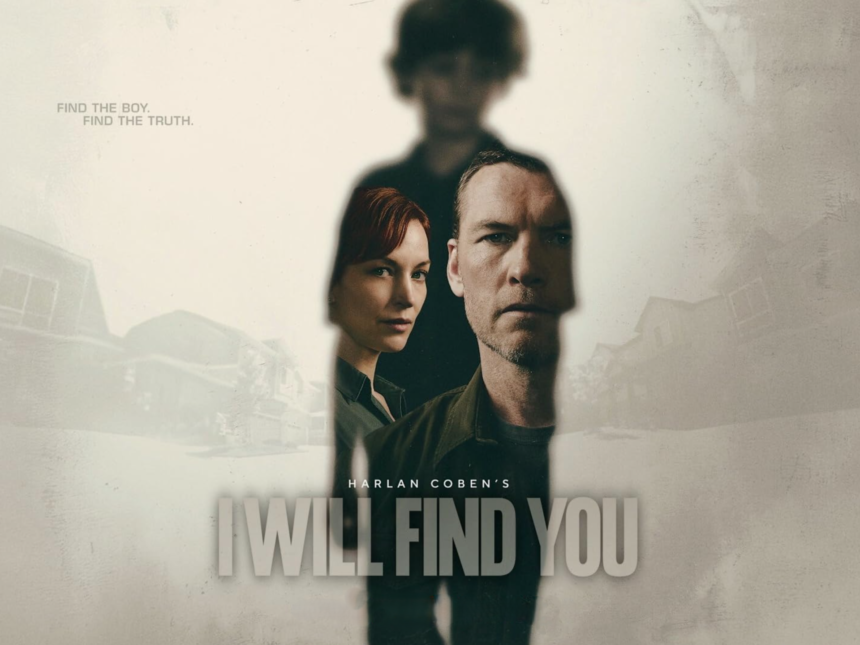
What if they told you that your son, who you buried with your own hands, might still be alive? A question that seems closer to a nightmare than reality, but it is the main driver of the events of the new Netflix series “I Will Find You.”
After 5 years spent in prison by former law professor David Burroughs after he was convicted of killing his 3-year-old son, he is still unable to remember what happened on that fateful night. This makes his ordeal even more cruel, not only because he insists on his innocence, but also because he does not have a clear memory that would enable him to prove it or even confirm it completely.
But his life turns upside down when he sees a picture in the background of which appears the features of a child bearing the distinctive mark that his son had. Then he clings to one possibility, that the truth on which he built years of pain may not be complete, so a frantic race begins that pushes him to challenge the law, the past, and reality at the same time.
Here, the mystery is no longer just a detective game, but rather turns into an open wound that refuses to heal. Every step the hero takes towards an answer leads him to more doubts, not only about others, but about everything he thought he knew about himself, his family, and his past, intertwining questions about memory, identity, and deception within a journey charged with tension and suspicion.
Harlan Coben’s latest bets
Based on the novel by Harlan Coben, published in 2023, which quickly made its way to the New York Times bestseller lists, the series continues the narrative mixture for which the American writer is famous, of family secrets, successive surprises, and sharp dramatic turns that reshape the picture with each episode.
However, “I Will Find You” gives more space than usual to the human side, as the chase becomes not only a search for answers, but a desperate attempt to regain what the hero of the story believes he has lost forever.
The experience also gains its privacy as it is the first American adaptation of Coben’s works produced by Netflix in the United States, after a series of previous works that took place in Britain and Europe, such as “The Stranger,” “Fool Me Once,” and “Run Away,” which gives the series a different character from most works adapted from his fictional world.
The project’s specificity is not limited to its American environment alone, but also extends to the way it was created. According to Coben’s statements, the idea of turning the novel into a series began during the early stages of its writing, when he discussed it with writer and producer Robert Hall before the script was completed, which he had never done before.
Thus, Coben not only wrote the original novel, but also participated as an executive producer and remained in contact with the writing team during the various stages of development. This was reflected in the series, which preserved the essence of the story and its main lines, despite the changes imposed by the nature of the television medium.
Some adjustments were made related to the rhythm and construction of the episodes, adding dramatic lines and new details that enhance the tension required in a work that extends for 8 episodes. Some of the secondary characters were also expanded compared to the novel, and human relationships and psychological backgrounds received more space on the screen, which gave the events a more present emotional dimension.
According to Robert Hall’s statements, the basic rule in dealing with Coben’s works is based on preserving the heart of the novel and its ending, while giving the creators the freedom to develop side paths that suit the screen. Therefore, the series preserved the main structure of the plot and its most prominent turns, while introducing some additions, including expanding the presence of the characters working in the FBI.
On the other hand, some of the legal details that had more space in the novel were shortened in favor of a faster pace that was more suitable for television viewing. While some readers felt that this came at the expense of some of the complexity of the original text, others saw it as a move that preserved the coherence of the narrative. But in the end, the series succeeded in achieving a balance between loyalty to the original material and providing an independent experience that has its own tools.
When the facts turn around
Although the series is full of surprises, not all of them are equally effective. It presents its first twist in the middle of the season, when different data are revealed than what the heroes thought they were chasing from the beginning. The biggest surprise comes during the last two episodes, when the work rearranges events from a completely different angle, in a turn that only readers of the novel may see coming.
Perhaps for this reason, many viewers considered that the series succeeded in preserving the element of mystery until its final stages, despite its reliance on some familiar tools in Coben’s works, which kept discussions about the ending present among viewers on social media platforms, after the final episode was shown.
Britt Lauer steals the show
If there is one name that will emerge from the series more brilliant than others, it is Emmy Award winner Britt Lauer, as her performance as Rachel was balanced between intelligence, fragility, and determination.
Although the character could have easily been transformed into a mere tool for moving events, Lauer succeeded in giving him an independent presence and real human weight. She also presented them in a way that made her motives convincing even in moments when some of her decisions seemed questionable. The dramatic chemistry between her and Sam Worthington contributed to giving the work a dimension that goes beyond the boundaries of the traditional police plot.
For his part, Worthington plays one of his most mature roles in recent years in the role of David Burroughs, far from his dominant presence in huge science fiction works such as “Avatar.” His performance was calmer and more dependent on secrecy than emotion, embodying a man exhausted by sadness and doubt, but who refuses to give up hope. However, it did not always achieve the emotional depth that some of the more detailed scenes required.
As for Milo Ventimiglia, who was associated with many viewers with his influential role in the drama series “This Is Us,” he presents here a different, more mysterious and complex character. In embodying Hayden, he relied on balanced presence and inner confidence, which made the character’s impact gradually escalate until it became one of the most striking elements of the work in its final episodes.
Output maintains tension
The direction enhanced the constant feeling of being pursued, even in the quietest scenes, as there was still a feeling that something was about to explode. Photography, with its cold colors and shades of gray, also helped express the state of isolation that the hero lives in, and build a tense psychological mood that haunts the events from the beginning, especially in the prison scenes and chases.
This method served the nature of the story based on escape, search, and uncovering hidden facts, and gave the dramatic world a realistic texture that matches its plot. In general, the work succeeded in moving between more than one dramatic line without losing its cohesion, although some episodes sometimes suffered from hasty transitions between events.
About parental love and other things
Although the series “I Will Find You” does not offer anything new in the world of television suspense, it is still able to attract the viewer thanks to its reliance on one of the most influential human themes: the loss of children and what hope can do to someone who refuses to surrender to reality. Humans, by nature, do not resist stories that begin with a simple question and then drag them into a whole maze of secrets.
Perhaps what is most distinctive about the work is that it does not deal with parental love as an ideal emotion, but rather as a force capable of pushing a person to challenge the most deeply held convictions. Hence, the strength of the series does not stem from its surprises alone, but rather from that human thread that remains present amid the chases and mysteries until the end.
Although we recommend the work for fans of mystery and psychological suspense, its age rating makes it directed to those aged 18 and over, given that it deals with topics related to child murder, kidnapping, and violence, which are elements that may not be suitable for family viewing or for younger teenagers.
Work evaluation
Story: 4
Acting: 4
Output: 3.5
Photography and visual effects: 3.5
Suitable for family: 3