Published 18.06

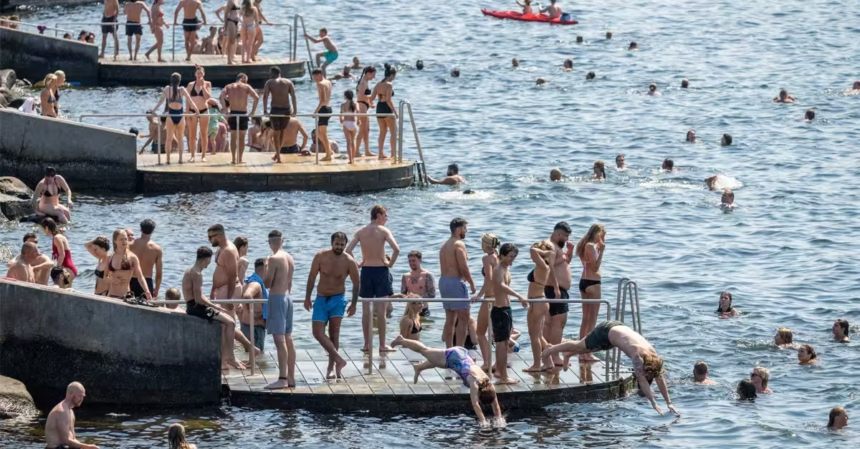
Several heat records in southern Sweden have already been measured during Saturday.
In some places it is 35 degrees on the thermometer.
– The perceived temperature will be even higher, says Klart’s meteorologist Lasse Rydqvist.
It is the hottest day in Sweden since July 21, 2022, and already during Saturday afternoon, heat records were established in several places.
With 35.1°C in Malmö, it is the hottest day measured in the city since 1917. 34.9°C in Ljungby and 33.3°C in Helsingborg from the day are also record highs.
– That says something about this heat and what it has already done, says Lasse Rydqvist, meteorologist at Klart.
But according to Rydqvist, the records can be both more and hotter.
– We will see temperatures that are higher. What we see now are only preliminary figures.

The highest temperatures from the day will be known during Saturday evening. In addition, some stations do not have continuous measurements.
– It comes in during the evening, for example Lund. We have no idea about that yet.
Could be a Skåne record
Although there is still some distance left to the national heat record of 38 degrees in Målilla from 1947, it is approaching the Scanian record of 36 degrees, measured in Ängelholm.
– That would mean that it has never been so hot there since -47. It coincided with the Målilla record.

There is a number on the thermometer, but it can be experienced as more, explains Lasse Rydqvist.
– It’s not just about the heat. There are high dew points and humid air in southern Sweden, so the perceived temperature will be even higher, oppressive heat. Even in the shade it is very hot.
For many, the temperatures can come with discomfort.
– Take a bath and drink water, he says and continues:
– It’s exciting for us meteorologists, but of course I’m thinking about risk groups.
“Expected development”

Markku Rummukainen, professor of climatology at Lund University is not shocked by the heat wave that southern Sweden is currently experiencing.
– It is an expected development that we get increasingly serious heat waves, and they will continue to intensify in the future because climate emissions have not decreased, he says and continues:
– It is a very strong heat wave we are seeing right now, which could hardly have happened at all if we go back, for example, 50 years. The ongoing climate change has changed the conditions.
He also believes that we must work on adaptation and learn to live with the changes that we failed to prevent.
– The effects around us now show that we are not prepared for the increasingly powerful heat waves, says Professor Rummukainen.