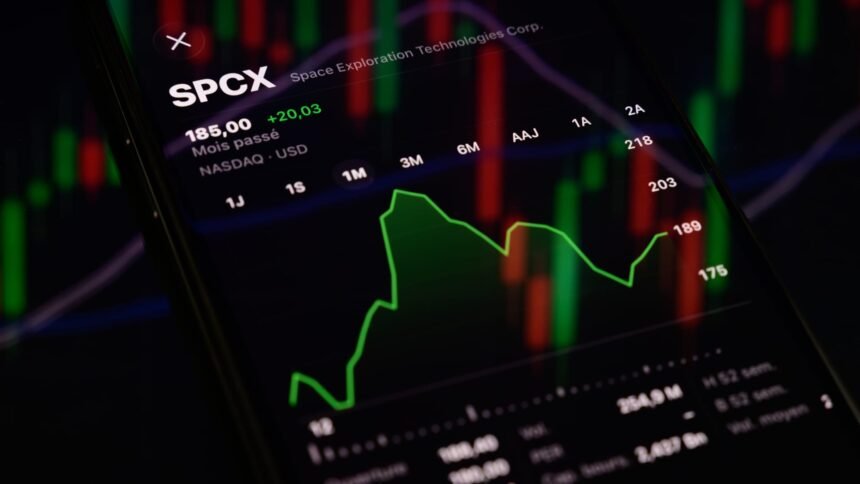
The stock of SpaceX continues its consolidation phase on the New York Stock Exchange one week after its Nasdaq listing.
Samuel Boivin | Nurphoto | Getty Images
SpaceX became one of the quickest additions ever to the Nasdaq-100 index, setting up a fresh wave of buying from passive investors less than a month after the company’s blockbuster public debut.
Nasdaq announced after the close Friday whether SpaceX qualifies for inclusion in the benchmark technology index. Assuming the company meets the requirements, index-tracking funds and other product sponsors would begin purchasing shares after the market closes on July 6, with SpaceX officially joining the Nasdaq-100 before trading begins on July 7.
More than $800 billion tracks the index, including the Invesco QQQ Trust (QQQ), which is one of the most popular securities traded each day and is seen as a barometer for the artificial intelligence bull market.
The aerospace and satellite company is expected to enter the index with a weighting of less than 1%.
Adding SpaceX this quickly would make the Elon Musk company one of the first beneficiaries of Nasdaq’s recently adopted fast-track inclusion framework for newly public companies. The changes allow some large IPOs to become eligible for the Nasdaq-100 after just 15 trading days, dramatically shortening what had historically been a far longer waiting period.
Under the previous framework, investors tracking the Nasdaq-100 could be forced to wait months before gaining exposure to newly listed market giants.
The inclusion could create another source of demand for SpaceX, which has been one of the most actively traded stocks since its June 12 debut. Index funds and exchange-traded funds tied to the Nasdaq-100 would need to buy shares to match the benchmark’s new composition, while active managers who track the index closely might also adjust positions.
Because SpaceX’s publicly tradable float remains small compared with its total market capitalization, even a modest index weighting could require meaningful purchases from passive investment vehicles.
Earlier this month, S&P Dow Jones Indices declined to create a similar fast-track process for the S&P 500. Therefore, SpaceX remains ineligible for inclusion in the S&P 500 because of that index’s separate profitability and seasoning requirements.
— CNBC’s Leslie Picker contributed reporting.