Tripoli – The decision of the Ministry of Economy and Trade of the National Unity Government to ban the export of a number of agricultural and marine resources sparked widespread controversy among farmers and exporters, who warned of its potential repercussions on the date sector, one of the most prominent agricultural sectors in the country.
The decision came within a package of regulatory measures issued by the Ministry during the current year, including a decision banning the export and re-export of a number of marine and agricultural resources, issued on April 21, as part of a government approach aimed at ensuring the abundance of goods in the local market and reducing rising prices.
Read also
list of 3 itemsend of list
The Ministry of Economy says that these measures are temporary and linked to the requirements of the local market, but date producers believe that the generalization of export restrictions threatens a sector that relies heavily on foreign markets to dispose of its production.
Foreign markets
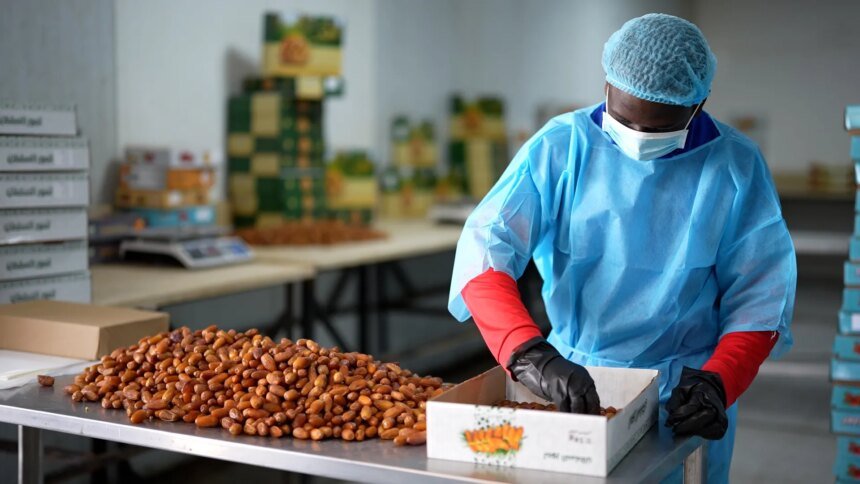
Dates are one of the most prominent agricultural export commodities in Libya, especially in the regions of Al-Jufra, Al-Kafra, Sebha, and the southern oases, where thousands of farmers depend on palm cultivation as a main source of income.
Data from the Food and Agriculture Organization of the United Nations (FAO) indicate that Libya’s production of dates reached about 188 thousand tons in 2023, which places it in eleventh place in the world, ninth in the Arab world, and fifth in Africa, while the number of palm trees is estimated at about 8 million palm trees spread in the oasis regions and the Libyan desert.
An important part of the production is directed to foreign markets, especially in the Maghreb countries, Turkey and a number of Asian markets, especially in light of the local market’s inability to fully absorb the annual production. Those working in the sector confirm that export represents an essential outlet for discharging the surplus and maintaining the stability of economic activity related to dates.
The sector is also seen as one of the tributaries of non-oil exports capable of providing foreign currency, at a time when economic policies tend to diversify sources of foreign revenues and reduce dependence on oil, benefiting from the competitiveness of the Libyan product in a number of international markets.

Inventory accumulation
Ibrahim Nasr, a member of the Board of Directors of the General Union of Date Exporters, told Al Jazeera Net that the quantities ready for export are still large despite the approaching end of the season.
He explained that the volume of quantities currently associated with export operations exceeds 4,000 tons, distributed between shipments inside containers and others on port docks, in warehouses, or on their way to export ports, indicating that there are about 3,000 additional tons with farmers or in various marketing stages.
He added that the continued uncertainty regarding export threatens the confidence of foreign importers in the Libyan market, especially in the main importing markets for Libyan dates, such as Morocco, Turkey, India, and Indonesia.
He warned that hesitation in decisions related to exports may push importers to search for more stable alternative markets, which will have a negative impact on the ability of the Libyan product to maintain its share in foreign markets.
Nasr pointed out that the storage facilities are almost completely full, at a time when only about two months are remaining until the start of the new date harvesting season.
He said that the sector is currently facing the problem of the previous season’s inventory overlapping with the expected production for the next season, which increases pressure on storage facilities and the supply chain.
He stressed that the volume of Libyan production far exceeds the needs of the local market, and that there is a large surplus that cannot be absorbed internally, which makes export an economic necessity for the continuation of the production process.
Repercussions of the ban
He added that the continuation of the ban may lead to a decline in date prices to levels below the cost of production, in light of the high costs of labor, fertilizers, agricultural medicines, and operational services.
He warned that farmers’ losses may prompt some of them to reduce their investments or refrain from expanding palm cultivation in the future, which may subsequently affect the volume of national production.
Those working in the sector believe that the repercussions of the decision are not limited to farmers and exporters only. Nasr explained that the dates sector is linked to a wide economic chain that includes transportation, storage, packaging, cardboard and plastic manufacturing, and logistics services, stressing that any disturbance in one of the links in this chain is reflected in the rest of the activities associated with it.
He also warned of potential social impacts, especially in the Jufra and oasis areas, where agricultural activity represents one of the most important sources of economic stability for the local population.

The authorities explain
The Ministry of Economy and Trade confirmed that the goal of the current measures is not to harm producers or exporters, but rather to protect the local market and ensure price stability.
The Office of the Minister of Economy and Trade said, in a special statement to Al Jazeera Net, that the ministry’s interest during this stage is to ensure the abundance of basic goods and meet the needs of citizens before expanding exports.
The office explained that the decisions to restrict or prevent the export of some agricultural and fishery products came as temporary regulatory measures aimed at enhancing local supply, achieving a balance between supply and demand, and reducing unjustified rises in prices.
He added that the effects of these measures have begun to appear on the prices of a number of commodities, especially some agricultural products and fish, compared to the levels that prevailed before their implementation.
He stressed that export is, in normal circumstances, an important tool for supporting the national economy, increasing revenues, and providing foreign exchange, but the current economic conditions require giving priority to the stability of the local market.
The office stressed that the Ministry aims in the future to increase national production and improve supply chains, allowing for the expansion of exports without affecting food security or the purchasing power of citizens.

Is ban the solution?
Economic analyst Abdul Karim Al-Jadeedi believes that addressing the problem should not be based on a comprehensive ban or opening exports without controls.
Speaking to Al Jazeera Net, Al Jadidi said that the solution lies in smart management of the production surplus, by determining the size of local consumption, annual production, and the exportable surplus before making any decisions.
He added that addressing high prices must start from the roots of the problem, by improving supply chains, facilitating procedures for exporters, supporting agricultural production, and developing strategic storage facilities.
He pointed out that the real economic value does not lie only in exporting raw dates, but rather in developing the manufacturing and packaging industries in a way that increases the added value of the Libyan product and enhances its competitiveness.
While the government seeks to control prices and ensure the abundance of basic commodities, producers believe that dates differ from a number of other seasonal crops, given the sector’s dependence on foreign markets to sell a large portion of its production.
While the Ministry of Economy confirms that the current measures are temporary and linked to market conditions, exporters warn that the time factor is not working in their favor, especially with the approach of a new season and the presence of thousands of tons that have not yet left warehouses.
The challenge before the government remains the ability to reconcile food security requirements with continued exports, in a way that maintains the stability of the local market without harming one of the most important agricultural sectors in the country.