Al Jazeera correspondents
Beirut – In the town of Hammana, summer is not measured by rising temperatures as much as it is measured by that red moment when cherries hang between the mountain hills, as if they were small signs of fleeting seasonal joy. There, the fruit appears not just as an agricultural crop but as a sign of a full life in which the land intersects with waiting, work as a livelihood, and the village with its quiet rhythm that only this short season awakens.
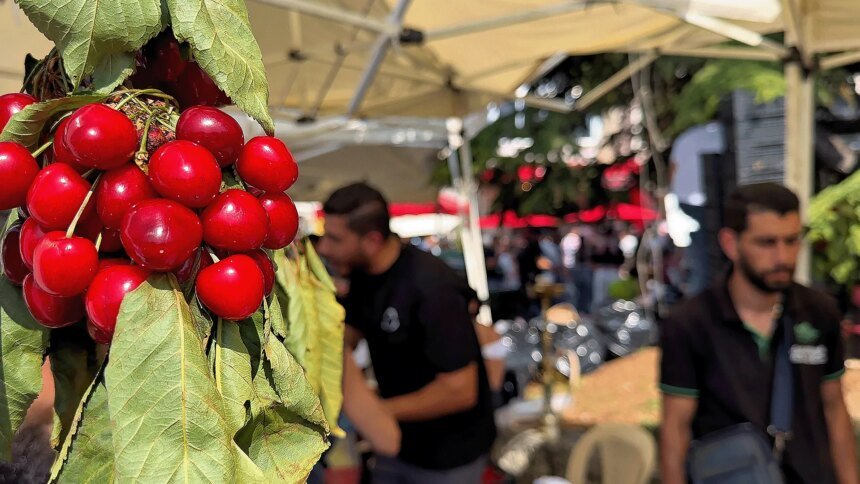
With the start of the “Cherry Festival”, the quiet town in Baabda district wakes up to a different rhythm. The alleys that were accustomed to silence are transformed into open spaces for visitors coming from various Lebanese regions, while the squares spread out like a vast agricultural market, revealing in its depths a fragile rural economy that is only active for a few weeks before it returns to its long dormancy.
Read also
list of 3 itemsend of list
Between these two images, celebration and economy, Hammana moves as if it redefines itself every summer. At the heart of this scene, farmer Naji Abu Al-Shalash stands as if linking two times: the time of the orchards, which begins before dawn when the trees are still wet from the cold, and the time of the festival, which glows under the sun on the roof of the town.
Under a red umbrella in the middle of the square, and in front of a white table on which cherries are arranged as if they were small lamps that caught the summer light, Naji watches the movement around him. From the outside, the scene appears to be a loud celebration, mixed with colors, laughter, and faces, but for him, it is the sum of an entire season of anxiety, continuous work, and waiting not devoid of anticipation.

The scene moves from one table to another, and from one vendor to another, before returning to Naji, who summarizes an aspect of the agricultural story in the town. In Hammana, the number of farmers who depend on cherries as a primary source of income does not exceed ten farmers, with an annual production of approximately thirty tons, but he refuses to let the numbers tell the story. Every tree, he says with experience, carries a full year of care, waiting, and accumulated work that cannot be measured by weight alone.
This year, the trees seemed more generous than they could bear. The branches were filled with fruits, and the soil was saturated with large amounts of water, which was reflected in the size of the grains, which were smaller than expected. Speaking to Al Jazeera Net, Naji goes over the details as if he were reading nature’s mood: When water increases in the roots, the fruit becomes smaller, even if the scene appears more abundant. However, the season was not less attended than the previous one, although last season was superior in terms of quality and return, despite the lack of abundance.
Legacy and return
From another angle at the festival, the story expands to include different voices. Stephanie Rizk sees cherries as more than just a crop. As she tells Al Jazeera Net, they are part of the collective memory of Hammana. In previous years, the festival went beyond the borders of the market to include full celebratory activities, including the election of “Miss Cherry Queen,” an expression of the transition of agricultural production from the field to the cultural and touristic identity of the town.
However, this identity, despite its brilliance, is inseparable from the harsh economic reality. Cherry prices this year ranged between about 2 and 4 US dollars per kilogram, according to the variety and quality. This increase reflects the high cost of production on the one hand, and the sensitivity of this crop on the other hand, as it requires careful monitoring from the moment of flowering until harvest.
Close to the tables, farmer Rami summarizes the practical side of the picture. He begins his talk to Al Jazeera Net in the months that precede the season, when work in the orchards does not stop: regular irrigation, daily monitoring, and continuous protection from pests. With the start of the festival, these efforts turn into a quick harvest. This year, he was able to sell about a whole ton in one day, a remarkable seasonal success, but it does not guarantee long-term stability.

As for Rita, who participates in displaying the products, she views the festival as an indispensable window in light of the decline in export opportunities and the difficulty of accessing some Arab markets. She indicated in her interview with Al Jazeera Net that the climate conditions were relatively better this year, which was reflected in the quality of production, but at the same time she stressed that this improvement remains fragile, linked to the fluctuations of nature and markets together.
Between the economic and realistic talk, the festival still has its social dimension, for the people. The event is not limited to buying and selling, but rather constitutes a space to restore memory. Rita says that preserving what they inherited from their ancestors is part of the reason for the annual participation, as the festival turns into an open meeting between people, and an opportunity for visitors to see how a single fruit can carry the identity of an entire town.
In this context, Eli, one of Hammana’s sons, adds to Al Jazeera Net that the festival has become an annual date that the people eagerly await, because of the economic and social vitality it brings, which restores the town’s pulse at the beginning of summer. He explains that visitors come from various regions to participate in the harvesting season and learn about the atmosphere of Hammana, as the people are keen to transform cherries from a seasonal crop into an integrated experience that combines agriculture and tourism.
The matter does not stop at selling fresh fruits, but extends to innovative products bearing the town’s imprint, such as the “Cherry Lemonade” drink, which combines cherries and lemons, along with cherry tarts and other types of sweets, in an attempt to re-present this fruit as part of Hammana’s identity, and not just a crop that passes through a passing season.

Accurate economic equation
According to the International Labor Organization, the cherry sector in Lebanon depends on heavy seasonal labor during the picking, sorting, and packing stages, within a rural economy that provides temporary income without guaranteeing long-term stability. In the town of Hammana, this paradox is clearly evident: active economic activity in a short season, matched by chronic fragility in sources of livelihood.
Here, the tree turns into a complete economic bet. A successful season may secure an entire year’s expenses, while a loss means deferred debts and fears that recur every summer. There are no real guarantees for farmers, except what nature gives and market fluctuations.
As the festival ends, the tables are folded, the wooden stairs are returned to their places, and the trees regain their stillness. But Uncle Naji Abu Shalash remains attached to a new season, waiting for the return of the cherries as a renewed test of Hammana’s relationship with its land, and with an economy that does not provide certainty, but rather a fleeting opportunity that is repeated every year.