Published on 6/25/2026
|
Last update: 15:52 (Mecca time)
Analysts linked US Secretary of State Marco Rubio’s visit to the Gulf region to what they considered to be regional arrangements being discussed at this stage, and an attempt to reassure the countries of the region about the course of negotiations between the United States and Iran.
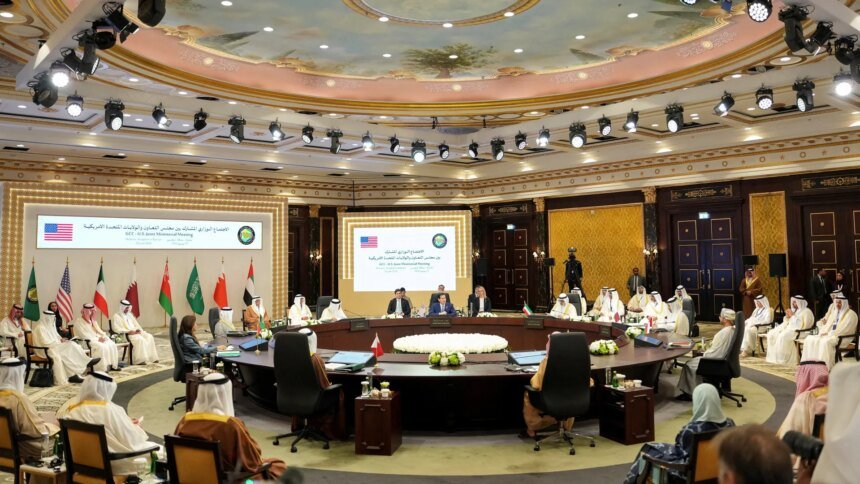
In his speech before the ministerial meeting of the Gulf Cooperation Council countries and the United States in the Bahraini capital, Manama, Rubio said that any decisions taken in the negotiations with Iran will guarantee the interests of the United States’ allies in the region.
In statements to reporters after the meeting, the American minister explained that he came to the region to reassure his country’s partners and assure them that Washington will not agree to any measure that undermines their security or poses a threat to them.
Rubio also stressed that he would not ultimately allow Iran to impose fees on ships crossing the Strait of Hormuz.
In an analysis on Al Jazeera, Dr. Abdullah Bandar Al-Otaibi, Assistant Professor in the Department of International Affairs at Qatar University, described Rubio’s Gulf tour – which also included the UAE and Kuwait – as very important, indicating that there will be regional understandings that will occur, and that the United States does not want to be far from it, but rather in its heart.
Al-Otaibi believed that what concerns the United States is the nuclear issue, while the countries of the region are concerned with regional security and the Strait of Hormuz, noting that Rubio explained to the Gulf people in the joint US-Gulf ministerial meeting in Manama the American red lines, which are that Iran does not possess a nuclear weapon, and does not impose any transit fees in the Strait of Hormuz.
Dr. Abdullah Bandar Al-Otaibi does not believe that the visit represents a reassurance to the Gulf states, because the latter defended themselves and are the ones currently mediating between Iran and the United States.

Iranian guarantees
As for the head of the Al-Madar Center for Political Studies, Dr. Saleh Al-Mutairi, he believes that the visit of the US Secretary of State and his speech during the Manama summit aims to reassure Washington’s allies in the region regarding the course of the talks between Washington and Tehran.
Al-Mutairi said – during an analytical segment on Al Jazeera – that the most important thing that the American minister emphasized is that “no country can impose its interests by force, and no specific country has sovereignty over waterways.”
He added that the Gulf states want to hear about respect for sovereignty, non-interference in the affairs of others, and freedom of navigation in waterways, which are guaranteed – according to Al-Mutairi – in any future agreement.
He pointed out that the Gulf states need Iranian guarantees not to misinterpret the current agreement between Tehran and Washington or others, and that it – that is, Tehran – does not focus on its interests without considering the interests of others.
According to the spokesman, any future joint security framework between the Gulf states and Iran requires transparent answers on three main files: Iran’s position on its allies, ensuring freedom of maritime navigation, and the fate of American bases in the region.
On the other hand, the director of the Arab Center for Iranian Studies, Dr. Muhammad Saleh Sedqian, describes the American minister’s visit to the region as important, and says that the Iranian side fears that it will be at the expense of the relations that should exist between Iran and the Gulf Cooperation Council.
Hormuz arrangements
Regarding the Gulf role regarding the arrangements related to the Strait of Hormuz, Bandar Al-Otaibi, Assistant Professor in the Department of International Affairs at Qatar University, explained that the Sultanate of Oman is playing a pivotal role at this stage by managing safe navigation routes in the Strait in coordination with international bodies, and this would prevent Iran from acting alone in the Strait.

Bandar Al-Otaibi also indicated that the countries of the region will also have a role to consider in the discussions that will take place regionally.
According to Reuters, Omani Foreign Minister Badr al-Busaidi confirmed today that “future arrangements related to the Strait of Hormuz do not involve imposing any transit fees.”
Iran imposed a blockade on the Strait of Hormuz as part of its response to the American-Israeli war launched against it, which caused a global economic shock. It has since announced plans to impose what it describes as “marine services fees.”