Read the original instead
Published at 05.00


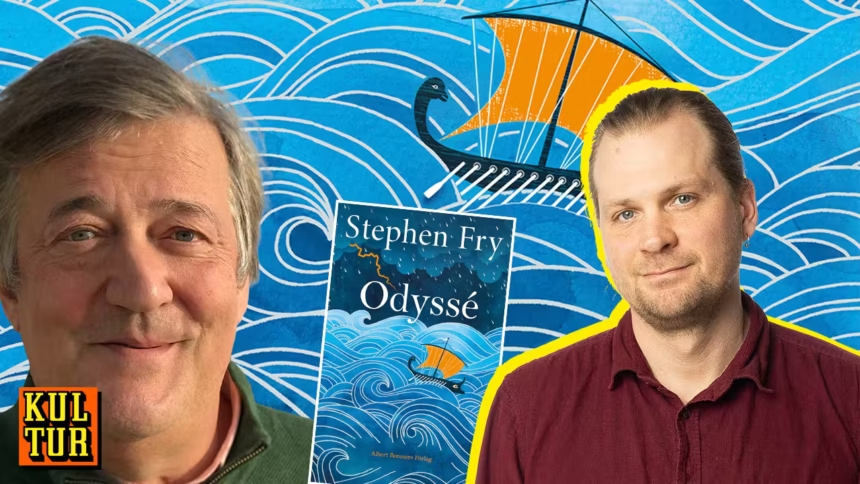
“Odyssey” by Stephen Fry
It is antique summer, The Mediterranean is bustling with tourists and the cinemas hope that Christopher Nolan will once again save them with the movie “The Odyssey”. But the 2,700-year-old story is a mess, and if you’re into the ancient Greeks, you might need a pop-culture sorting out of it. Enter: the comedian, writer and Hellenophile Stephen Fry.
Fry’s “Odyssé” is Homer epic retold, but scrubbed clean of cryptic references, neatly swept into footnotes during the story. It is his fourth book in the antique series, and in Swedish there is previously “Mythos”. The project has something old-fashioned about it – things like teaching uncles with names like Alf Henriksson used to deal with – but with Fry you don’t get the discreetly formed chuckle over “the crazy customs of the olden days”. This is “The Odyssey” retold – plain and simple.
“The Odyssey” was added on 7th century BCE Fry claims that “Homer” is probably a collection of rhapsodes that created the story orally over a long period of time. But according to the philologist Alexander Andrees newly published “The Fates of Dead Poets”, the researchers increasingly agree that both the “Odyssey” and the “Iliad” were composed by one person. However, not of the same. “The Iliad” – which depicts the Greek equivalent of the Second World War (the war against Troy) – is a straight story about the wrath of Achilles. “The Odyssey” – which portrays the post-war period – has a more elusive, ambiguous and complicated hero. Unlike “The Iliad”, it also does not stick to the unity of time and space, but constantly looks forward and backward – which gives the impression of a modern, novel-like work. Or for that matter: cinematic.
Why should one trudge through Homer? Well, try reading only the first two songs of the “Odyssée”. There, Odysseus’ son Telemachus meets Athena in disguise – Mentor – who urges him to gather an army of warriors on the island of Pylos. Once there, Telemachus meets the wise king Nestor. And yes, the words “mentor” and “nestor” come from here. Then skip to the section where Odysseus sails between Scylla and Carybdis. You’ve probably heard the saying, but did you know that Skylla is a six-headed monster and Karybdis a sea monster that creates a maelstrom?
You can keep going like that. Reading “The Odyssey” is like upending our entire culture’s root system and looking at it. It is the most overwhelming flow of infotainment you can experience as a person with a thirst for knowledge. And it’s certainly not just “high culture” that you get at rocket speed. Take the TV series “The Boys” with its spoiled, violent and impatient superheroes – what are they if not modeled after the moody Greek gods? Or the filmmaker Hayao Miyazaki’s breakthrough “Nausicaä”. Of course it is the name of the Fajakian princess in “The Odyssey”.
Fry succeeds in parts capture the most moving aspects of the story. We can feel Odysseus’ homesickness when he almost returns home to Ithaca, but is thrown out to sea by an angry Poseidon. We can be appalled with Penelope at the forced marriage that the suitors are trying to subject her to. No one who has read “The Odyssey” can claim that man was particularly different 2,700 years ago – and this is palpable with Fry.
Nevertheless, I feel that you come much closer to Odysseus in Homer’s original, through all the sensual details that Fry stripped away. As in the fifth canto where Homer describes Odysseus’ torn skin stuck to a rock outside the island of the Phaeacians after a storm. You can still feel the pain and despair. The episode is like a direct link into the consciousness of the boat refugees in the Mediterranean.
Overall, I understand not the point of Fry’s “Odyssé”. He doesn’t like Annika Thor in “Odysseus’s boy” stripped away the side stories and reduced the supporting characters. Thus, it is not a simplification of “The Odyssey”. And why is such a retelling needed when the original exists? In addition, is Molle Kanmert Sjölanders Substandard translation. A man is described as “muscular” – what kind of horrible Anglicism is that? When Skylla grabs Odysseus’s crew, it is called “the disgusting death of the six able-bodied men”. “Capable men” it’s called, for the bully. In another place it is said that Odysseus is “losing his riches”. It sounds like Google Translate at its worst.
Want to load up for Nolan’s movie? Then go directly to the original. Hexameter doesn’t sound very beautiful in Swedish, though Ingvar Björkesons translation from 1995 is down-to-earth and easy to read. If you want to read to an older child, Fry’s book is too complicated – choose instead Thor’s elegant simplification of the story, seen from Telemachus’ perspective. Fry’s “Odyssé” appears as a superfluous commentary track in comparison. A noise from the waves hitting the shores of Ithaca.
Rasmus Landström is Aftonbladet’s literature editor.
GREEK MYTHOLOGY
» Odyssey
Stephen Fry
Trans. Molle Kanmert Sjölander
Albert Bonnier’s publisher