
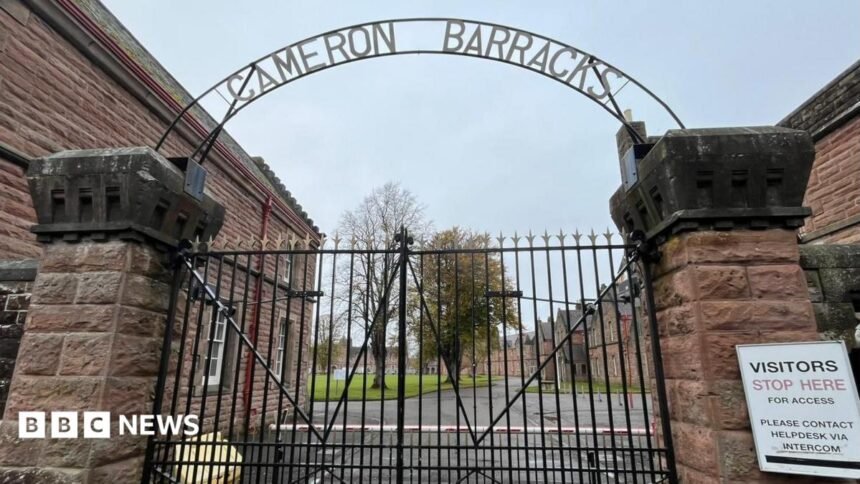

Asylum seekers were due to start arriving at Inverness’ Cameron Barracks in December
Asylum seekers were due to start arriving at Inverness’ Cameron Barracks in December
A scheme to house up to 300 male asylum seekers at Cameron Barracks in Inverness has been dropped by the UK government, according to a Highland MP.
The Home Office originally wanted to move people into the barracks by early December and use the site for 12 months, but the plans were delayed.
Angus MacDonald, Lib Dem MP for Inverness, Skye and West Ross-shire, said he has been told by UK Border Security Minister Alex Norris that the plan has been dropped.
The UK Government wanted use the site as part of drive to close asylum hotels, which led to campaigns in support and in opposition.
MacDonald said: “This is the right outcome, and it is a result of the strength of feeling shown by residents, and by the military families connected to Cameron Barracks who made their concerns heard from the very start.”
He added: “There was also a strong local feeling that the site itself was simply too close to the city centre, schools and residential areas.
“The sense of closing asylum hotels in town centres in the South of England while opening an Inverness asylum barracks similarly poorly located defied logic.”
An asylum seeker is someone who wants to be in the UK because they say they cannot live safely in their own country due to persecution or violence.
The government must house an asylum seeker if they cannot financially support themselves while their claim is being considered. There were 93,653 people in asylum accommodation as of March 2026.
About 22% of those people, 20,885, were in hotels. These are used when there is not enough shared housing available, such as houses of multiple occupation (HMOs) or former military sites.
The government has pledged to stop the use of hotels by 2029.
More people are in hotels across the south of England than elsewhere in the UK, while HMOs are more common in the north of England and Scotland.
A modern browser with JavaScript and a stable internet connection is required to view this interactive
Type in a postcode or the name of a local council below to see how many asylum seekers are housed in the area
A total of 93,525 people applied for asylum in the UK from April 2025 to March 2026. This was down by 12% on the same period in the previous year.
Most people who arrive in the UK by small boat claim asylum, but they were only 42% of all asylum seekers from April 2025 to March 2026.
The rest include people who arrived by other illegal means or who came to the UK legally and applied for asylum while holding, or just after holding, a valid visa.
It can take years for the government to decide whether someone should be granted asylum.
In March 2026, 48,758 people – across 35,744 asylum applications – were waiting for an initial decision. The number of people awaiting an initial decision was down by 55% on the previous year.
As of March 2026, a further 87,450 refused asylum applications were part of a second backlog, waiting the outcome of an appeal in the courts. This was up by 72% on the previous year.
Together, these initial decision and appeal cases form the government’s total asylum applications backlog, which it has pledged to clear.
Refugee status was granted in about 39% of asylum decisions made by the Home Office from April 2025 to March 2026.
About 39% of asylum appeal cases concluded between April 2025 to March 2026 resulted in a previous refusal decision being overturned.
In early December people took part in demonstrations near the 140-year-old base in Inverness city centre.
One was organised by Highlands Against Hate, which supports refugees coming to Scotland, and another involved supporters of anti-illegal immigration group Peterhead United.
A potential stumbling block to the proposals was that Highland Council believed the barracks would need to be licensed as a house of multiple occupancy.
Usually, an HMO is a property rented out by at least three unrelated people who share the bathroom or toilet and kitchen.
A licence can last for three years.
In March, Highland Council said it had initial discussions with the Home Office on an HMO, but it had not received a licence application.
Cut costs
The UK government previously said it was “furious” at the level of illegal migrants and asylum hotels.
Elsewhere, Asylum seekers have moved into Crowborough training camp in East Sussex.
A spokesperson told BBC Scotland News earlier this year: “This government will close every asylum hotel.
“Work is well underway, with more suitable sites, such as military bases, being brought forward to ease pressure on communities and cut asylum costs.
“We are working closely with local authorities, property partners and across-government so that we can accelerate delivery.”
The Home Office has been asked for a comment.
It is an offence to come to the UK without permission, although international law says refugees should not be penalised for illegal entry.

The barracks are about 140 years old
The barracks are about 140 years old
Scotland’s social justice secretary, Shirley Anne Somerville, said the Scottish government – along with Highland Council and NHS Highland – repeatedly raised questions around the practical suitability of the site.
She said: “The UK government failed to adequately answer these questions.
“The reported decision not to proceed is in the best interests of the local community and the people who would have been accommodated at the site.”
Somerville said Scotland had a long history of welcoming people of all nationalities and faiths, including those seeking refuge and asylum from war and persecution.
Highland Council said it had received no written confirmation of the UK government’s plans.
Scottish Conservative MSP for the Highlands and Islands, Tim Eagle, said Inverness residents would be relieved that the UK government had “finally seen sense and abandoned this misguided plan”.
Related topics
Fresh clarity call over barracks asylum seeker plans
Barracks asylum plan presents complex challenges, says council
Opposing rallies take place over Inverness barracks asylum plans