Published on 6/24/2026
|
Last update: 11:48 (Mecca time)
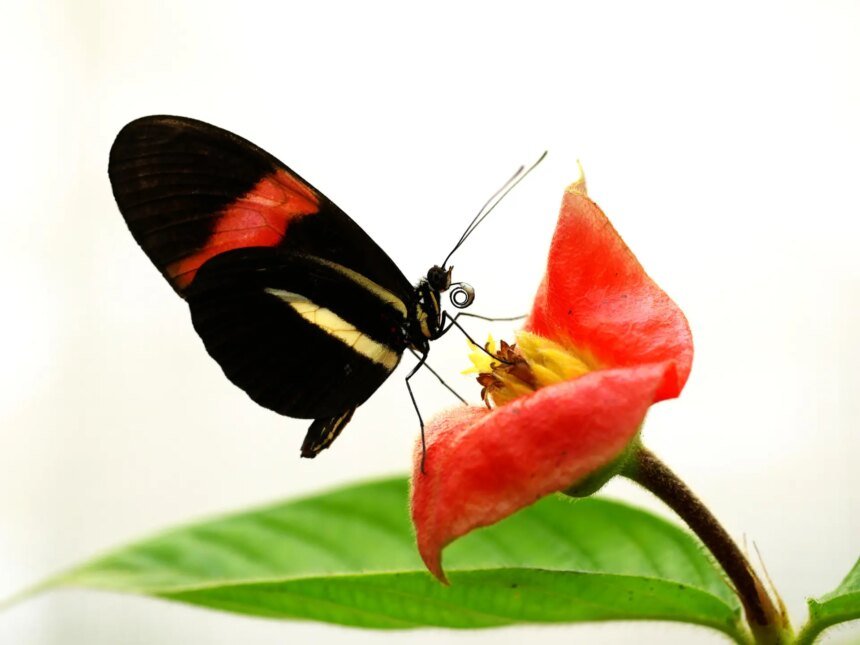
In the tropical forests of Panama, the lives of butterflies at first glance seem short and fleeting; They emerge from their cocoons with colorful wings, fly among the flowers, mate, lay eggs, and then quickly disappear.
But some butterflies do not follow this rule; They do not live only a few days or weeks, but their lives may extend for many months, an unusual lifespan among butterflies.
A new study indicates that the secret may lie in a rare dietary habit, which is eating pollen. Researchers found that butterflies of the genus Heliconius developed longer lives and slower aging compared to their close relatives, not because of a single gene or simple factor, but rather as a result of a long interaction between food, evolution, and body functions.
The authors of the study, published June 16 in the journal Nature Communications, collected data from commercial butterfly houses, tag-release and re-monitoring experiments in semi-natural settings, and laboratory experiments at insect breeding centers. Through these various sources, researchers found that some Heliconius species may live for periods approaching a full year, which is a very long lifespan by butterfly standards.

Unfamiliar food and longer life
The study shows that some relatives of these butterflies do not live more than a few weeks, while the longest lifespan recorded in one of the Heliconius species reached 348 days. The team found that butterflies that feed on pollen live, on average, about three times longer than their relatives that do not.
“This is an unusual feeding habit among butterflies,” says Jessica Foley, lead author of the study and a researcher at the University of Bristol’s School of Biological Sciences. “Many adult butterflies rely mainly on flower nectar, a sugar-rich food that gives them energy. Pollen, on the other hand, contains more complex nutritional components, including proteins and amino acids, which may help the body maintain and repair for a longer period.”
Jessica explains in statements to Al Jazeera Net that pollen not only gives the butterfly energy to fly, but also substances that help it maintain its body as it ages.
The team focused on two species: the first is the Heliconius heikali butterfly, which feeds on pollen, and the Dryas aeolia butterfly, a close relative that does not depend on pollen in the same way. The researchers then placed the butterflies in two feeding experiments; One group received pollen, and the other was deprived of it.
The results revealed that the butterflies that received the vaccine lived an average lifespan of 63 days, compared to 47 days for the group that was deprived of it. But even when she was deprived of the vaccine, she continued to live much longer than her relative, who almost did not benefit from adding the vaccine to her diet.
According to the study, this means that pollen does help prolong life, but it does not explain the whole story. There appear to be deeper evolutionary changes that make Heliconius butterflies able to delay aging and maintain their body functions for a longer period.

Slower aging, not just longer life
To find out how this manifests itself in the body, the researchers measured the butterflies’ body mass and grip strength with age. The lead author of the study explains that weight loss and muscle weakness are clear signs of physical deterioration; Hence, the study found that Dryas aeolia butterflies lost mass and strength with age, while Heliconius heikali maintained their grip strength even at advanced ages.
Depriving Heliconius heikali of pollen increased weight loss and made it generally weaker, but did not eliminate its main advantage: slow aging. This suggests that the vaccine is an important part of the story, but it works within a biological system that originally evolved to support longer life.
The team sees these results as a new door to studying aging in nature. Rather than focusing solely on familiar laboratory organisms like the fruit fly, the researchers suggest that Heliconius butterflies may become an important model for understanding how evolution can extend “healthy lifespan,” the period during which an organism retains its strength and ability to move and reproduce, not just stay alive longer.
However, the researchers point out that some age data came from commercial butterfly houses and unpublished records, and the maximum age may be affected by sample size and the presence of rare, very long-lived individuals; Therefore, comparison between species needs to be done with caution, especially when based on records from different sources.
The transition to feeding on pollen occurred only once in the history of this group, which makes proving a causal relationship between pollen and longevity statistically difficult. When a trait appears only once in a family tree, it becomes difficult to separate the effect of food from the rest of the evolutionary characteristics that characterize the same group.