The Trump administration and a company that is promising to bring long-gone animals back from extinction announced a partnership on Thursday to preserve cells, tissue and DNA from threatened and endangered species.
The company, Colossal Biosciences, said its goal was to store samples from every animal and plant protected under the Endangered Species Act, which includes more than 2,300 listings worldwide.
As more species face the risk of extinction, scientists see such biobanks as a critical backup. But concerns are also growing that the rise of genetic engineering and de-extinction efforts will erode support for on-the-ground conservation, which often requires protecting habitat from drilling, mining and other development.
The announcement comes as the Trump administration has been rolling back protections on land and water in favor of expanded oil and gas exploration, commercial fishing and other economic activities.
“This partnership brings together the scientific expertise of the U.S. Fish and Wildlife Service and the ingenuity of the private sector to develop new tools that can help recover species, preserve critical genetic resources, and strengthen the future of wildlife conservation,” Doug Burgum, the interior secretary, said in a statement.
Under a memorandum of understanding, Colossal and the Fish and Wildlife Service will collaborate to identify high-priority actions, and the government will provide a list of which species it wants to prioritize.
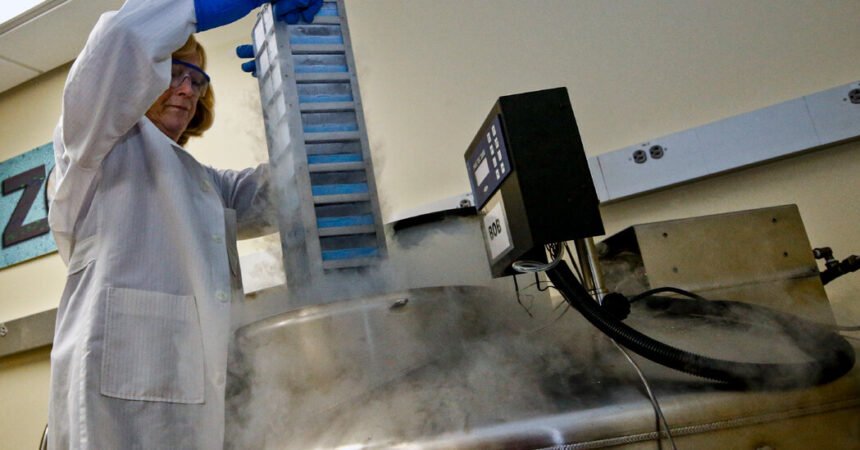
Federal biologists will typically collect the samples, Colossal executives said, noting that the company would also send out collection teams if needed. After the material is gathered, Colossal will analyze and store it. The government would not pay the company, said Ben Lamm, the chief executive of Colossal, which is based in Dallas.
“This is tens of millions of investment on our part,” Mr. Lamm said.
The company will have the right to access the biobanked material for research, including “biotechnology development,” according to the memorandum. The agreement will remain in effect for five years, but can be unilaterally terminated by either party. If the memorandum is terminated, Colossal will retain all the samples it collected with its own funding, equipment, or personnel.
Storing biological samples is hardly new. Zoos and other organizations have worked closely with the Fish and Wildlife Service for decades, banking cells from animals and seeds from plants. But some conservation biologists expressed worries about depending so much for the long-term guardianship of precious samples on a private company.
“It seems like a bit of a risk for the U.S. government to place biomaterials in a for-profit company that doesn’t have a very long track record,” said Oliver Ryder, a conservation geneticist at the San Diego Zoo Wildlife Alliance, which operates a storage effort called the Frozen Zoo that has been preserving cells for about 50 years.
Colossal Biosciences launched in 2021 with a mission to bring the woolly mammoth back from extinction. Since then, it has revealed efforts to “de-extinct” other species, including the dodo and the Tasmanian tiger. The company’s plan is to edit the DNA of closely related living species to create animals with key features of their lost cousins.
Last year, Colossal received both accolades and scrutiny when it claimed that it had revived the extinct dire wolf. Many scientists pushed back, pointing out that the animals were simply gray wolves with a smattering of altered genes that made them resemble dire wolves.
Concerns that genetic engineering would replace critical conservation work heightened when Mr. Burgum, the interior secretary, celebrated the company’s announcement on X, writing that “the marvel of ‘de-extinction’ technology can help forge a future where populations are never at risk.” The Fish and Wildlife Service is part of the Interior Department.
Colossal executives emphasize that their efforts are intended to add to conservation strategies, not supplant the important work of protecting habitat.
After beginning its de-extinction efforts, Colossal branched out into biobanking. In February, the company announced a partnership with the United Arab Emirates to build what it calls a BioVault in Dubai, intended to store cell and tissue samples from more than 10,000 species.
Biobanks have long enabled scientists to study the biology of animals and plants. More recently, they’ve also played a growing role in conserving endangered species. The Frozen Zoo, overseen by Dr. Ryder, has thawed frozen cells from black-footed ferrets to create new clones that can build up the species’s genetic diversity.
Gabriela Mastromonaco, chief science officer at the Toronto Zoo, called the U.S. plan laid out in Thursday’s announcement hugely ambitious.
“To collect every threatened and endangered species, that is a massive endeavor,” she said. “That means tracking, trapping, immobilizing, and getting your hands on a lot of animals.”
She expressed concern that the initial announcement was short on planning details that would be standard in many other nations.
The company will work with Fish and Wildlife biologists to get samples from the wild and bring them to their headquarters in Dallas for storage, according to Matt James, chief animal officer at Colossal. Eventually, samples would also be stored in other Colossal-owned facilities around the world, to create redundancy.
The company will sequence the genomes of the species they store, he said, and make them freely available online for research.
Mr. Lamm, the Colossal chief executive, said he was motivated to invest tens of millions of dollars in the effort for “public good and impact.”
He dismissed the possibility that a company like Colossal might eventually decide that biobanks are not part of their business plan. “I think it’s more likely that a company with the right capital resources has a higher likelihood of long-term preservation,” he said.
Colossal is valued at more than $10 billion. It currently gets revenue from cloning pets and horses through a company it acquired last year, and claims to have future sources of revenue from licensing technology it develops for its de-extinction projects.
Dr. Mastromonaco of the Toronto Zoo said the announcement left many questions unanswered, such as how Indigenous communities would participate in decisions about the program and the rules for who gets to use the samples for research. She said she was addressing these questions herself as Canada develops its own plan for biobanking wild species.