Published on 6/20/2026
Archaeologists in eastern Mexico have discovered the remains of a building and a sculpture bearing unprecedented characteristics, in a discovery that President Claudia Sheinbaum described on Friday as “extremely important.”
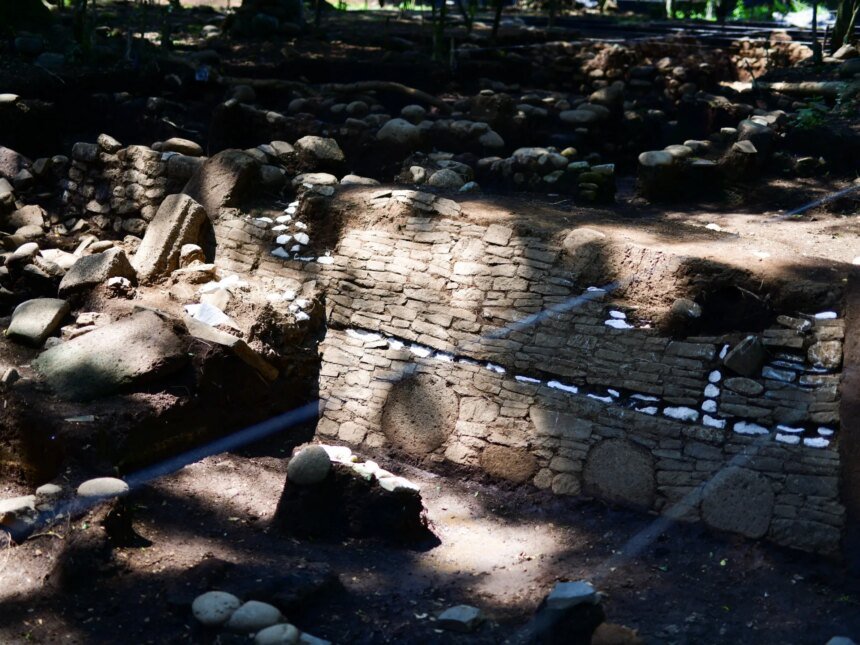
The discovery represents a platform whose sides are decorated with circular stones, different from what has been discovered so far in this Mexican region. A huge stone block was also found bearing an inscription of a figure with features likely belonging to the Mayan civilization, according to the National Institute of Archeology and History.

The Mexican President pledged that her government would allocate resources to conduct research related to the discovered antiquities and their restoration.
“It is a unique discovery, like no other,” Lino Espinoza García, an archaeologist at the National Institute of Archeology and History and one of the coordinators of the Campo Viejo site in Coatepec, Veracruz, told reporters.
The ruins, dating back to the Early Classical period (between 200 and 600 AD), include an architectural composition of panels and limestone, decorated with lines or square-like shapes, in addition to circular stones. The institute explained in a statement that these characteristics are not common in the region and have not been documented before.

“It’s an extraordinary installation,” said Alberto Vasquez, another archaeologist in charge of the site.
The block is a stone plaque measuring 1.88 meters high and 1.47 meters wide, with a thickness ranging between 22 and 25 centimeters, and two figures appear on it.
The Maya civilization is considered one of the greatest civilizations that flourished in Central America and southern Mexico, as its roots extended back to more than three thousand years BC.
This civilization reached its peak during the Classic Age, extending between the third and tenth centuries AD, when the Maya built magnificent architectural cities, developed a writing system, and excelled in astronomy, mathematics, and calendar time.
The state of Veracruz, located on the coast of the Gulf of Mexico in the east of the country, was a region historically characterized by the multiplicity and intermingling of civilizations, as well as being a vital commercial and cultural corridor between the peoples of central Mexico and the Maya civilization in the Yucatan Peninsula.
Archaeological studies have revealed the influences of the Maya civilization on the Veracruz region, especially in arts, architecture, and sculpture styles.
The new discovery at the Campo Viejo site in Coatepec is of great importance, as it dates back to the Early Classic Period between 200 and 600 AD, the same era that witnessed the beginning of the Maya civilization’s prosperity and expansion beyond its geographical center on the Yucatan Peninsula.