
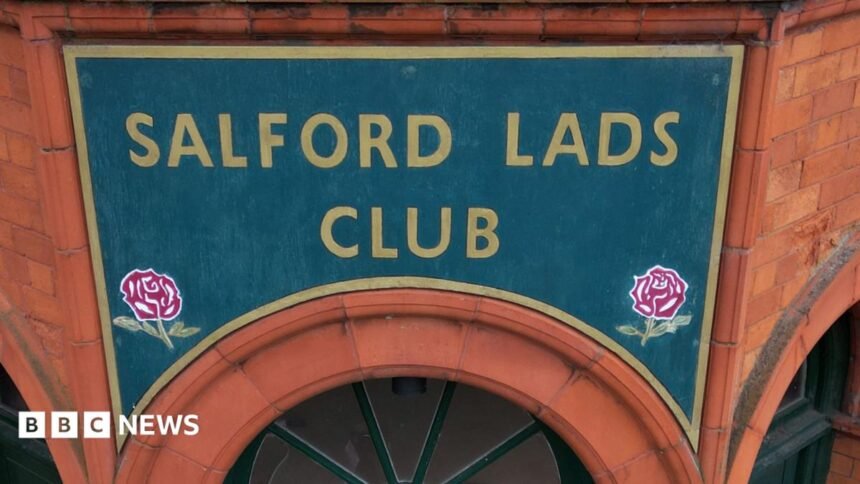

The Salford club was designed by architect Henry Lord and established in 1903
The Salford club was designed by architect Henry Lord and established in 1903
A “remarkable” 123-year-old youth club building made famous after The Smiths posed outside it for a photo shoot has had its listed status upgraded to Grade II*.
Salford Lads Club opened on Coronation Street in the city in 1903 and has helped generations of boys – and later girls – by offering activities such as sport, art and music.
The upgrade came less than two years after a campaign to save it from closure raised £250,000, which included donations from former Smiths singer Morrissey and music legend and former club member Graham Nash.
Leslie Holmes, culture and heritage projects manager at the club, said it was what he had been working towards “since I first came into the building in 2002”.
The Salford club was designed by architect Henry Lord and established in 1903, with its official opening happening in January 1904, and it first received Grade II listed status in 2003.
It was initially part of a federation of lads clubs in working class communities across the UK, but the majority of the others closed between World War One and World War Two.

Laura Slingsby (left, with Claudia Kenyatta) said the club was “incredibly proud”
Laura Slingsby (left, with Claudia Kenyatta) said the club was “incredibly proud”
It holds records for all its members past and present, which included Nash and his former Hollies bandmate Allan Clarke.
It became internationally known when it provided the backdrop for a photo of The Smiths, which was used on posters, promotional material and the inner sleeve of their most successful album, 1986’s The Queen Is Dead.
Holmes said the creation of The Smiths room and the archive room at the club had enabled it to showcase its unique cultural importance and attract thousands of visitors every year, many of whom had recreated that famous Smiths photo.

The dedicated Smiths room has proved a draw for fans of the band
The dedicated Smiths room has proved a draw for fans of the band
The club’s chief executive Laura Slingsby said they were “incredibly proud” of the listing upgrade, adding that the recognition had helped “secure its future for generations to come”.
“This is a tribute, not only to the building itself, but to the generations of members, volunteers and staff who have kept it at the heart of the community for more than 120 years,” she said.
Salford City Council’s heritage lead Hannah Robinson-Smith said the building held “such a special place in many residents’ hearts” and had “played a huge role in so many people’s lives”.

Crossley House was opened as Crossley Lads’ Club in 1912
Crossley House was opened as Crossley Lads’ Club in 1912
The club was not the only one in Greater Manchester celebrating good news from Historic England (HE).
Crossley House in Openshaw, Manchester, which was formerly the Crossley Lads’ Club, has been added to the National Heritage List for England at Grade II.
Built in 1912 as a memorial to industrialist and philanthropist Sir William Crossley, HE said it was a “rare and important survivor” and its architecture and innovative construction made it nationally significant.
Designed by John Broadbent, it combines an Edwardian Baroque front with a rare early reinforced-concrete frame and still has many of its original features, including its gymnasium, lecture theatre, running-track gallery, parquet floors and decorative concrete structure.
HE said the Department for Culture, Media and Sport’s decision, which followed its advice, recognised the two rare surviving examples of purpose-built lads’ clubs.
HE’s Emma Squire and Claudia Kenyatta said the “two remarkable buildings tell the story of a movement that transformed opportunities for generations of young people”.
Get in touch
Tell us which stories we should cover in Greater Manchester
Listen to the best of BBC Radio Manchester on Sounds and follow BBC Manchester on Facebook, external, X, external, and Instagram, external. You can also send story ideas via Whatsapp to 0808 100 2230.
Related topics
Salford Lads Club – what happens next?
Johnny Marr to auction guitars he played with The Smiths and Billie Eilish
City’s famous youth club could close ‘next month’
Related internet links
Department for Culture, Media and Sport
Historic England
Salford Lads and Girls Club