Published on 6/25/2026
|
Last update: 11:37 (Mecca time)
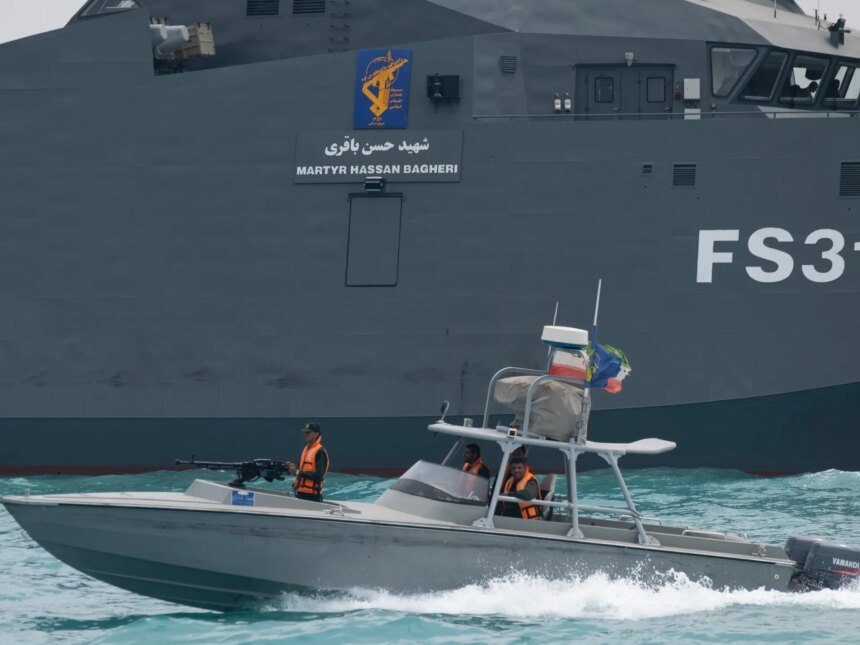
Today, Thursday, the Iranian Revolutionary Guard Navy warned against ships sailing outside the routes specified by Iran in the Strait of Hormuz, noting that any new corridor announced without coordination with it is considered “unacceptable and entails extreme danger.”
The Iranian Fars Agency quoted the Revolutionary Guards Naval Force as saying that “some parties” announced a new route without informing Tehran, stressing that safe crossing and the only permitted route through the strait is the one determined by Iran.
The Revolutionary Guard confirmed that coordination with it is mandatory for ships to transit through Hormuz, warning that it will take measures against violating ships.
Oman announces a corridor in Hormuz
The Iranian warning came after the Sultanate of Oman announced that it would allow the use of a temporary sea lane for all ships wishing to cross the Strait of Hormuz in coordination with the International Maritime Organization, according to what was reported by the Omani News Agency.
The official agency explained that the decision – which was taken on Tuesday – was based on the Sultanate’s firm commitment to the principles of international law and the law of the sea, which guarantees freedom of navigation in the strait without imposing transit fees and is consistent with the results of the efforts and endeavors reached recently by America and Iran.
Yesterday evening, Wednesday, the official account of the Maritime Security Center in the Sultanate of Oman on the X platform published a guide map for ships wishing to cross the Omani corridor in the strait.
Movement to regulate navigation
The political and diplomatic arena is witnessing an intense movement to reorganize navigation in the Strait of Hormuz and ensure the continued flow of oil and gas without obstacles or additional fees, amid differences in positions regarding the mechanisms for managing this vital artery through which about 20% of global energy trade passes.
Yesterday, Wednesday, US Secretary of Energy Chris White confirmed that the return of global oil flows to normal was delayed during the recent period as a result of the sea mines that the United States accused Iran of planting in the Strait of Hormuz, stressing that Tehran is no longer able to close the strait to international shipping traffic as before.
NATO Secretary-General Mark Rutte said that a number of European allies deployed naval vessels near the Strait of Hormuz to contribute to mine clearance operations and secure shipping lines, in a move aimed at facilitating the crossing of commercial ships and ensuring the continued flow of energy supplies through the strategic corridor.
Navigation data indicate a noticeable improvement in the movement of ships through the Strait, coinciding with Oman’s announcement of the opening of a temporary sea lane through the Strait in coordination with the International Maritime Organization, in a step aimed at organizing the movement of ships and ensuring their safe passage without imposing transit fees.
This initiative is based on Muscat’s commitment to the principles of international law and the law of the sea, with a focus on ensuring freedom of navigation as an international right not subject to blackmail or political restrictions.
Oman also called on ships wishing to cross the Strait to coordinate in advance with the International Maritime Organization to ensure the smooth flow of navigational traffic and adherence to approved safety procedures.