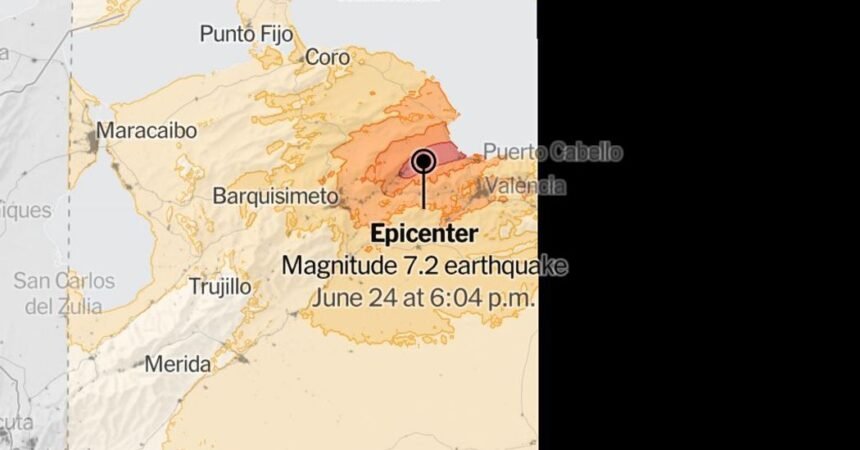
The magnitude 7.5 earthquake in Venezuela on Wednesday was the largest to strike the country or just off its coast since 1900, according to the U.S. Geological Survey.
A magnitude 7.7 earthquake was recorded near the coast of the South American country on Oct. 29, 1900, according to the U.S.G.S. catalog.
Because recordings of this quake from modern instrumentation were not available, that magnitude calculation is based on reports of damage and effects in the area, said Paule Earle, a geophysicist with the U.S.G.S.
The so-called San Narciso Earthquake of 1900 shook Caracas early in the morning, killing 21 people and injuring 50 more while toppling churches, public buildings and homes across the city, according to an impact report from the agency.
The New York Times received details of the massive quake more than two weeks later and reported on Nov. 17, 1900 that “some 300 buildings collapsed, the tower of the university and several church spires fell, and the Government buildings were more or less damaged.”
A large number of Venezuelans were left to live in tents, The Times reported.
The U.S.G.S. estimated that Wednesday’s quake, which was preceded by a magnitude 7.2 earthquake, could be far deadlier than the one in 1900, though the human toll and the scale of the damage were not yet clear. Experts said the two quakes were related, describing the 7.2-magnitude quake as a foreshock and the 7.5 one as the main shock.
“An earthquake can cause stress changes in the ground and that can cause other earthquakes, which is likely what occurred in Venezuela,” said William Barnhart, a geophysicist with the U.S.G.S.
Venezuela sits between the South American and Caribbean tectonic plates so, earthquakes are somewhat common, he added.
Venezuela has been struck by other earthquakes of magnitudes of 7.0 and above. A magnitude 7.3 quake struck on Aug. 21, 2018, and a magnitude 7.0 quake was recorded on July 9, 1997.