Published on 6/24/2026
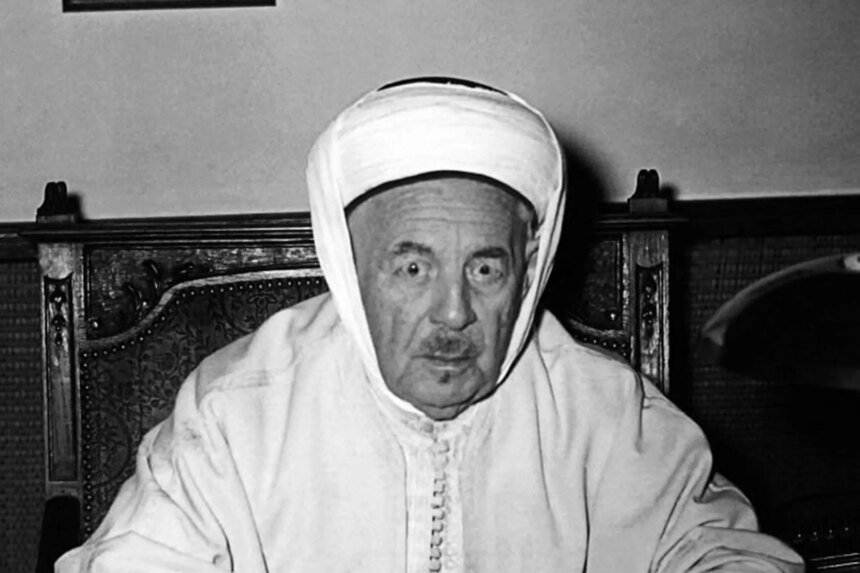
Abdelkader (Kaddour) Ben Ghabrit was an Algerian diplomat, translator, and religious figure. He was born in 1868 and died in Paris on June 24, 1954. He was famous for his role in the course of relations between France and the Islamic world during the French colonial period. He was the first dean of the Grand Mosque of Paris and one of the most prominent contributors to its founding.
His positions sparked widespread controversy during his life and after his death, because of his close relationship with the French colonial authorities and his positions in support of some of their policies.
His name was also linked to the role of the Grand Mosque of Paris – during his administration – in helping Jews persecuted by the Nazi occupation of France, by providing them with protection, shelter, and documents, which added more complexity to his historical picture.
Generator and configuration
Abdelkader Ben Ghabrit was born on November 1, 1868 in the city of Sidi Bel Abbes, Algeria, to a family whose origins are from the city of Tlemcen.
He received a distinguished education in his childhood and youth. He studied at the Tha’alibi School near the shrine of the jurist and interpreter Abd al-Rahman al-Tha’alibi, then he moved to the city of Fez to study at the University of Al-Qarawiyyin. Thanks to this educational path, he succeeded in acquiring a solid and dual language training in Arabic and French.

Leader and diplomat
Ben Ghabrit began his professional career by taking advantage of his linguistic skills. He worked as a judicial translator in Algeria, and then moved to work in the Moroccan administration, which was then looking for qualified “school” graduates. To contribute to the implementation of administrative reforms launched by King Hassan I.
Thanks to his academic training and mastery of languages, in 1904 he opened a French-Arab school in the city of Tangier.
He also assumed official translation duties, and was an essential link between the Moroccan palace and the French authorities, and played an important role in the negotiations and political communications that preceded the imposition of French protection on Morocco.

As his administrative influence expanded, he was appointed Director of the Noble Protocol, a high position that was responsible for supervising official ceremonies and organizing relations between the Royal Court and foreign delegations. He also rose to the rank of Minister Plenipotentiary, which was one of the highest diplomatic ranks at that time.
His roles were not limited to the administrative and diplomatic fields, but rather extended to political and cultural tasks with an international dimension. He participated in several official missions and missions, including joining the French mission that went to the Hijaz in 1916 to perform the Hajj, which reflected the appreciation of the French authorities for his competence and political role, especially Resident General Hubert Lyautey.
These accumulated experiences formed the basis for the position he later occupied in France, as he became one of the most prominent Islamic and diplomatic figures in Europe, and he crowned his career by contributing to the founding of the Grand Mosque of Paris.
Grand Mosque of Paris
Ben Ghabrit is considered the central figure behind the establishment of the Grand Mosque of Paris, as he laid the legal foundation for the project when he established in 1917 the “Society of Endowments and Holy Places of Islam,” before amending its goals in 1920 to include building an institute and a mosque in the French capital.
Through this project, he sought to create a landmark that symbolizes the friendship between France and the Islamic world, and commemorates the sacrifices of Muslim soldiers who participated in World War I.
Thanks to his extensive relationships and political standing, Ben Ghabrit was able to mobilize official and financial support for the project. It received the sponsorship of senior French officials, and the French Parliament approved a special budget for the construction of the mosque. Under his supervision, construction work began in 1922, before the mosque was officially opened on July 15, 1926.
His role was not limited to the founding, but he took over the management of the Islamic Institute and the Grand Mosque of Paris from the launch of the project until his death in 1954, transforming it into a prominent religious and cultural center for Muslims in France.

Controversial trends
Abdelkader Ben Ghabrit’s political and religious positions sparked widespread controversy in Maghreb and Arab national circles, as his name was associated with close relations with the French authorities during the colonial era. His critics accused him of adopting positions consistent with French policies, taking advantage of his religious and administrative status to defend their orientations.
Among the positions for which he was criticized: his support for the French forces’ bombing of the city of Damascus in 1925 during the suppression of the Great Syrian Revolt. He was also known for his opposition to the movements against French colonialism, and his refusal to grant the podiums of the Grand Mosque of Paris to activists calling for the liberation of Islamic countries from colonial control.
In the Algerian context, he was criticized for his negative stance on the Algerian National Movement, and for classifying the National Liberation Front as a terrorist organization.
These positions led to a decline in his popularity in Algerian national circles, and he was accused of cooperating with the colonial administration and serving its interests. He was also criticized by a number of figures of the reformist and nationalist movement, including Sheikh Abdelhamid Ben Badis, who considered him one of the figures who harnessed his religious status to serve the colonial project.

One of the most controversial aspects of Ben Ghabrit’s biography is the narratives related to the role of the Grand Mosque of Paris during the Nazi occupation of France between 1940 and 1944. As the dean of the mosque and the primary person responsible for its administration, his name was associated with the efforts made to Jews who were threatened with arrest and deportation, through various means that included granting some of them identity cards and documents proving their affiliation to Islam.
Stories also spoke of the mosque’s administrators – under the administration of Ben Ghabrit – resorting to claiming that some of its residents were infected with tuberculosis and were receiving treatment, which prompted German soldiers to avoid searching the place or checking the identities of those inside it.
Other accounts indicate that a port linking the mosque to the Paris tunnel network was used to help some fugitives move away from the supervision of the Nazi authorities. The testimonies add that the mosque received Jews fleeing concentration camps and provided them with shelter, food, clothing, and medical care.
These efforts were not limited to Ben Ghabrit alone, but a number of imams, doctors, and administrators participated in them.
Death
Kaddour Ben Ghabrit died in Paris on June 24, 1954, at the age of about 86 years.