April Lo remembers when the most coveted real estate in Taiwan was farmland.
When she moved to the area 16 years ago, there were no department stores, office parks or fine-dining restaurants.
“It was very desolate,” she said.
Today, nothing could be further from the truth. The rice fields have given way to Hsinchu, home to Taiwan Semiconductor Manufacturing Company and ground zero for an industry driving the global economy: the production of the advanced computer chips powering the artificial intelligence boom.
As Taiwan’s semiconductor industry took off, TSMC made chips that drive virtually every kind of electronic device. That includes the sought-after A.I. accelerators designed by Nvidia, the world’s most valuable company. Farmers were gradually priced out of the area by factories, offices and luxury high-rises. The high-speed rail linking Taiwan’s largest cities now carries 80 million people a year through Ms. Lo’s backyard.
In northern Hsinchu, an area known as Zhubei, real estate prices have skyrocketed as buyers compete for spots on yearslong waiting lists for new apartments near Hsinchu Science Park, where TSMC has headquarters. Plastic surgery clinics, upscale restaurants and boutique fitness studios have sprung up to serve tech workers flush with A.I. riches.
Over the past six years, households near Hsinchu Science Park have reported some of the highest incomes in Taiwan. In one neighborhood, average household incomes exceeded $146,000 in 2023 — about five times Taiwan’s average.
The prosperity has given rise to the so-called Zhuke Mama: a woman whose husband works in the lucrative semiconductor industry, allowing her time for pursuits like going to Pilates classes, shopping for vacation homes in Thailand and managing their children’s academic advancement.
While the rest of Taiwan and much of East Asia are grappling with a sharp population decline, so many children have been born in Hsinchu in recent years that the schools cannot keep up. Public high schools in the area now admit only students with sufficiently high test scores, a practice that Ms. Lo and a group of mothers have protested. Those who do not make the cut must commute to another school district.
“The population exploded,” Ms. Lo said. “It became very competitive.”
Today, Hsinchu is home to more than one million people, and those without ties to the technology industry have largely been priced out. The wealth generated by semiconductors has not translated to wage gains in other industries. While chips are driving record exports, the headline numbers mask a widening divide between those connected to the industry and everyone else.
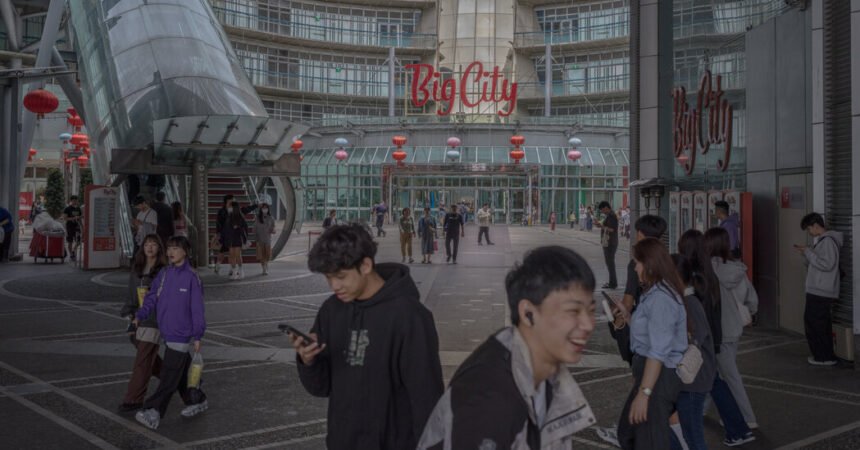
The local shopping mall, Big City, now ranks among Taiwan’s top-performing retail centers. During its big sale last December, it generated more than $100 million in just 12 days, a 6 percent increase from the year before, according to Alex Ro, a general manager.
The mall is a temple catering to Hsinchu’s nouveau riche, with a Tesla showroom on the first floor, feet away from an Apple Store. At Brooks Brothers, some suits cost nearly $1,500 — more than the monthly salary of most retail workers.
Several times a year, chip company engineers receive bonuses worth several months’ pay. That’s when they show up at Lin Ping-yang’s real estate office.
“My clients often tell me they don’t know what to do with their bonuses,” Mr. Lin said. “So they either buy a new car or use the money as a down payment on a house.”
Over the past 10 years, home prices in Zhubei have doubled, he said.
The success of Hu Han-yen’s family mirrors the transformation of Hsinchu.
Forty years ago, his father’s construction crane company, Chi Deh Crane Engineering, helped build some of the earliest factories in Hsinchu Science Park, including TSMC’s first manufacturing plant.
At the time, Taiwan’s semiconductor industry was little more than a government-funded experiment. Companies that needed chips had to bear the enormous cost of manufacturing them, requiring constant investment in new technology. But TSMC transformed the industry by offering a different model: Customers would design the chips, and TSMC would manufacture them.
Mr. Hu bet that the fledgling industry would need far more than just a few factories. He invested his family’s savings to import massive cranes capable of building factories, airports and skyscrapers.
Now, Chi Deh is trusted to transport the complex, highly calibrated machines made by the Dutch company ASML that help give Taiwan its edge in chip manufacturing.
Mr. Hu became known for his flamboyant style, wearing brightly patterned floral prints and posting photos of himself alongside his cranes on social media. To celebrate his success, he built his family business an elaborate office on the outskirts of Hsinchu. The building borrows from the colonnaded grandeur of Versailles, its stark white facade lending it an air of presidential authority. Inside, cabinets are filled with contemporary art and jeroboams of prized kaoliang, a Taiwanese sorghum liquor.
“This place used to be a desolate wasteland,” Mr. Hu said. “It’s completely different now, a complete transformation.”