When George Washington left the presidency in 1797, he may have brought his political career to a close, but he didn’t stop working. He returned to his Virginia estate, Mount Vernon, where he opened what would become his final legacy: a distillery.
At the encouragement of his Scottish-born farm manager, James Anderson, Washington bought a set of copper stills to turn the extra grain grown on his expansive farm into whiskey. A lot of whiskey: Within a year the Mount Vernon distillery was one of the largest in the country, primarily producing rye.
“Two hundred gallons of Whiskey will be ready this day,” he wrote to his nephew William Washington in 1799. “The sooner it is taken the better, as the demand for this article (in these parts) is brisk.”
George Washington died later that year, and the building burned down soon after. Its remnants sat forgotten until 2001, when a group of distilling companies teamed up with Mount Vernon and the Distilled Spirits Council of the United States, a trade group, to bring it back it as a working distillery.
Today, the resurrected distillery operates with the same tools and techniques as its 18th-century predecessor. While its output is infinitesimal compared with a giant like Jack Daniel’s, the mere reminder that Washington himself was a distiller put a presidential imprimatur on American whiskey in the late 2000s, just as sales of the domestic product began to boom.
“The only thing that would have been better would have been if they found out that the miracle of Cana was whiskey and not wine,” said Frank Coleman, a former vice president at the Distilled Spirits Council, who helped organize the project.
Its focus on rye whiskey was especially timely, coming just as bartenders were rediscovering classic rye-centered cocktails, bringing the spirit back to life after decades of neglect.
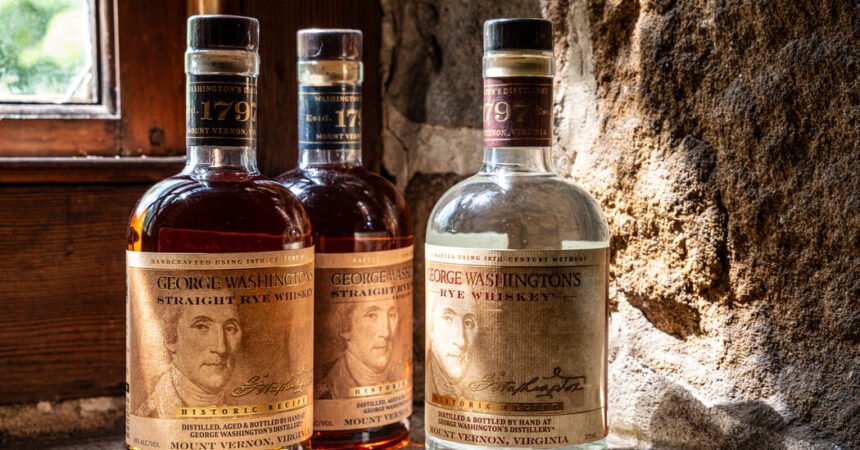
This year, Mount Vernon is marking the 25th anniversary of the distillery’s groundbreaking, along with the country’s 250th birthday, with a series of limited-edition releases. They include a seven-year-old cask strength bourbon drawn from just two barrels, distilled and aged on site.
That Washington would build a distillery on his farm was not unusual: Most farmers knew that the best thing to do with excess fruit and grain was to turn them into spirits, which were not only shelf-stable but in high demand at a time when the average American consumed the equivalent of three gallons of pure alcohol per year.
“We have records of 11,000 gallons of whiskey produced at Mount Vernon” before Washington’s death, said Jeremy Ray, who oversees historical interpretation at the estate. “That makes it the largest whiskey distiller in the United States.”
Hundreds of people were enslaved at Mount Vernon, and Washington and his farm manager put five of them to work making whiskey. The distillery now explores that history on its guided tours, citing the enslaved men and boys who worked there by name: James, Peter, Nat, Daniel and Timothy.
Operating a distillery was hard, hot, dangerous work, involving scalding steam, heavy barrels and long hours stirring mash. The five stills sat in a row inside a two-story stone-and-timber building, and when all five were running the air inside was stifling.
The resulting whiskey went straight into a barrel and straight to market. It was clear and fiery, though the wholesalers who bought it might have added fruit and spices to soften its bite. Most of it was sold through taverns, either as drinks or in jugs to take home. Whiskey back then was an anonymous commodity; no one asked for Washington’s whiskey by name. And none of it survives, so there’s no definitive way to know how it tasted.
Still, there were plenty of clues. Along with letters and other records, archaeological digs found burn marks and indentations on the distillery grounds that showed how the interior probably looked.
The initial idea to rebuild came from the Mount Vernon Ladies’ Association, which operates the estate. They contacted the Distilled Spirits Council, which quickly raised $1.5 million from its members, including heavyweights like Diageo, Brown-Forman and Maker’s Mark.
The companies also lent their expertise in the form of master distillers, including Lincoln Henderson of Woodford Reserve and Dave Pickerell of Maker’s Mark. Over the years that it took to get the distillery operating, they made trips to Mount Vernon to offer advice and make sure the final product was worthy of Washington’s name.
The team originally intended the distillery to be more of a museum, with a small still for demonstration purposes. But after a series of high-profile public events, including the release of a George Washington blend of whiskeys made by different distilleries, they decided to go bigger.
Vendome Copper and Brass Works, a Louisville, Ky., company that makes distillery equipment, provided five custom-built stills using 18th-century designs. Following an industry tradition, the stills all received women’s names: Maggie, Anne, Elizabeth, Jane and Helen.
Mount Vernon no longer grows its own grain; instead, it buys rye, corn and wheat from Virginia farmers. The grains are ground in a water-powered mill next door, which is likewise equipped with period machinery. (The mill also makes flour for Mount Vernon’s restaurants, and for sale to the public.)
Most of the whiskey produced at the distillery is sold at the Mount Vernon gift shop or online, though a small amount makes it into stores in Virginia and Washington, D.C.
Even many teetotalers enjoy seeing the distillery as part of their visit to Mount Vernon, because it highlights a side of the first president that is often overlooked.
“Everybody knows about George Washington, the president, the statesman, but not many people know about his entrepreneurial side,” said Lisa Hawkins of the Distilled Spirits Council. “This was a great way to show that.”