Last Sunday, in between trips to Europe to negotiate an Iran peace deal, Vice President JD Vance and his very pregnant wife, Usha, posted a Father’s Day Instagram Reel talking about how much they love reading to their kids and about the imminent arrival of their fourth child.
“Luckily, there’s going to be a new baby for you to read to,” the second lady says to her husband, “so you’re going to have many more years ahead of you.” She is wearing a stretchy coral dress that hugs her stomach, making what she is talking about very clear.
He grins and responds, “I was not yet ready to be out of the baby phase, so here we are, about to jump right in in just a few short weeks.”
As a promo for the first public pregnancy of a vice-presidential family since Ellen Colfax, the wife of Schuyler Colfax, in 1870, it doesn’t get any clearer than that. And it follows the equally public pregnancies of the Trump world figures Karoline Leavitt and Katie Miller. Leavitt, the White House press secretary, gave birth to her second child on May 1 (and has just returned from maternity leave). Katie Miller, the wife of Stephen Miller, a White House deputy chief of staff, who had their fourth child on June 3.
That three such prominent women in the MAGA movement were pregnant at pretty much the same time was, indubitably, a coincidence. But for an administration that has such an intuitive and strategic understanding of the power of aesthetics that an unspoken dress code in which men outfit themselves in the image of the president has developed, it has also become a telling one.
Together, the women have created a notably consistent, and somewhat paradigm-shifting, picture of the White House’s family and fertility platform.
If the bare-chested, muscled mixed martial arts fighters of the U.F.C. match that President Trump hosted on Flag Day were the poster guys for MAGA’s image of masculinity, then the pregnant women of Trump world are one half of their feminine counterparts. Along with the sheath-clad, lip-filled, pageant-haired Mar-a-Lago set, they offer an image of idealized womanhood that gives literal shape to the pronatalist movement.
“It almost feels like a memo went out,” said Jill Filipovic, the host of the “Week in Women” podcast. “They have quite intentionally opted to present themselves as, ‘I am really pregnant, and this is what women were chosen to do,’ and they are happy to say that both with their looks and their mouths.”
If in doubt, simply consider posts on X and Instagram last month from Miller, who was then some nine months pregnant. “In honor of Mother’s Day,” she wrote, “a reminder that peak feminism is having babies. The most radical thing a woman can do is embrace her biological destiny.”
Along with her words came a portrait taken from the side, in which Miller is shown wearing low-slung, unbuttoned jeans and a black sports bra, her dark hair cascading in waves down her back. Like the stretchy and black knit Milly dress with a tulip on the front worn by Usha Vance for a military mothers celebration at the White House, and the form-fitting gowns worn by Leavitt and Miller to the White House Correspondents’ dinner in April, the photograph placed Miller’s rounded stomach front and center, enshrining her pregnancy for all to see.
It’s a notable change from the wardrobe choices of former political spouses like Cherie Blair, who surprised Britain when she became pregnant when her husband, Tony Blair, was prime minister. (Their son Leo was born in 2000.) Her maternity style consisted primarily of tunics and other loosefitting attire. Ditto Jacqueline Kennedy, who, when she was carrying her third child during her husband’s 1960 presidential campaign, wore Empire-waist dresses and trapeze-like shapes that sufficiently skimmed her pregnant body to leave most of its reality to the imagination. (The baby was born prematurely and did not survive.)
It’s also a change, said Helen Lewis, the author of “Difficult Women: A History of Feminism in 11 Fights,” from the wardrobes of professional women of yore, whose clothes were chosen largely to disguise their pregnancies, lest they be regarded as stumbling blocks to work. And though it mirrors much of modern style (and speaks to the body positivity movement), the look is also a departure from the tradwife aesthetic that has … well, burgeoned with the MAGA movement and features more smock-like and demure pregnancy clothes on its influencer moms.
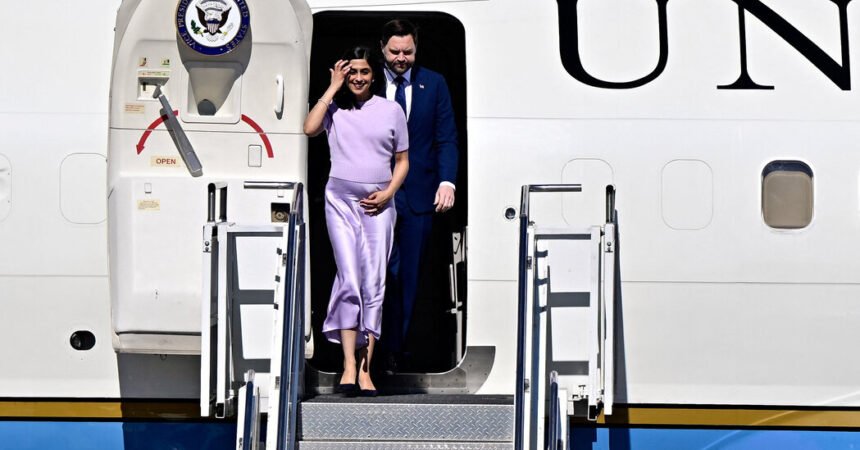
Indeed, ever since Vance, Leavitt and Miller revealed their pregnancies, their public appearances have showcased their growing stomachs. There was Vance in April, deplaning on an official trip with her husband in Hungary in a body-hugging lilac sweater and a satin skirt, cradling her growing stomach; here she was later that month greeting King Charles III in another body-aware dress. There was Leavitt, at Christmas, in a stretchy knit dress, hand atop her belly; here was Miller at Trump’s party on New Year’s Eve at Mar-a-Lago in a bias-cut halter gown, arm also cupping her stomach.
Forget the maternity muumuu. Forget body-con. This is baby-con. In case you missed it, the hand serves to focus the eye.
“It’s really noticeable that the MAGA women are not hiding their pregnancy,” Lewis said. “There is pride in being pregnant and being fertile.” They are modeling the idea, she said, that “one of the ways women can hold power is by being mothers and leaning into the imagery of that.”
This is particularly striking when it comes to Vance, in part because she is the most reticent Trump world figure and the woman who least fits the obvious mold. Before announcing her pregnancy, she spoke on Meghan McCain’s podcast about feeling that three children was enough. According to Vice President Vance’s new book, “Communion,” it was hearing from Charlie Kirk’s widow, Erika, that she regretted not having more children before her husband was killed that helped change Usha’s mind.
(“I think I had already started to open my mind to the possibility,” Usha herself told CBS News in a joint interview with her husband. “I wouldn’t say this was for me, in any way, the decisive factor, but it came in the middle of a conversation that we were already having.”)
Whatever the reason, Vance acknowledged that her choice of clothes reflected her change in circumstance. In March, she told NBC News: “I have to dress up a lot more. I enjoyed my last pregnancy — there were a lot of sweatpants. I was working from home and sometimes put a blazer on over what was under.”
After all, as second lady, her job is also to represent and humanize the vice president. By spotlighting her pregnancy, she is doing exactly that. “I want more babies in the United States of America,” her husband said in a speech at the March for Life in 2025. His wife is showing the world that starts at home.
The result, Filipovic said, is that “you have some of the most powerful women in the country throwing themselves not just behind these ideas but creating the aesthetics that propagate these ideas.” That, she said, “is very influential.”