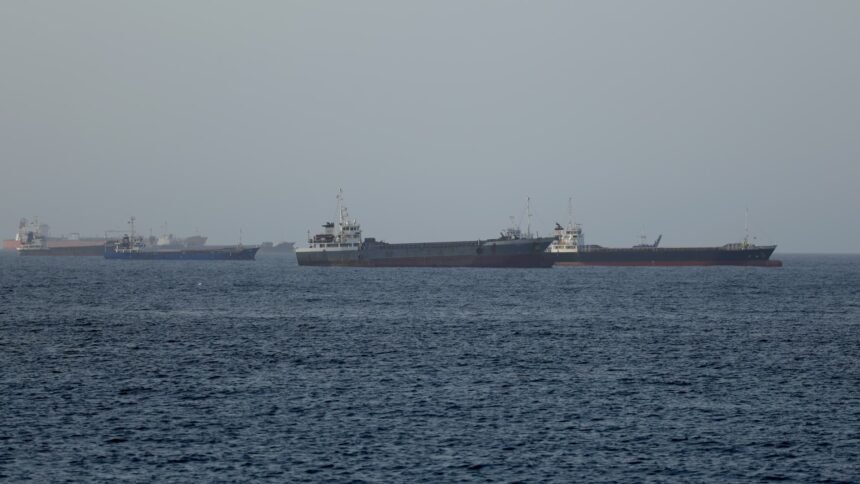
Commercial vessels and oil tankers preparing to transit through the Strait of Hormuz, one of the most critical strategic waterways for global trade flows, maintain their wait in the Gulf of Oman, on June 17.
Anadolu | Anadolu | Getty Images
Oil extended losses during Asian trading hours on Wednesday as concerns over potential supply disruptions eased, while investors monitored developments in the Strait of Hormuz.
International benchmark Brent crude futures for August fell 0.91% to $76.38 a barrel. U.S. West Texas Intermediate futures for August dropped 0.94% to $72.52 per barrel.
U.S. President Donald Trump on Wednesday criticized oil companies for not lowering gasoline prices in line with the recent decline in crude prices.
“The big Oil Companies are not dropping their price at the pump commensurate with the sharply lower prices they are paying for Oil. Those prices are dropping like a rock!,” Trump wrote in a Truth Social post.
“In other words, customers are being “gouged.” I have instructed the DOJ to immediately start looking into this. Gasoline prices better start going down a lot faster than what I’m seeing!,” he added.
Karen Young, a senior research scholar at the Columbia University Center on Global Energy Policy, described the post as “political theater,” noting “that’s not really how gasoline prices work in the U.S.”
“There are state and local taxes, which are applied to the price of gas at stations in the United States,” Young told CNBC’s “Access Middle East.”
“It really is up to refiners, and it takes a couple of weeks before crude prices drop, that then the prices at refineries, and then on to eventually consumers, can really respond.”

Investors were also encouraged by signs that maritime traffic through the Strait of Hormuz could begin returning to normal.
More than 11,000 seafarers stranded in the Persian Gulf will begin exiting through the Strait of Hormuz after safety guarantees were secured, according to the International Maritime Organization.
“We have secured the necessary safety guarantees and have thoroughly verified the conditions for safe navigation to support these operations,” IMO Secretary-General Arsenio Dominguez said in a statement.
Dominguez added that it will be carried out “in close cooperation with Iran, Oman, all other coastal States in the region, the United States and the maritime industry.”
Supply chain pressures have increased due to longer transit times for vessels trapped in the Strait of Hormuz and disruptions to air freight capacity, CEO of DHL Global Forwarding Greater China Aditi Rasquinha said on CNBC’s ‘Squawk Box Asia.’
“With the Strait opening up, potentially a lot of that should ease,” Rasquinha said, but noted that it would take some time for the supply chain to normalize.
— CNBC’s Spencer Kimball contributed to the report.