Published on 6/23/2026
The 2026 FIFA World Cup is characterized by an unprecedented abundance of goalscoring, with more than 25% goals scored compared to the same period of previous World Cup matches, a clear indication of a major change in the offensive system within the tournament.
Preliminary statistics indicate that this remarkable increase is not only related to the development of the teams’ technical performance, but also extends to include organizational and technical factors within the tournament itself, which has made the current version the focus of widespread attention from observers and experts.
Read also
list of 2 itemsend of list
Championship ball
One of the most prominent reasons that have been discussed regarding the high scoring rate is the ball used in the 2026 World Cup, which was designed by FIFA in a special way that differs from previous versions.
The Federation explained that the ball came with deep stitching aimed at giving it ideal stability while flying in the air, which directly affects the accuracy and speed of shots.
Players and coaches confirmed that the ball moves more quickly towards the goal, and it also gives additional capabilities that help in shooting and dribbling, especially in wet conditions, which made dealing with it more decisive inside the penalty area.

Austria national team coach Ralf Rangnick said that the ball seemed “as fast as a cannonball,” noting that powerful shots at the right angles had become more difficult to block, which explains part of the increase in scoring rates.
Another factor that contributed to the increase in goals was the introduction of a pause time designated for drinking water (hydration sessions) during matches, which is a new procedure applied for the first time in the history of the World Cup tournaments.
This amendment increased the actual playing time in some matches, giving players additional opportunities to score, and indirectly contributed to an increase in the overall scoring rate.
121 goals in only 40 matches
The first forty matches of the 2026 World Cup resulted in 121 goals being scored, at a rate of approximately 3 goals per match, a rate that reflects the offensive nature of the tournament so far.
The majority of these goals were scored by international stars active in the most prominent European leagues, as players from the three major leagues in Spain, England and Germany topped the list of scorers with more than half of the goals scored.
English Premier League players lead the list by a clear margin, which reflects the influence of this league on the current version of the tournament.
League numbers… English superiority
English Premier League players scored 28 goals, compared to 16 goals for German League players, and 11 goals for Spanish League players, while French League players scored 7 goals, and Italian League players scored 5 goals.
American League players also scored 8 goals, in the notable presence of a number of names active outside Europe.
In one of the most prominent matches, the Netherlands national team defeated Sweden by a score of five goals to one, with all six goals coming from players active in the English Premier League during the 2025-2026 season, in a clear indication of the influence of this league in the tournament.
Real Madrid, Liverpool and Inter Miami players topped the list of scorers, thanks to the contributions of Argentine player Lionel Messi, who played a pivotal role in raising his team’s tally.
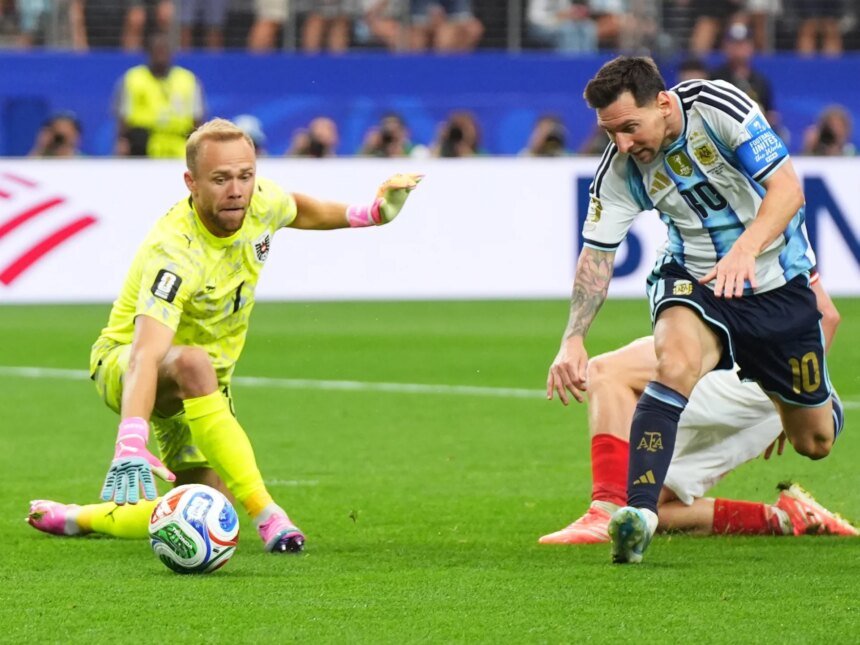
Messi scored a hat-trick against Algeria, and added two goals against Austria on Monday, becoming one of the tournament’s most prominent stars in terms of scoring effectiveness.
Distribution of goals between clubs and leagues
American League players scored 8 goals, distributed among a number of players, including Croatian Peter Musa, FC Dallas player, Paraguayan Matias Galarza, Atlanta United player, and New Zealander Finn Surman, Portland Timbers player, in addition to Messi’s goals.
When the official lists were announced, there were 200 professional players in England at club level, nearly double the number of professional players in Germany, which amounted to 109 players, which was reflected in the registration statistics.
Real Madrid and Liverpool topped the list of clubs that contributed most to scoring goals.
Real Madrid players scored 6 goals, 3 goals by Frenchman Kylian Mbappe, 2 goals by Brazilian Vinicius Junior, in addition to a goal by English player Jude Bellingham.

As for Liverpool, its players scored a large number of goals, including two goals by Dutchman Cody Jacobo, one by defender Virgil van Dijk, one by Swede Alexander Isak, in addition to a goal by Egyptian Mohamed Salah, as all of them were within the club’s ranks at the time the national team lists were announced.
Bayern Munich players scored 4 goals, with two goals for Englishman Harry Kane, and one each for German Jamal Musiala and Colombian Luis Diaz.
Bayern Munich was also the second most represented club on the national team lists with 18 players, behind Manchester City of England, which included 19 players, and who in turn scored two goals through their Norwegian star, Erling Haaland.
Comprehensive numbers… rates that change historically
With 121 goals scored by 88 different players during the first 40 matches, the scoring average reached 3 goals per match.
Only 3 matches ended in a goalless draw, while 8 own goals were scored, which reflects the clear offensive nature of the current version.
The 2026 World Cup is on track to break the record set in the Qatar 2022 World Cup, which witnessed 172 goals scored in 64 matches, while the current edition includes 104 matches.
Calculations indicate that the scoring rate in the current version may approach 194 goals, which exceeds the previous record if the scoring pattern continues as is.
The increase in scoring was not limited to the World Cup only, but also extended to the Champions League during the last two seasons, where the goal average reached 3.27 goals per match during the 2024 to 2025 season, and rose to 3.47 goals in the following season from 2025 to 2026.
Between the rising numbers and new factors, it seems that football is entering a different scoring phase, reshaping the features of the game in its largest global forums.