Published on 6/23/2026
Pakistan’s mediation to reach an agreement to stop the Iran war has received widespread diplomatic praise, and may bring Islamabad some economic gains, but analysts wonder whether these gains will help address the structural weaknesses in its economy.
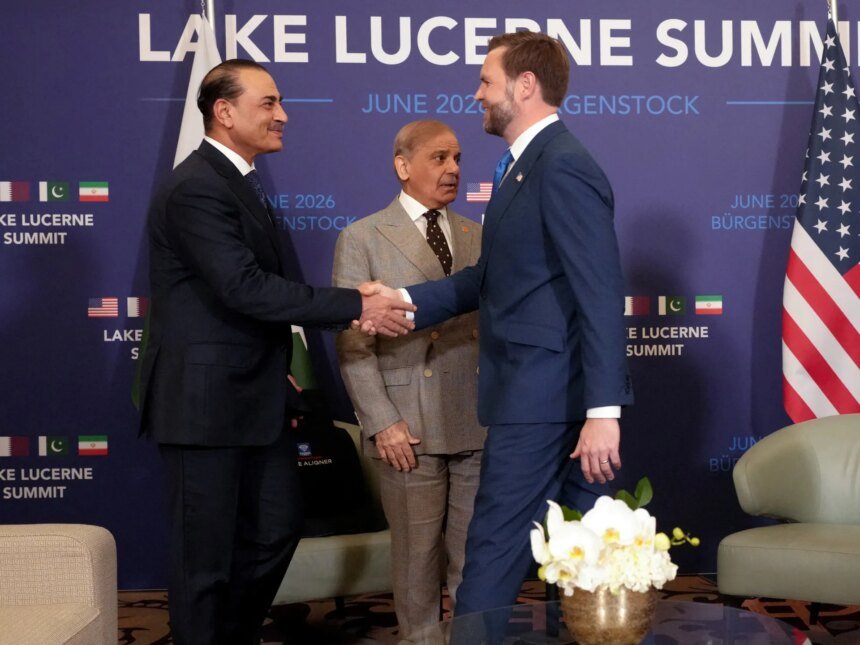
Pakistani Prime Minister Shehbaz Sharif and Army Commander Asim Munir attended the talks between Iran and the United States in the Swiss mountain resort of Bürgenstock over the weekend, marking the culmination of Pakistan’s months-long role in one of the most important diplomatic negotiations in the world at the present time.
Read also
list of 4 itemsend of list
J.D. Vance received US Vice President Asim Mounir with a warm welcome upon his arrival at the Swiss resort. Mounir and Sharif also have a good relationship with the Speaker of the Iranian Parliament, Mohammad Bagher Qalibaf.
Both sides of the war, along with a number of world leaders, thanked Islamabad for its help in alleviating a conflict that could have kept the Strait of Hormuz closed for a long period, suffocating oil supplies, and increasing pressure on the global economy.

Potential gains
Analysts told Reuters that the country with a population of 250 million people has an opportunity to turn this positive momentum into some gains for an economy that has oscillated between recovery and contraction for decades.
But they said any benefits were unlikely to address the deeper structural problems that prompted Islamabad to agree with the International Monetary Fund on several loan and aid programs to support its economy.
Pakistan’s domestic product reached $371 billion in 2024, according to the latest figures available from the World Bank, and the growth rate did not exceed 3%, while the inflation rate was 12.6% in the same year.
A report by the “Modern Diplomacy” website explained that the most prominent problems of the Pakistani economy include the following:
- Low tax collection and narrow tax base
- High external debt
- Repeated reliance on the International Monetary Fund
- Weak export competitiveness
- A large deficit in the general budget
- Unequal distribution of income in society.

The Morden Diplomatic website report also indicates that the potential economic benefits for Pakistan after its mediation to stop the Iran war include the following:
- Expanding trade with Iran if sanctions are eased
- Strengthening investment relations with Gulf countries
- Easy access to western markets
- Wider opportunities for infrastructure and energy projects
- The possibility of broader cooperation in the defense and technology sectors with countries in the region.
In this context, Khurram Shehzad, advisor to the Pakistani Minister of Finance, said, according to Reuters, “A nation that achieves stability at home and helps enhance stability abroad becomes a more credible destination for investment.”
“A growth-oriented economic agenda, coupled with a reputation as a force for peace and stability, puts Pakistan in a uniquely favorable position to attract investment into its people, infrastructure, technology and future growth sectors,” he added.
Many analysts expect some generosity from the United States, but no signs of a windfall of this kind have yet emerged.

Broader economic partnerships
Alex Vatanka, a senior fellow and director of the Iran program at the Middle East Institute in Washington, said one gain for Pakistan is “the great potential to become a more integrated part of the broader Middle East” and eventually move toward broader economic partnerships in the region that also include defense.
For his part, former Pakistani Finance Minister Muftah Ismail said that another possibility is that easing sanctions on Iran may allow “huge trade between Iran and Pakistan,” especially across their land borders in the Balochistan region.
Ismail added that the diplomatic role strengthened Pakistan’s international standing, but that did not affect the high costs, low exports, and foreign debts that must be repaid, keeping it dependent on the International Monetary Fund.
He added, “Our internal situation is in such a state of chaos that foreigners will not be able to truly help us unless we help ourselves. Nothing in this war will change that, and we will remain constantly dependent on the International Monetary Fund.”
Previous experiences
The alliance with Washington, after the September 11, 2001 attacks and the US invasion of Afghanistan, helped ensure the rescheduling of the debts of more than a dozen creditors to Pakistan and renewed support from the International Monetary Fund and other multilateral lenders, in addition to US aid. But analysts said Pakistan did not benefit from this due to structural weaknesses in its economy.
Economic analyst and journalist Khurram Hussain said that the current situation is similar to what it was after the events of September 11, but with one fundamental difference, which is that that moment was at “the beginning of a long and destructive war in which Pakistan was forced to play a role on the front lines,” but this time it is “playing the role of peacemaker.”
This difference in roles means that Pakistan’s influence this time stems from its being beneficial to multiple parties at the same time, namely the United States, Iran, the Gulf states, Turkey, and China.
British Minister for the Middle East, Hamish Falconer, thanked Islamabad for its role in keeping peace during a visit he made last week. He told Reuters that Britain sees “wide scope for consolidating trade relations” with Pakistan, and that the British Trade Minister is expected to visit it in the coming months.

“It is not a path for loans.”
In the same context, Atif Mian, professor of economics, public policy and finance at Princeton University, said that Pakistan should avoid dealing with diplomacy as “another path to obtaining deposits, renewing loans or relief” similar to that provided by the International Monetary Fund.
He pointed out that the real gain is to be an “axis of peace”, externally and internally, based on regional trade and energy relations with Iran and deeper integration with the Gulf states and Turkey through export, technology transfer and interconnection of industries.
Asim Ijaz Khawaja, a professor at Harvard University and director of the Harvard Center for International Development, said Pakistan must resist concessions.
Financial: Short-term that does not increase productivity.
He stated that Pakistan should instead seek academic exchange, scholarships, preferential access to textile markets, IT services, technology transfer and environment-friendly investment frameworks.
Analysts said that any new economic gains would not solve the larger problems facing Pakistan.
“The country is at risk of internal collapse in the coming decades unless structural reforms are implemented,” explained Adeel Malik, associate professor of development economics at Oxford University.
He added, “There are deep-rooted complaints among the youth and the shrinking middle class about the ruling elite in Pakistan. The prevailing regime gave the ruling elites another chance to survive, but it made the country suffer from social and economic insecurity.”