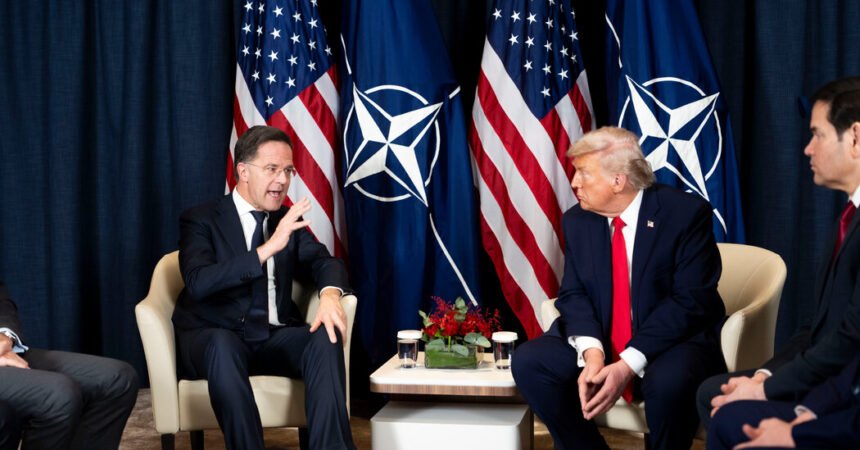
When the NATO secretary general, Mark Rutte, met with President Trump in January, the alliance seemed to be teetering. Mr. Trump had vowed to seize Greenland from Denmark and refused to rule out using force to do so.
This unprecedented threat, by one NATO ally against another, imperiled the alliance’s very existence.
Mr. Rutte got his job in part because of his ability to calm Mr. Trump. That skill was being put to the test.
“We can’t help you if you want to become an owner of Greenland,” Mr. Rutte told him during a conference in Davos, Switzerland, according to people briefed on what was said.
“But,” Mr. Rutte added, spinning up a deal for the president, “we can help you on security.”
Mr. Rutte sketched out vague and existing plans for NATO exercises in Greenland and packaged them as a new NATO mission in the Arctic. Mr. Trump, apparently mollified, backed down from his threats for the time being.
It seemed like a win for Mr. Rutte, a former Dutch prime minister who took over the job in 2024 in part to Trump-proof NATO. But behind the scenes, his negotiations sowed irritation and mistrust.
That same day, it emerged that NATO officials were debating giving the United States control over the land beneath American bases in Greenland. The Danes believed that Mr. Rutte was discussing sovereignty and the future of Greenland, matters that were a red line for them — and well beyond his job description, according to people familiar with the matter who spoke on condition of anonymity to describe internal discussions.
The exchange was an example of how Mr. Rutte, who has been called the “Trump whisperer,” walks a delicate line. NATO needs him to have a close relationship with Mr. Trump. But that coziness has sometimes angered the very European leaders who expect him to placate and modulate Mr. Trump to preserve the alliance.
Mr. Rutte, 59, is tasked with softening such blows. But he is also regularly accused inside NATO of pandering to Mr. Trump, especially on issues outside his purview. His support for Mr. Trump has alienated some European allies, who like the Danes earlier this year, worry that he is not fully representing their interests.
“We don’t comment on the details of discussions between leaders,” said Allison Hart, a NATO spokeswoman, “but I can say that at no point did the secretary general discuss or propose anything related to the sovereignty of any ally.”
Mr. Rutte and Mr. Trump talk several times a week, sometimes bantering about golf or world affairs beyond NATO, according to people familiar with their dynamic. Mr. Rutte once delayed a diplomatic dinner to sit in the car outside a Brussels brasserie talking on the phone to the American president, said Thijs van der Plas, the Dutch ambassador to NATO. (Asked for comment, a U.S. official denied the two men spoke that often.)
Another time, on a visit to the White House, Mr. Trump ushered Mr. Rutte and his staff into the private dining room and gave them MAGA paraphernalia that Mr. Trump compared in quality to a Lamborghini, an aide said.
Olivia Wales, a White House spokeswoman, said that Mr. Trump “has a strong relationship” with Mr. Rutte. “NATO countries must take greater responsibility for their own defense,” she said. “And they should have been there for the United States” during the war with Iran.
At last year’s summit, Mr. Rutte suggested that Mr. Trump was the alliance’s “daddy,” prompting the White House to highlight the remark with a music video. (Later, somewhat abashed, Mr. Rutte said that “daddy has all sorts of special connotations, and now I have to live with it for the rest of my life.”)
Mr. Rutte, whose 13-year tenure as prime minister of the Netherlands earned him the nickname “Teflon Mark,” is an unlikely liaison to the famously ostentatious American president. Mr. Rutte refuses to live in the opulent secretary general’s residence in Brussels, according to people close to him, and urges people to call him “Mark.” (Some still don’t.) A creature of habit, he returns to The Hague nearly every weekend to visit his favorite haunts and to teach high school students, a volunteer pursuit since 2008.
And despite having been an experienced prime minister and a strong defender of the trans-Atlantic relationship, his track record on military spending, often considered key for NATO’s top job, was seen as poor.
But Mr. Rutte proved his worth to NATO at a contentious summit in 2018, when Mr. Trump was threatening to leave the alliance. In a closed-door meeting of world leaders, Mr. Rutte, prime minister then, diffused tensions by crediting Mr. Trump with inspiring European leaders to boost defense spending.
He “basically saved the summit,” said Timo Koster, a former NATO official who was in the room.
NATO’s secretary general is chosen by consensus, with strong influence from the United States. And when the job came open in 2024, diplomats recognized Mr. Rutte’s rapport with Mr. Trump. Even former Biden administration officials said that his relationship with Mr. Trump made his candidacy more attractive, especially as it became clear that Mr. Trump could return to the White House.
But lately, some say he has gone too far. He has praised Mr. Trump for going to war in Iran, even though many European leaders have called the war illegal and Iran is outside NATO’s area.
“Did he need to compliment the president on the Iran war and urge Americans to support it?” asked Julianne Smith, the U.S. ambassador to NATO under President Joe Biden. “Many feel that crossed a line.”
Mr. Rutte declined to be interviewed. But numerous NATO ambassadors say he has three major goals: To keep Mr. Trump and the United States fully engaged in NATO; to push Europe and Canada to increase military spending; and to keep U.S. and allied support flowing to Ukraine. In particular, that means ensuring that Washington continues to provide Kyiv with battlefield intelligence and keeps selling American weapons systems to the Europeans, who in turn provide them to Kyiv.
Staying close to Mr. Trump is vital to achieve those goals, they say. That’s particularly true as the president occasionally questions NATO’s mutual defense policy, known as Article 5.
“At NATO they say he knows he’s prostituting himself for Trump, to try to prevent any escalation on Trump’s part to further undermine the credibility of Article 5,” said Jan Techau, a German former defense official who directs European security for the Eurasia Group. “It’s not pretty, and deeply embarrassing for all of us, but he’s concluded that’s the only thing that works.”
Jon Finer, who was a deputy national security adviser under Mr. Biden, once backed Mr. Rutte for the job. More recently, he said, he has told Mr. Rutte that appeasing Mr. Trump should not come at the cost of damaging the alliance. But, Mr. Finer conceded, the risks for Ukraine run high “and he has to assess the level of risk with Trump.”
Mr. Rutte’s defenders say that his friendliness toward Mr. Trump is part of his political calculus. “He always told me, ‘You have to dance with the people you meet on the dance floor,’” said Jan Driessen, a former campaign strategist for Mr. Rutte in the Netherlands.
Mr. Rutte has close relationships with other world leaders, including President Emmanuel Macron of France and President Volodymyr Zelensky of Ukraine, and his supporters say that in his conversations with Mr. Trump, he often defends European interests.
The approach has yielded some successes. When Mr. Trump, angry at comments on Iran by Chancellor Friedrich Merz of Germany, suddenly announced he would withdraw 5,000 troops from Germany, Mr. Rutte worked with the top NATO commander, Gen. Alexus G. Grynkewich, an American, to minimize the damage.
But Mr. Rutte’s engagement has not prevented Mr. Trump from calling NATO “a paper tiger” and questioning collective defense, raising doubts that Washington would come to Europe’s aid in a crisis or a war. Nor did it prevent Mr. Hegseth from announcing the six-month review of forces in a blistering and highly critical speech.
The NATO secretary general reports to the North Atlantic Council, NATO’s decision-making body, and traditionally speaks only after building consensus within the organization.
Mr. Rutte has repeatedly bucked that tradition, said Mr. Koster, the former NATO official. “The consensus at NATO at this point is really, really fragile, and he takes a huge risk by doing that.”
Reporting was contributed by Koba Ryckewaert, Lara Jakes, Ana Swanson and Zolan Kanno-Youngs. Susan C. Beachy contributed research.