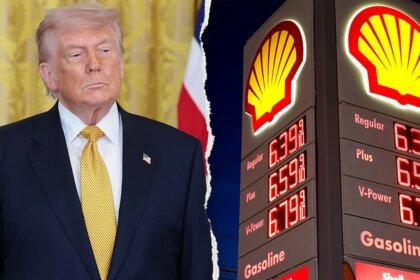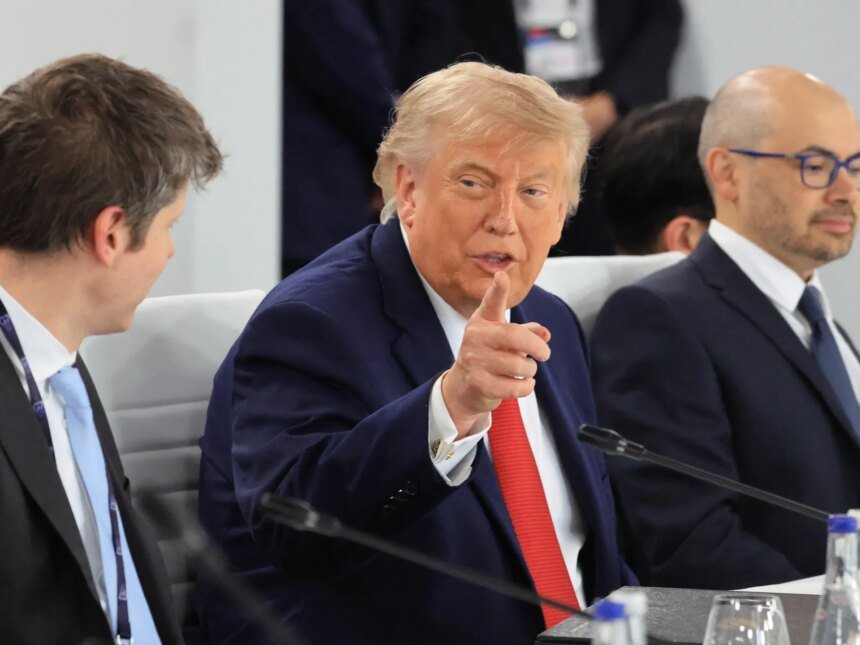
US President Donald Trump is reimposing customs duties after the Supreme Court ruled that the International Emergency Economic Powers Act does not give him the authority to impose broad duties on imports, which prompted his administration to search for alternative legal tools that preserve the same protectionist goal, which includes raising the cost of foreign goods, reducing the trade deficit, and pushing companies to move more production to the United States, according to Bloomberg.
According to the agency’s report, the new version does not completely restore the tariff map that Trump announced on April 2, 2025, the day he called “Liberation Day,” as the administration now relies on investigations under “Section 301” of the Trade Act of 1974, with a prominent focus on the files of forced labor and industrial surplus capacity in manufacturing..
Section 301 is defined as a group of articles in the US Trade Act of 1974 that give the Office of the US Trade Representative powers to investigate foreign trade practices that Washington deems unfair or restrictive of its trade, and to respond to them with measures that include imposing tariffs or restrictions on imports, suspending trade privileges, or reaching a binding agreement with the country concerned to stop the practice in question or compensate the United States.
On April 2, 2025, Trump imposed broad customs duties on America’s trading partners, which included a basic duty of 10% on most imports, and higher duties on certain countries, according to what the White House described at the time as trade imbalances, in addition to sectoral duties that affected cars and metals, in one of the broadest waves of trade protection launched by the American president in his second term.
The new mechanism (after the court ruling) imposes a different reality on Washington’s trading partners. Some countries that faced high duties in 2025 may be in a better position if the duties stabilize at lower levels, while other countries that were at a temporary global duty of 10% face the possibility of moving to higher duties or additional customs layers.
The exceptions remain one of the elements of ambiguity, according to Bloomberg, in Trump’s trade policy, as the administration used them to exempt imports that it does not want to raise their costs internally, such as artificial intelligence equipment, agricultural tractors, and Brazilian coffee, while they could expand the scope of goods or countries targeted by tariffs that Washington saw as serving the goal of trade pressure.
Winners
The Philippines
The Philippines appears to be among the most prominent potential winners, as it was subject to a 19% duty in the “Liberation Day” system, but it may face a duty of only 12.5% if forced labor sanctions are imposed as proposed, and it is also not included in achieving industrial surplus capacity, which means that no subsequent increase is expected from this path, according to the agency.
This opens the door to a nearly 7% reduction in duties in April 2025, at a time when US imports of Philippine goods amounted to $7.7 billion during the first 4 months of 2026, an increase of 51% over the same period in 2025, which strengthens Manila’s position in Asian supply chains.

South Africa
South Africa is moving from extreme pressure to a relatively better situation, after it imposed 30% tariffs in April 2025, amid repeated accusations from Trump that its government discriminates against white Afrikaners, while the tariffs are now expected to stabilize at 12.5% after the end of the forced labor investigation.
However, the improvement in customs does not cancel out the impact of the previous shock, as shipments of South African goods to the United States amounted to $3.5 billion during the first 4 months of 2026, a decline of 56% year-on-year, which reflects the cost of trade policy disruption on exports before any new settlement.
Pakistan
Pakistan appears among the smaller economies that may benefit from rebuilding the customs wall, as its duties may decrease by 19 percentage points to 10% from 29% in the April 2025 system, benefiting from Washington’s move to a legal formula that distinguishes between countries according to investigations and obligations, not according to a single emergency fee.
This reduction gives Islamabad a comparative advantage if its competitors’ tariffs remain higher, especially in labor-intensive sectors such as textiles and clothing, sectors in which companies usually move quickly when tariff differences between production markets change.
Myanmar
Myanmar appears to be one of the biggest digital winners, as it was hit with a 44% duty in April 2025, while duties on most of its goods may fall to a range between zero and 2%, effectively returning it to the levels of most-favored-nation duties on a large number of items.
According to Bloomberg, this shift may make Myanmar a potential destination for some supply chains looking for loopholes in the new customs wall, but the actual benefit will remain linked to compliance, sanctions, and governance risks, which are elements that low tariffs alone do not eliminate.
Laos
Laos falls on a track close to Myanmar, as it was one of the small economies hit by high tariffs in the Liberation Day regime, but it could benefit from a return to lower duties on most goods if they are not included in additional tariff layers.
Low tariffs provide Laos with a limited but important opportunity to attract assembly or light manufacturing activities, especially if companies look for countries whose trade with the United States does not exceed $10 billion to avoid direct political and commercial targeting.
Lesotho
Lesotho appears to be a potential winner from the same rule, as its tariffs could drop from high levels to lower tariffs on most goods, giving a small economy that relies on limited exports a better chance of competing in the US market.
Losers
Singapore
Singapore appears to be the clear loser in the new system, as it was not subject to a special emergency levy in April 2025, and was at the level of the temporary global levy of 10%, but it now faces the proposed forced labor levy of 12.5%, in addition to the possibility of another levy from achieving surplus industrial capacity.
The nature of Singapore’s trade increases the sensitivity of the situation, as it is one of the most active re-export centers in the world, as raw materials and components enter its ports and industrial zones and then exit in the form of finished products, which raises the burdens on American importers who pay duties and deal with compliance requirements.
Between profit and loss
Canada
At first glance, according to Bloomberg, Canada appears to be in a better position than April 2025, with exemptions for eligible goods under the US-Mexico-Canada Agreement, but sectoral tariffs on metals have put pressure on the Canadian industry and kept Ottawa within the circle of uncertainty.
Trump increases this ambiguity, according to the agency, with his repeated threats to withdraw from the agreement that he helped conclude during his first term, in addition to his criticism of Canadian retaliatory measures, which makes Canada unable to be reassured before reviewing the North American trade agreement during the second half of the year.
Mexico
Mexico seeks to reduce sectoral duties on cars, and says that the rate of duties on them has become higher than some cars imported from South Korea or Japan, which puts the Mexican auto industry in a stressful position despite its deep connection to the American market.
As part of the US-Mexico-Canada Agreement talks, Washington is pushing for a rule that makes cars in the northern trade area at least 50% of US-origin goods, a requirement that could reshape the Mexican production model based on cross-border supply chains.
European Union
The European Union remains pending on confirming its trade agreement with Washington, after the agreement set a ceiling at 15% for most European exports, including cars, while Trump threatened to raise duties on European cars to 25% if ratification is not completed before July 4.
The European Parliament ratified the agreement, with member states giving their final approval, but a new American investigation under “Section 301” against Germany regarding the prices of innovative medicines revived fears that Washington would use new legal tools to pressure Europe outside the texts of the agreement.

China
China appears to be in a much better position than expected at the beginning of Trump’s second term, according to Bloomberg, as he pledged during his 2024 election campaign to impose a 60% duty on Chinese goods, while Bloomberg Economics estimates indicate that the actual rate of duties is now close to 21%.
Washington and Beijing are waiting to review their customs truce in the fall, but China demonstrated over the past year its ability to use rare earths as a pressure card, after it restricted its exports and highlighted the dependence of advanced American industries on Chinese supplies.
It is noteworthy that China imposed export restrictions on Monday on 10 American companies working in the field of defense and rare metals, in response to Washington’s inclusion of Chinese companies on a blacklist.
India
India is following the new path among the countries that have signed or negotiated trade understandings that set lower tariff ceilings, and the visit of US Trade Representative Jamieson Greer to New Delhi may provide an indication of how Washington deals with countries that have existing agreements, according to Bloomberg.
According to the local Indian news agency ANI, Indian Minister of Commerce and Industry Piyush Goyal said that the outstanding issue currently is that Indian fees should be lower than those of competing countries, which reveals that New Delhi is not asking for an absolute exemption, but rather an advantage compared to competitors.
Japan, South Korea and Britain
Japan, South Korea, and Britain join the list of economies on which the impact of the new customs wall is still unresolved – according to Bloomberg – because they have signed agreements or understandings that set lower negotiating ceilings, especially in cars, while American officials are trying to reassure them that “the agreements are still in place.”
But recent experience indicates that the trade agreement with Trump is not the end of the matter, as sectoral investigations, exceptions to goods, or the inclusion of new products can reopen the same files, and turn unsuspecting countries into losers if the White House’s calculations change.