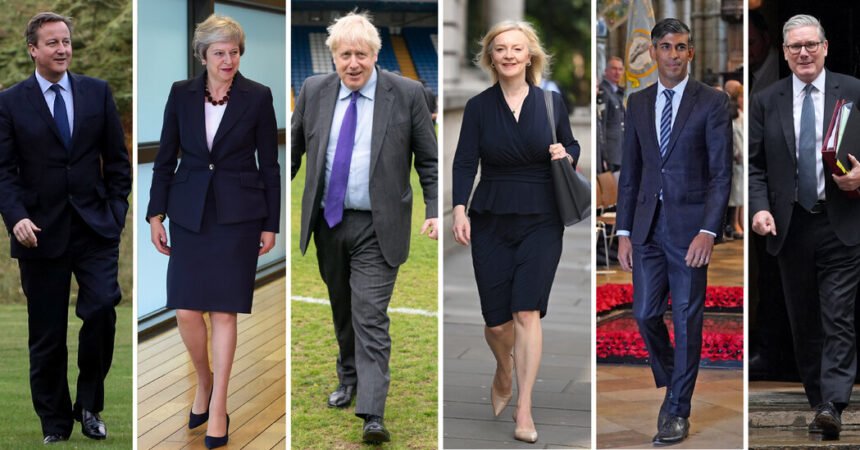
Prime Minister Keir Starmer of Britain led his Labour Party to a resounding election victory just two years ago, promising an antidote to years of Conservative Party turmoil that had seen a quick succession of leaders come through 10 Downing Street.
Now he, too, has announced his resignation, meaning Britain will soon have its seventh prime minister in a decade. That revolving door has become a feature of Britain’s volatile politics in the post-Brexit era.
Some have criticized the swapping out of prime ministers as undemocratic, and opposition politicians often use the moment to call for a new general election. But in Britain’s parliamentary democracy, a change of prime minister does not require a general election, as British voters do not elect a premier but rather a party to govern. It is the party that gets to decide who is at the helm.
Here’s a timeline of the changeovers.
2016: Brexit vote brings down David Cameron
David Cameron, Britain’s prime minister from 2010 to 2016, called a referendum on the country’s withdrawal from the European Union, in an attempt to keep his Conservative Party united. He campaigned for Britain to remain in the bloc, and when a slim majority voted on June 23, 2016, in favor of leaving, he announced plans to step down.
2019: Failed talks end Theresa May’s tenure
Mr. Cameron’s successor, Theresa May, faced her own struggles as she took on the complex task of navigating Britain’s departure from the E.U.
Hard-line euroskeptics in the Conservative Party rebelled against Ms. May, who favored a softer Brexit that would have kept Britain largely within the E.U.’s economic orbit. Her plan failed to pass Parliament three times, and in May 2019 she said she would resign.
2022: Scandals topple Boris Johnson.
Boris Johnson, the former mayor of London and one of Ms. May’s most vocal critics, succeeded her and eventually secured a Brexit deal.
But Mr. Johnson, known for his brash persona, was eventually brought down by a series of scandals, including parties held in Downing Street that defied his own government’s coronavirus lockdown rules.
2022: Liz Truss lasts just six weeks.
Liz Truss succeeded Mr. Johnson but was Britain’s shortest-serving prime minister, famously outlasted in her final days in office by a head of lettuce.
Her introduction of an unfunded tax plan proved disastrous to the economy — the British pound fell to its lowest ever level against the dollar — and her party swiftly ousted her.
2024: Rishi Sunak calls a general election.
Ms. Truss’s successor, Rishi Sunak, made history as the first British prime minister of Indian heritage. He was seen as far more competent than Ms. Truss, but the preceding years of turmoil in the Conservative Party had dented the party’s popular support, and he was forced to call a general election after about a year and a half in office.
The Labour Party, led by Mr. Starmer, won by capitalizing on frustration with the Conservatives.
2026: Starmer, deeply unpopular, is on his way out.
Labour’s victory, however, was not followed by smooth sailing.
As Britain’s economic outlook remained gloomy, Mr. Starmer took heat for policy reversals, and critics accused him of lacking charisma. After damaging losses for the Labour Party in local elections in May 2026, pressure grew on Mr. Starmer to step aside.
When Andy Burnham, a popular Labour mayor of Greater Manchester, won a seat in Parliament last week with a resounding majority, Mr. Starmer’s departure was increasingly seen as inevitable.