
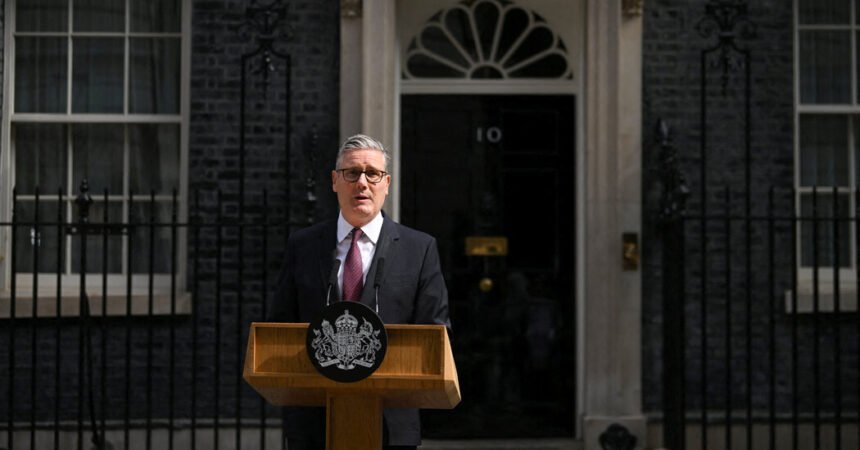
Prime Minister Keir Starmer of Britain announced his resignation on Monday, bowing to a mutiny inside his party and a challenge to his leadership of the country.
Mr. Starmer said he would remain as prime minister until a new party leader is selected, by September, rather than fight to remain in the job he won almost two years ago. His decision clears the way for Britain’s seventh prime minister in a decade, extending a period of political turmoil for the country since it voted to leave the European Union in 2016.
“The question my party is asking now is whether I am best placed to lead us into the next general election,” Mr. Starmer said in brief remarks in front of No. 10 Downing Street, his voice breaking with emotion at times.
“I have heard the answer of my parliamentary party to that question, and I accept that answer with good grace,” he said. “That is why I will resign as leader of the Labour Party. I have spoken to His Majesty the King this morning to inform him of my decision.”
The most likely replacement for Mr. Starmer is Andy Burnham, whose resounding victory last week in a special election energized his bid to oust the prime minister. Mr. Burnham, the former mayor of Greater Manchester and one of Labour’s most popular politicians, received almost 55 percent of the vote in the Makerfield district.
Mr. Starmer’s tenure as prime minister began in 2024 when Labour won a large parliamentary majority and put an end to 14 years of Conservative Party government. But Labour earned a record-low vote share of 34 percent in that election, prompting analysts to call the victory a “loveless landslide.”
In his remarks, Mr. Starmer defended his record, citing economic improvement, investment in health care, increased military spending, falling illegal immigration and other legislative accomplishments. It was, he said, “change promised by a Labour government, change fought for by a Labour government, change delivered by a Labour government.”
But the prime minister’s time in office was increasingly defined by political decline, which left him looking weak, indecisive and not in command of his own party. In recent weeks, Mr. Starmer had repeatedly vowed to fight any challenge to his position — from Mr. Burnham or anyone else — saying he was unwilling to walk away from his responsibility to Britain.
In the end, he appeared to accept the political reality that came with being one of the least popular prime ministers in modern British history.
“I will do everything I can to ensure an orderly handover of power,” he said. “I will also give my successor my full and unequivocal support, knowing that they will inherit a Britain that is far stronger and fairer than the one I inherited two years ago.”
Mr. Starmer had been struggling politically since early in his tenure, amid a sagging economy that had driven his popularity among voters to record lows. For months, his political adversaries seized on his tendency to backtrack on policies in the face of anger from party members, the public, the media or his critics.
His political standing was deeply wounded this year by revelations about his decision to appoint Peter Mandelson as ambassador to the United States despite Mr. Mandelson’s close ties to Jeffrey Epstein, the convicted sex offender.
But it was the devastating Labour losses in elections to municipal councils in England, and to the Scottish and Welsh Parliaments, in May that were the final straws for many members of Mr. Starmer’s party. More than 1,400 Labour Party candidates lost council seats in England, with many voters citing frustration with Mr. Starmer as the reason for their votes.