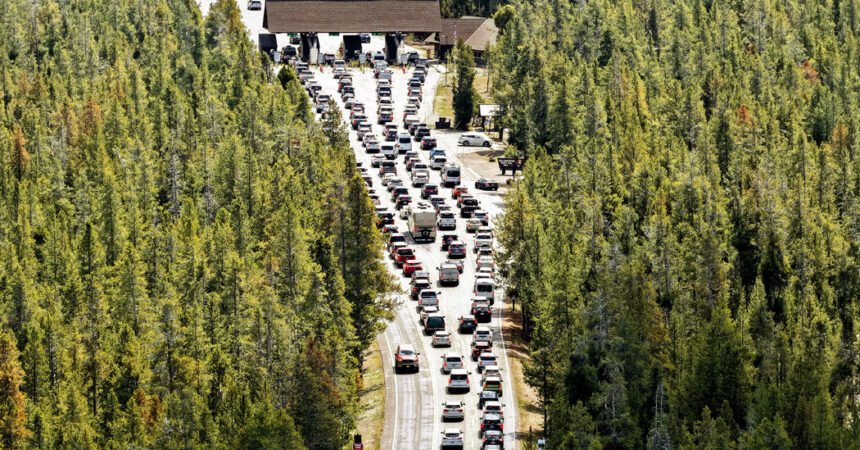
Soaring international airfares and other fallout from the war in the Middle East have many Americans looking to stay closer to home this summer, and the 433 National Park Service locations are looming large in those plans.
A summer travel industry forecast released last month by Expedia Group said that interest in national parks and other outdoor hot spots has spiked 65 percent over last year, and that seems to be bearing out: Last month was Yellowstone National Park’s busiest May on record.
Despite major staffing cuts and a 43-day partial government shutdown, more than 323 million people visited national parks last year, about 3 percent fewer than the record-breaking numbers logged in 2024. To accommodate the crowds, parks pulled workers from other duties to focus on visitor services.
This year, staffing remains sharply reduced, and some parks have scrapped their reservation systems, already leading to gridlock at popular sites. In addition, steep new fees for foreign visitors have caused confusion at entry gates, resulting in delays.
Here’s what to know if you’re planning a national parks trip this summer.
Staffing is still stretched thin.
Overall declines in staffing will be “the biggest thing that will affect people’s national parks experiences this year,” said Cassidy Jones, senior visitation program manager for the National Parks Conservation Association, a nonprofit group.
Last year, personnel cuts and hiring delays caused backups and facility closures at some parks, though an April 2025 Interior Department directive requiring superintendents to maintain visitor services helped blunt some of the impact.
That directive is still in effect, but the Park Service has now reduced permanent agency workers by 25 percent, which could cause problems like long waits at entry gates, uncleaned restrooms, understaffed visitor centers, more traffic jams, slower emergency responses and fewer ranger-led interpretive services this summer.
The cutbacks could also have lasting effects, as workers prioritize visitor-facing services over long-term stewardship. For example, specialists like wildlife biologists and structural engineers may have to pitch in on tasks like cleaning bathrooms and directing traffic.
Park Service officials have previously described the personnel cuts as appropriate and necessary cost-saving measures, saying they were prioritizing law enforcement, public safety and visitor services. But they did not respond to questions about factors that may affect the 2026 summer season.
You may no longer need a reservation to enter.
A handful of major parks have scrapped timed entry reservation systems that they had been testing over the past few years, particularly during peak periods, to control traffic.
This summer, that shift, aimed at broadening public access, affects popular national parks like Arches, in Utah; Glacier, in Montana; Mount Rainier, in Washington; and Yosemite, in California.
May visitation at Yosemite increased more than 12 percent over last year, with especially large crowds over Memorial Day weekend. Numerous local media outlets, including the ABC News affiliate in Los Angeles and The San Francisco Chronicle reported issues like entry delays of 90 minutes or longer, clogged trails at popular sites and widespread illegal parking in sensitive areas.
Those problems persisted through the first week of June, said Sydney Williams, 41, a San Diego-based author and public speaker specializing in wellness, who spent several days in the park leading volunteers in removing invasive weeds.
“We’ve never seen anything like it,” Ms. Williams, who has been visiting Yosemite several times each year since 2018, wrote in an email. Parking areas were full by 7 a.m. on weekdays, and shuttle buses were “stacked up three deep with no room for anyone to board,” she said.
“Timed entry wasn’t perfect, but it was better than nothing,” Ms. Williams added.
Yosemite managers eliminated the reservation system in February after a study last year found that it was “not the most effective approach for the coming season,” Superintendent Ray McPadden said in a statement announcing the changes.
Mr. McPadden said that Yosemite would rely on a network of in-road traffic sensors, additional staffing during peak periods, rangers stationed at key intersections and parking lots, a text alert system, and other tools to manage crowds. Glacier has begun a pilot shuttle program to Logan Pass and will put a three-hour parking limit in place there starting July 1. Arches plans to impose temporary access restrictions at overcrowded sites, while Mount Rainier’s superintendent, Gregory Dudgeon, said in a February statement that the park would continue using “proven traffic and parking management strategies.”
Still, said Don Neubacher, who served as Yosemite’s superintendent from 2010 to 2016, “The damage is going to increase, visitor enjoyment is going to go down and crowding is going to get worse.”
However, not all parks have ended reservation systems. A few that had formally adopted them as part of visitor management plans — including Acadia, in Maine; Rocky Mountain, in Colorado; and Zion, in Utah — are keeping them.
To avoid crowds and complications, consider visiting quieter parks; avoiding weekends and holidays; arriving before 7 a.m. or after 4 p.m.; buying advance passes online at recreation.gov; using shuttles; and seeking out less popular park entrances like the North Rim of the Grand Canyon and at Yellowstone, the Northeast Entrance near Cooke City, Mont.
New nonresident fees are causing headaches.
A new entry surcharge for non-U.S. residents has caused widespread confusion and frustration in trip planning and at entry gates among international travelers, tour operators and park staffers, said Lisa Simon, the chief executive of the International Inbound Travel Association, a nonprofit U.S. trade group.
Nonresident visitors 16 and older are now required to pay an extra $100 plus the standard $35 entry fees at each of 11 marquee parks: Bryce Canyon, in Utah; Everglades, in Florida; Grand Teton, in Wyoming; Sequoia & Kings Canyon, in California; and Acadia, Glacier, Grand Canyon, Rocky Mountain, Yellowstone, Yosemite and Zion.
They can also buy a $250 nonresident annual pass — available online or at park gates. The same pass costs $80 for U.S. residents.
Until this year, the Park Service had not tracked visitors’ nationalities. But industry estimates put foreign travelers at 5 to 15 percent of total entries, and often 20 percent or more at the most popular parks, said Brian Yablonski, chief executive of the Property and Environment Research Center, a nonprofit policy research group. Mr. Yablonski said his group had long pushed for the nonresident surcharge because it would use visitor funds to address issues arising from record visitation and an estimated $23 billion in deferred maintenance projects.
But the quick rollout of the surcharge, less than six weeks after it was announced, has been a bumpy process, Ms. Simon said.
Tour operators were instructed to buy passes in bulk online in advance, but no effective system exists for that. Processing tour buses has caused delays both for passengers and for other park visitors.
“The parks have not been operating consistently because they don’t have good guidance,” Ms. Simon said, adding that she hopes a workable system will soon be adopted to help avoid further delays.
Follow New York Times Travel on Instagram and sign up for our Travel Dispatch newsletter to get expert tips on traveling smarter and inspiration for your next vacation. Dreaming up a future getaway or just armchair traveling? Check out our 52 Places to Go in 2026.